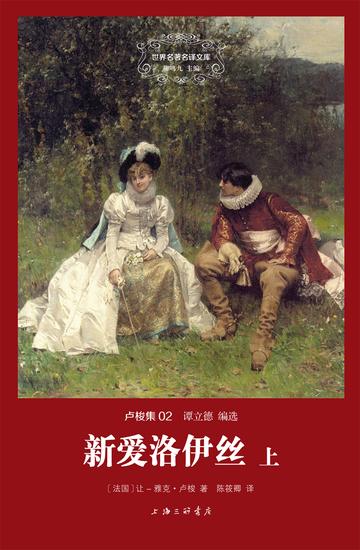
"New Heloise" is an epistolary novel written by Rousseau in 1761 and is known as an important novel in the 18th century. The book is divided into six parts. The plot of the novel is from 1732 to 1745 and consists of 163 letters. The title of the book is borrowed from the love tragedy of the 12th century girl Heloise and her teacher Abelard. The novel tells the story of the love tragedy of the heroine Julie and her teacher Saint-Preux who fell in love but failed to do so. This book is the first novel in the history of French literature that praises love as a noble sentiment of human beings and describes the beautiful scenery of nature. It had a huge influence on subsequent French literature.
Reader comments
This book tells a poignant love story in the form of letters, making people feel the beauty and helplessness of love. I like the author Rousseau very much. His descriptions are delicate and nuanced, making me feel like I am in the world in the book. However, I kind of hate the villains in the book, who always thwart the love affairs of the protagonists. Overall, this is a book worth reading and highly recommended!
A spiritual autobiography full of Rousseau's obsessions. Saint-Preux is undoubtedly the embodiment of his passionate emotions, while Julie is the perfect crystallization of all his ideal feminine qualities - freedom, submission and nobility. This world built by "unbelievable" stories, but because of its romantic core, has profoundly influenced later generations of great masters such as Byron and Shelley.
After Julie became a mother, her image sublimated, seeming to merge motherhood and divinity. It was the torn and unsent letter before her death, in which she poured out her immortal love for the Holy Spirit, declaring, "I died with this beautiful wish: to exchange my life for my eternal love for you without committing a crime, and to express to you again, I am so happy!" - The ultimate loyalty of love, accompanied by the chilling indifference and betrayal of her husband Wal-Mart. This sense of tearing is exactly the reflection in Rousseau's writings of the irreconcilable entanglement between his own theory (advocating natural emotions) and reality (social moral shackles). Julie's last words are not only a swan song of fiery emotions, but also a cold testimony of human nature struggling in moral dilemmas.
This book tells a poignant love story in the form of letters, making people feel the beauty and helplessness of love. I like the author Rousseau very much. His descriptions are delicate and nuanced, making me feel like I am in the world in the book. However, I kind of hate the villains in the book, who always thwart the love affairs of the protagonists. Overall, this is a book worth reading and highly recommended!
A spiritual autobiography full of Rousseau's obsessions. Saint-Preux is undoubtedly the embodiment of his passionate emotions, while Julie is the perfect crystallization of all his ideal feminine qualities - freedom, submission and nobility. This world built by "unbelievable" stories, but because of its romantic core, has profoundly influenced later generations of great masters such as Byron and Shelley. After Julie became a mother, her image sublimated, seeming to merge motherhood and divinity. It was the torn and unsent letter before her death, in which she poured out her immortal love for the Holy Spirit, declaring, "I died with this beautiful wish: to exchange my life for my eternal love for you without committing a crime, and to express to you again, I am so happy!" - The ultimate loyalty of love, accompanied by the chilling indifference and betrayal of her husband Wal-Mart. This sense of tearing is exactly the reflection in Rousseau's writings of the irreconcilable entanglement between his own theory (advocating natural emotions) and reality (social moral shackles). Julie's last words are not only a swan song of fiery emotions, but also a cold testimony of human nature struggling in moral dilemmas.
Well, this book is worth reading.