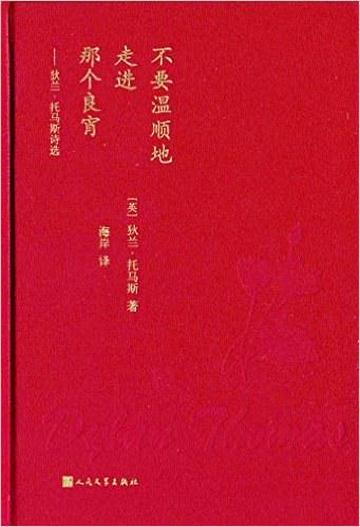
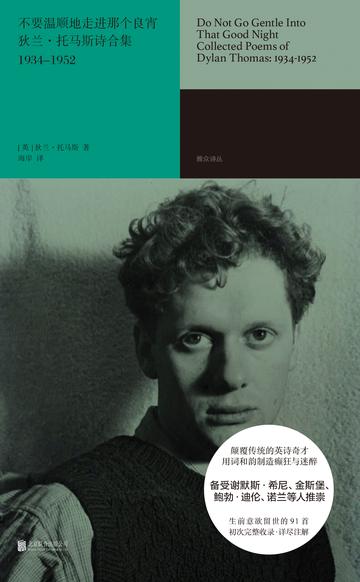
Dylan Thomas was the most outstanding poet in Britain and the United States in the 1930s, opening a new chapter in the history of British and American poetry. His poems revolve around the three major themes of life, desire, and death; his poetic style is rough and passionate, and his phonology is full of vitality yet rigorous; his arbitrarily set dense images collide with each other and restrict each other, expressing the natural growth force and the rhythm of human nature. Many of his early works are obscure and difficult to understand, and although his later works are clear and crisp, certain details remain puzzling. Because Dylan Thomas was a poet who was transitioning from tradition to modernity, previous translators were generally reluctant to translate him. It was difficult for ordinary translators to understand the original text of his poems. Therefore, there were no relevant translations in the early 1980s - except for Professor Wu Ningkun who translated five poems and had a huge influence on contemporary Chinese poetry. In 1951, Dylan Thomas wrote in a "Notes on Poetry" written in response to an interview with a college student in Wales: "The earliest reason why I wrote poetry stemmed from my preference for words. The earliest poem I remember was a nursery rhyme. After I could read these nursery rhymes, Before, I only liked the words of nursery rhymes. As for what the words represented, symbolized or meant, it was secondary; the important thing was that I heard the sound of the words for the first time, coming from the lips of adults who were far away and didn't know much about me but lived in my world. Words seem to me like the notes of a bell, the sound of an instrument, the sound of the wind, the rain, the waves, the rattle of the milk truck, the clatter of horse hooves on the cobblestones, the tapping of branches on the window lattice, or perhaps the miraculous discovery of a person born deaf. When it comes to hearing. I don't care what the words say, or what they mean to Jack and Jill. I care about the sound shape they make in my ears when they name or describe actions; I care about the timbre they make when they hit my eyes." "Do. "Not Go Gentle into That Good Night" is a poem in the UK that primary and secondary school students are required to recite in full. It was written in 1951. At that time, Dylan Thomas's father was already in his octogenarian years. The poet used this poem to encourage his father to fight against his deteriorating eyesight and health instead of accepting it. On November 9, 1953, Thomas himself died suddenly after drinking 18 glasses of whiskey in a row. He was only 39 years old.