Stats
9.3Score
21Chapters
Tags
Synopsis
Reader comments
In booklists 11
Nobel Prize for Literature, Mao Dun Literature Prize, Lu Xun Literature Prize and Other Literary Works
I want to read a book similar to "One Sentence is Worth Ten Thousand Sentences: Collector's Edition".
122.5MViews725Books3dUpdated
Masterpiece! ! ! a Chinese and Foreign Classic Book! ! !
94.6MViews930Books3dUpdated
World Famous Books
🍅All the world famous books I can find are thrown at me, I can bear it
9.3MViews764Books5dUpdated



Looking for Super Good Japanese Light Novels
7.8MViews91Books9hUpdated
Does Anyone Like Literary Classics as Much as I Do?
I recommend twenty-three literary masterpieces to you
4.4MViews948Books5dUpdated
Literature Books, I Want Literature Books! ! !
Family members, I want to read literature books, books that can improve my writing skills or increase my knowledge. Beg on your knees!
3.1MViews564Books23hUpdated
Advanced Literary Works
Are there any novels that can be included in compositions or novels about famous people?
3.1MViews836Books6dUpdated
Looking for Chinese and Foreign Masterpieces
If you can write your thoughts after reading, you don't need to write online articles, they are very story-telling.
1.5MViews576Books4dUpdated
Are There Any Books to Improve Your Writing Skills, Suitable for Beginners Who Don't Know How to Write?
4.8kViews52Books1yUpdated

Are There Any Books That Can Calm Your Mind? Am I Feeling Erratic Now?
2.3kViews27Books1yUpdated


This Is a Super Amway Book
I want to read a book similar to "The Foolish Plays of the Gods". Enjoy this book, The Foolish Play of the Gods (it feels good, Chew Chew Chew)
1.9kViews32Books1yUpdated
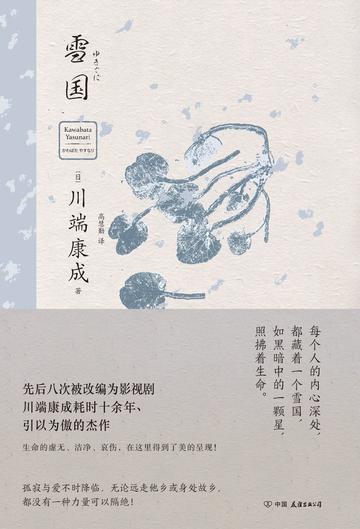
As the first of Kawabata Yasunari's three masterpieces, "Snow Country" stands out among the non-political correctness and has become a peak of Japanese aesthetic novels. The story revolves around the relationship between Dao Cun and Koma Zi. Dao Cun went to the Snow Country three times as a clue. It shows us a gentle and pure friendship. In the context of the prevalence of Japanese militarism at that time, this friendship was like a dancing butterfly, illusory and beautiful. Ye Zi and Ju Zi were both geishas, but she had a tragic life. She accidentally died in a fire, which brought the story to an abrupt end and a sudden sadness. Kawabata Yasunari's naturally desolate style of writing adds a layer of mystery to the story (out of respect for the impermanence of life). In fact, it is obvious that the author is also full of hesitation about the future. But only in the present moment, in my own writing, can I express my confusion (I deeply feel the same). To put it in easy-to-understand terms, Kawabata Yasunari is more like the artistic combination of Shen Congwen and 40-year-old Ji Xianlin's novels. Shimamura came to the snow country three times to meet Juzi, which was accompanied by death and the gradual warming of their emotions. Since Dao Cun has a family, Ju Zi inevitably falls into conflicts. Juzi would go to the tavern to meet Dao Cun every night (no matter the wind or snow). For her, Dao Cun was not only a rare confidant, but also her ideal lover. Dao Cun is aware of this, but there is nothing he can do about it. They looked at the night sky together. "It was a cold night scene with no moon. Looking up, there were an amazing number of stars, hanging brightly in the sky, as if they were falling quickly and without a trace. The stars gradually approached, the sky became more distant, and the night became darker." On a return trip, Shimamura missed the snow country, felt sad for the scenery, and shed tears over the passing insects... The novel does not describe much about the emotions of the characters, but the vivid description of the scenery expresses the mood of the characters very well. (Compared to some of the articles that make people laugh, it makes people sigh.) In the snow country, every snowflake is like a unique dancer, flying freely and freely. Yes, the Snow Country exists in my heart, and all my madness stayed in the Snow Country after reading it. "It is not only the country of snow, but also the intersection of emotion and philosophy." - Mo Yan
This book reminds me of a friend of mine. Her love is as nihilistic and poignant as the stories in the book. Juzi's persistence in love moved me very much. I was also fascinated by the beauty of Japanese mourning shown in the book. The translation is also very good, and you can feel the artistic conception of the original work. I recommend you also read this book.
Many people think that it is normal to be disgusted by poor reading, due to cultural differences, and an instinctive dislike of Japan. But just from the description of the scenery and the creation of the characters, it is difficult to compare with it. I can only give this evaluation. There are really few books with such beautiful descriptions. This is undeniable. The story of this book is too simple, which makes it difficult to guarantee the storytelling. In Japan, this is called Mono-Ai Aesthetics, which believes that death is a kind of beauty. There are many images in the article, but it is not just these, it is more about the author's disillusionment with utopia. Ye Zi is a pure person on a macro level, Juzi is a worldly person but has a pure soul, and the protagonist is simply worldly, as can be seen from the text. I recommend watching it by yourself, because it's really beautiful. If you don't want to read the story, you can just enjoy the beautiful scenery.
The language is beautiful and delicate, with a touch of sadness and ethereal feeling, fully demonstrating the Japanese aesthetics of mourning. The third-person perspective with Shimamura as the center, because he already has family affairs, feels that the encounter with Komako and even Ye Zi is just a fruitless and futile effort, so the words "dream" and "futile" are repeated throughout the book, creating an ethereal atmosphere. In the comments, I often see book friends saying that Juzi is the person after Ye Zi died. Although it seems reasonable when I think about it, I don't quite understand where to confirm it. I hope some book friends can give me an answer~
I actually want to see Ye Zi go out. But unfortunately, the fire came too suddenly. I still remember when the book describes the flames shining on her pale face, and talks about Shimamura seeing Ye Zi for the first time, seeing her face reflected in the lights through the car window, her eyes shining like stars. But I'm actually wondering, does this description at the beginning already indicate Ye Zi's subsequent fate? This is only a one-sided understanding. But this book is so beautiful, and so is the characterization. If the colt is the purity of snow, then I think the leaves are the coldness of snow.
At the beginning, I felt that what I was watching was not very realistic. Then I stopped for a while and studied nihilism and absurdism. Then I came back and watched it again. It suddenly dawned on me that there are nihilistic people and nihilistic things, but the slightest expression of emotion in the nihility is even more delicate.
I have little talent and knowledge, and have never been to Japan, so it is difficult for me to sympathize with the author's writing style. What impressed me most after reading it was the delicate and profound sense of the picture and the capture of female psychology, which made me doubt whether it was written by a male writer.
Seeing all the ultimate beauty in the world as a fragile illusion may be the key to understanding "Snow Country". The snow country described by Kawabata Yasunari is pure white and so quiet. The love between Shimamura and Komako is like the footprints in the snow, clear but eventually covered by new snow. There is no eternity, only a momentary tremor. I always feel that those who are obsessed with pursuing "pure beauty" tend to fall into a self-made prison. Shimamura came to the Snow Country with the nihilism of an urbanite. He was obsessed with Komako's liveliness, but he always maintained his alienation as a bystander - he was intoxicated by her dance and her infatuation, but never thought of taking root in this feeling, because he subconsciously regarded "the purity of the Snow Country" as his norm and did not want to let the worldly fireworks taint this beauty. Juzi knew that this relationship was fruitless, but he still tried his best to burn himself and regarded love as the only light in his life. Isn't this almost paranoid persistence a kind of self-restraint? The "supreme purity" often found in foreign literature turns into the ultimate emptiness and beauty in "Snow Country". Shimamura's addiction to nothingness and Komako's pursuit of pure love are essentially denying the ordinary nature of people - they are unwilling to accept the reality that love will fade and life will return to dullness. They always want to seize the fleeting "holiness", but in the end they suffer from the gap between reality and fantasy. Just like the snow in the Snow Country, it looks white and flawless, but is actually bitingly cold, hiding endless holes. The translation is average. I personally like the translation by Ye Weiqu and Tang Yuemei.
Kawabata Yasunari's writing is extremely simple, with a delicate and subtle emotion contained in restraint. The whole life is like looking through a peep show through a mirror. In Snow Country, Shimamura is a dance researcher with a craftsman spirit. From kabuki drama to traditional dance to dance drama to Western dance, he comments. When it comes to dance, women are addicted to their own imaginary appearance. Everything is just to cover up his indifference, everything is in vain, the world is meaningless and even nihilistic. Wanting to love but alienating love, wanting to escape with nowhere to go, a feeling that is so nihilistic that it is neither sad nor happy. Juzi, who was crazy about love, went crazy, and quiet Ye Zi died. Years ~ Two half-brothers died in World War II, the mother eloped with the eldest brother's classmate, the father died suddenly, and was abandoned by his lover (the younger brother was a classmate of the older brother). Life is unpredictable, and only the passage of time accumulates, "Life and death are big things, and they change quickly." Finally, he accepted his mother's return and started over in a different environment. Lespeda ~ There are two articles, what are you thinking about? Love? War? Life and death?
They all want to escape the barren life. For example, Ye Zi has a yearning for Kyoto, and Ju Zi is infatuated with Shimamura. Ye Zi once had a passion for nursing, and Ju Zi displays Tokyo souvenirs, as well as many interests and hobbies. They all have aspirations, but they have to be locked in that world by life, and their dreams cannot be realized. The emergence of the "generous" Shimamura gives them an interface with the world of their dreams. But as the book says, Shimamura is powerless because he already has a family. But can't the two heroines clearly see this "futility"? They may need hope too much. Until everything collapses, they are also struggling with this life. Just like us in life, how can we not fight for things in life. As a reader, I particularly resonated with one part of the book. Komako has devoted everything to Dao Cun, but she does not understand the life outside Dao Cun Hot Spring Village, even in Zhouzao Village. It seems that the whole text is connecting the two with each other, but if you think about it carefully, it is more like Shimamura is acting as an interface, allowing Komako to input. Regarding the maintenance of the relationship between the two, Shimamura still focuses more on the beauty of Juzi and Ye Zi, their skin, and their silk hair, which is different from Juzi's feeling of a couple facing life together. My language expression ability is limited. After reading the full text, I really feel that I can't do anything about it. I hope you can meet your own Ju Zi, and I also hope that you can keep Ju Zi's heart at the first moment, and walk on that "couple's road" that you have never gone before! [Cry]
I haven't finished it yet, but I know the ending. I really like Komako. Komako's love is so sincere and sad, careful and passionate, but I can't criticize Shimamura even from this point of view. Shimamura himself can't do anything about it, and he can't explain why. After holding it in for a long time, he could only vent his anger and call him a scumbag. The whole story is "in vain". Combined with the poignant material sorrow, it has a unique artistic conception.
The beauty of Japan described by Master Kawabata, from the tea ceremony, flower arrangement, geisha haiku, the beauty of nature to the weakness and weakness of human nature, is deeply rooted in people's hearts.
When discussing the book with my relatives, I went around and found that there was no rating. This book undoubtedly has the greatest impact on people like me. A touch of sadness melts in the snow, Shimamura is confused and drifts with the tide. Maybe he doesn't care about anything. Maybe he just wants to find out what else he can do in his life. Does he really still have a soul? The night Ye Zi died, the Milky Way fell upside down in the sky. What did he see? It's probably an end point. Haha, life.
"Snow Country" is the pinnacle of Kawabata Yasunari's aesthetics of mourning. The snow-covered countryside serves as the background, intertwining three hazy love relationships between Dao Cun, Ju Zi and Zi Zi. The text is as clear as ice and snow, depicting the melancholy of fleeting beauty and futile love. Hidden under the cold poetic tone are thoughts on the emptiness of life, and a few words of ink create an ethereal fantasy unique to the East. The snow country is beautiful
Snow always carries a kind of sadness and desolation, like a symbol of departure, covering all colors and covering up all emotions. The repressed person can only say goodbye in the snow after all, because he understands the impossibility, understands the nothingness, is too clear-headed, and sympathizes. Emotions are really complicated, and people are really passionate and ruthless. Delicate dialogues and entangled fates that generations of people cannot escape.
Read on October 14, 2024
Beautiful, I always like it
The ultimate in aesthetics and the pinnacle of material sorrow
"Snow Country" was read in a hurry, but the subsequent "Years" really interested me.
I like «Years» better than «Snow Country».
No need to say too much
A book worth reading again and again
I finished reading it in a daze.
Little people face the futility of life and love
Poignant and slightly sad. The language of prose poetry is very pictorial.