Stats
Tags
Synopsis
Reader comments
In booklists 42
Explore more →
Books That Students Should Read, In-Volume Essentials
Mathematics, Chinese, English, chemistry, physics, biology, geography, history, ancient poetry...
Study Books
Are there any books that are helpful for studying? Please recommend! ! ! ! ! !
Easy-To-Understand Learning Technology Books
There Is a God Named Qi Xia, a Crazy Critic Named Lin Yuan, and a Legend...
I want to read a book similar to "The End of Ten Days". After "The End of Ten Days", "Legend Management Bureau" and "Seven-year-old Me Participating in Rules and Ghost Stories", there are no masterpieces. If you don't accept it, let's argue.
I Beg You to Read Secretly During the Summer Vacation, and Book That Will Kill Your Classmates at the Beginning of the School Year.
A Profound Book That Can Help Me Grow My Brain
Logically rigorous, not mindless sweet stories, with deep foreshadowing, and a grand world view, this kind of
A Book That Can Help You Learn and Increase Your Knowledge
Knowledge that can increase (useful, practical), interesting and not boring
I Read Secretly During the Holidays and Became Obsessed with My Classmates' Books.
I would like to read a book similar to "How to Read a Book".
It's Very Informative. After Reading It, I Feel Like I Can Take the Tsinghua University Entrance Exam.


This Is the Novel That Chinese People Should Read
We are both Chinese, and you will definitely get excited after reading this



I Am Certified as a Writer, How Can I Withdraw? Waiting
A Book That Will Make Your Brain Faster After Reading It
Full of Useful Information: All-Round Learning Book
Learning Books
It's the kind that has depth and can be seen through.
Are There Any... Math Books, English Books, Chinese Books...🌚🌝
My parents always say that all my books are novels, and there are no novels about learning🌚🌝

I Want to Study (Internal Volume), Please Recommend a Book
Learning Books
If you are tired of reading romance, just read it to learn. Everything is OK. Focus on learning! ! !
An Internal Essay About Killing a Classmate. as Long as You Can Learn Knowledge
Learning Books

Life Skills, Useful Books
I would like to read a book similar to "Survival and Life Skills to Master for a Lifetime".
Have You Ever Read a Book That Made You Want to Study Hard?
Save the children who don't want to study😭

Books Where You Can Learn Something
Don't be boring. I want a book that integrates knowledge into the storyline. Don't make it empty. The knowledge is real and effective.
Come in If You Want to Learn Real Skills.
I want to read a book similar to "The Art of Testing Chinese Characters". If you want to learn real skills, come in and you are guaranteed to learn something.
Thoughts after reading The core meaning of this book: input-digestion-output The key method of this book: study straight to the goal, learn the essentials, and learn the basics. 1. Input: "Dream Backward Method": First imagine the result you want - then work backwards on the path to achieve it - then decompose the tasks - and finally complete the tasks one by one. 1.1 Choose textbooks before studying: Choose textbooks and exam syllabus for exam-oriented education; the focus of long-term learning is perseverance; the focus of essential learning is to find the essence. 1.2 Methods when studying: preview-study-review, preview and review are very important. 2. Digestion (digestion focuses on self-examination and problem solving) 2.1 Before self-examination: Mentality is very important, either insensitive or confident. 2.2 During self-examination: Self-examination methods: source search (list self-examination method), result search (examination inspection, analysis of works, inspection by others). 2.3 After self-examination: start immediately without procrastination; work on one difficult point at a time and focus on solving problems; learn to use external forces to solve problems. 3. Output 3.1 Expression output: speak out knowledge or draw knowledge structure diagrams and mind maps. 3.2 Problem-solving output (applicable to small knowledge points and single knowledge points): Do homework and review before doing it. 3.3 Examination output (applicable to comprehensive knowledge): Through various examinations, each section of knowledge, each knowledge point, and the relationship between each knowledge point are detected. 3.4 Application output: Solve practical problems and use a skill at least 3 times each time (33 principle). Important: ① Don't delay, just do it; ② Develop good habits.
Good book. I hope you are younger than me when you read this book and have more time to study than me.
After reading it roughly, even if you find a method that suits you, it's worth it [laughs][laughs]. Just practice it after reading it. The key is execution.
The content is explained in great detail, which is very helpful for learning. However, one thing to note here is that in addition to using these methods, I think the most important thing is to race against time. I feel like this is the most painful thing (it's just my personal understanding, don't comment if you don't like it)
When I read this book, I could feel the sincerity of the author. I also found some of the cases cited by the author. I will work hard to correct the shortcomings I still have. I also want to be such a good person.
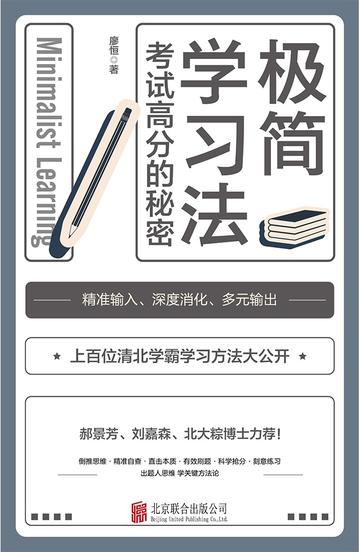
You can never have youth and the feeling of youth at the same time. As a student who passed the exam step by step from the countryside, when I read the learning, understanding, output and other learning methods introduced in the book, what echoed in my mind was the picture of myself learning and exploring methods bit by bit when I was a student. Learning methods used to be like martial arts secrets, but now they are all free to read. Not only do you feel the changes of the times~ Back to the topic, this book summarizes efficient learning methods and introduces a concise and effective learning method-minimalist learning method. [What is the minimalist learning method] Accurate input, deep digestion, and multiple outputs. Precise input emphasizes clarifying learning goals, finding the most suitable learning materials, and acquiring the most useful knowledge in the least time. In-depth digestion requires truly understanding what you have learned, and internalizing the knowledge into your own abilities through self-questioning, summarizing, etc. Multiple output is the application of learned knowledge in various ways, such as doing questions, telling others, writing articles, etc., To test and consolidate learning results. (It's just twelve words, but it's a skill that many students need to practice continuously in 12 years) Content Sharing 1. "The core of the minimalist learning method is to use the least time and energy to achieve the best learning effect." 2. "Accurate input, deep digestion, and multiple output are the three steps of the minimalist learning method." 3. "Only by clarifying the purpose of learning first and then inputting it in a targeted manner can you get twice the result with half the effort." 4. "In-depth digestion means truly making knowledge your own and being able to use it flexibly." 5. "Multiple outputs can test learning results and further consolidate knowledge."
After reading it for the first time, I felt very lucky to have read this book two days before the start of school... I only wish I had not read it earlier! ! ! I have benefited a lot! There are methods that I have used before, but I didn't understand what the goal was before, and I was just confused and wanted to do well in the exam. After I did well in the exam (city 5600/20000), my ranking quickly fell, and now I can never recover. I never understood why. Now I understand it was because my goals were not clear enough. Thank you so much. So I watched it again! ! ! ! ! I made a four-sided mind map and made a study plan! ! School is about to start, I will definitely study hard! ! ! Prepare for next year's college entrance examination! ! ! ! ! ! I will follow up and share my college entrance examination results with everyone! ! ! ! ! ! ! ! !
This tomato said let me help readers But I'm not that good personally, so everyone just makes do with it. First of all, I summarized this method in elementary school and junior high school⊙▽⊙ When I got to high school, I didn't practice it. Well, I chose to follow the school's rhythm. I couldn't go on with my poor grades. I decided to follow my original path. If no one affirms me, I will affirm myself. Then it's about persistence. There are too many methods. In our society, method theories emerge in endlessly. At the right time, choose a suitable method and then do it. The scarcity of things does not care about its original value. On the contrary, it is often a relative value. When you are hungry, you need to eat, so food becomes precious. When you are thirsty, you need to drink water. At this time, water is precious. We have to face many theories, and some theories contradict and criticize each other. For us personally, we just choose the one we think is right. After careful consideration, we will not regret it in the future, and then do it firmly. Indecision and failure do not belong to us. Be firm, do it, practice it, analyze and evaluate it, and only then can you be qualified to turn around and say whether it is good or not, and whether it can work. I think this is the case, so I told everyone, hoping it will be helpful to everyone.
It took me an afternoon to read it. In fact, I feel that I have known these methods before when I was struggling with procrastination. I have even practiced them in the past years. It is not that difficult to understand. However, after reading the examples in this book, I organized it again and looked for methods from scattered memories in the past. However, they are not systematic. After reading it, I still feel that it is very interesting. The emphasis is on practice, starting first!
The theory is okay, but I don't know if it can be used in actual practice. At least after reading it, it can increase your confidence and increase your probability of being admitted to 985 and 211 universities or even Tsinghua and Peking University. Many methods are very common, but the author also explains the principles and examples to give people the motivation and direction to take action. Many problems are actually not as simple as the author says, and are very difficult. For a procrastinator like me, I have tried the method mentioned by the author, but it just doesn't work. I still have to find something that suits me. The author also mentioned that it requires more exploration and practice. So I'm going to try it out next semester. If I'm still short of one star, it depends on how effective it is in practice🤔🤔🤔
In summary, this book is quite useful for scholars who have never been exposed to it. Since I have read several books, most of the content overlaps, but there is also some new content. For example, I learned that it must be done within 72 hours and must be used at least three times. This one is new. I have read a few books before, and I found that what they said is actually quite different. Hey, even their experiences are similar. Tell me, what is your relationship with Ye Xiu, who wrote "Attack of the High School Master"? They are all English majors who are not good at English. One was ridiculed because of his poor speaking skills, and the other worked hard because he couldn't understand the teacher's jokes. The other two books I read, whose names I can't remember, were about learning methods. The authors of these two books are not the same person at all, but their experiences are very similar. They both braved the wind and rain to climb mountains to go to school when they were young. Then they were too scared, so in order to stabilize their minds, they started to memorize Chinese texts, and then they became good at Chinese subjects from an early age. No, are the experiences of top academics so similar? Another piece of advice, don't waste too much time on this type of book. This is not to say that the book is not good. It's a human problem. Don't regard this kind of book as a martial arts secret book (from Ye Xiu).
In school we learn textbook knowledge, in life we need to master various life skills, and even when playing games we often learn some game skills. It can be said that in this era of information explosion, learning is everywhere. Since learning is so important, are there any good learning methods? "Minimalist Learning Method" breaks down learning into three links: input, digestion, and output, and uses this to build a complete set of implementable systems. The following is a brief introduction to the contents of the book. 1. Input: Focus on the core and make rational choices Core concept: "Pursuing lean" requires learning to focus on key knowledge for solving problems; "getting to the essence" emphasizes understanding the underlying logic of knowledge. Select the right materials: Exam-oriented learning should organize teaching materials around "transparent, complete, stringent, and multiple"; continuous learning can select materials from dimensions such as brand and translation evaluation. The learning process is divided into three steps: preview, study and review. Pre-study, preparation for formal study, marking difficult and difficult points. There is a purpose in learning, focusing on difficult points and marking points that you still don't understand after studying. Review after learning and re-alienate the knowledge chain to consolidate the results. 2. Digestion: self-examination and breakthrough, laying a solid foundation Mentality and self-examination: Face setbacks with "insensitiveness", admit shortcomings and make breakthroughs with "self-confidence"; accurately locate learning stuck points through "self-examination of knowledge list" and "self-examination of results". Deliberate practice: clarify goals, break through comfort zones, pay attention to feedback, and achieve deep internalization of knowledge. 3. Output: practice and application, test results Multiple output: Transform knowledge from theory into applicable tools through three methods: "speaking, writing and using". Scenario-based output: Use "examination triangle" thinking to grasp scoring points when taking exams; when applying, the method can be transferred to different learning scenarios. 4. Beyond learning: motivation and habits, long-term support Motivation cultivation: Build long-term learning motivation through "dream visualization" and "self-reward". Habits and anti-procrastination: Applying the "2 minutes first" rule can effectively overcome the fear of learning and promote action by lowering expectations. Personal reflections "Minimalist Learning Method" provides an overall framework for learning, summarizing the entire learning process through three core links, and is worthy of reference.
In fact, the talk is quite specific, and several practical examples are given to analyze specific problems in detail, but you still have to rely on yourself to do it, so go for it!
1. Diligent and tireless 2. Strive for excellence .3. Plow deeply and carefully 4. Give your full attention 5. Be broad-minded yet manageable, accumulate thickly but thinly send 6 Integration 7. Diligently 7. Tirelessly: describes learners who are diligent 8. Unity of knowledge and action: Praise learners for not 9. Apply what you learn: Emphasize the purpose of learning 10. Unique discernment
Systematic, systematic, easy to understand and easy to operate 1. He is not too academic like some books. "Minimalist Learning Method" is like a good friend and a good teacher. You will be very easy to accept and understand. 2. Extremely practical. If this book is organized using mind maps, everyone will be shocked. The viewpoints of "Minimalist Learning Method" are extremely clear and concise. Each viewpoint and case complements each other and has an excellent match. It can stimulate thinking during the reading process and truly transform learning into understanding and application. 3. Comprehensive, extremely comprehensive. "Minimalist Learning Method" covers the entire process of preparation, learning, and mastery of minimalist learning, and assists in the adjustment of mentality. Not only is it a systematic methodology, but it also gives people confidence and motivation Found a good book
It's very rewarding and worth watching. It introduces many methods, such as solving procrastination, which are quite practical for me. There are also many learning methods in the past, all of which are worth using. I don't want to read other books after reading them once, but I really want to read this book several times. I want to absorb it a few more times. Really highly recommended.
I finished reading it in less than two hours. I usually read very slowly, but when I thought about what the book said, if you read with a purpose, you will really read quickly [stunned]
The minimalist learning method talks about a learning method that starts with the end in mind and understands the essence according to the input-digestion-output method. In fact, they are all clichés about those who know but do not do it. As the saying goes, "Those who know are not as good as those who are good at it, and those who are good at it are not as good as those who enjoy it." If you can regard learning as fun, you can learn well without learning methods, because you will find your own learning methods. After all, no matter how good the learning method is, it must be based on the memory rule of input-maintain-reproduce and recognize, and knowing the rules without the internal drive to actively learn means not knowing the rules. After all, no matter how much you know but cannot implement, it is nothing. That is to say, learning methods are only means, and falling in love with learning is the foundation. The methods of improving self-control, memory, and thinking ability discussed in efficient learning are also intended to serve the input, digestion, and output discussed here. In the past, when information was limited, it was difficult to know. Now that information is exploding, it is difficult to do it.
After sorting out my notes, I found that this book is quite helpful for studying for exams, and some of the methods can also be applied to learning other skills. However, some parts of the book talk about college entrance exam-oriented education, which is more focused on exams. Some methods are quite constructive and inspiring. "Minimalist Learning Method" 1. Core logic: input → output The core of the minimalist learning method is to establish a closed loop of "input → output" to achieve efficient transformation of knowledge through accurate input and effective output. (1) Backward learning method - Logic: learn whatever you want to use and what you can imagine. Starting from the goal, the learning content is deduced backward to avoid ineffective learning. (2) Get to the essence - Path: input from the essence→digest from the root→multiple output. Deeply understand the underlying logic of knowledge, and then consolidate it through diversified output methods. 2. Precise input: building a knowledge system Accurate input is the basis for efficient learning, which requires clear goals, selection of high-quality resources, and focus on the core. (1) Enter goals and strategies - Reading example: clarify "why you read" (purpose), distinguish "key points" and "understanding methods", turn the goal into a year-end summary and refine the steps, and stay focused on the goal without deviation. - Selection of teaching materials: A thorough understanding of the teaching materials needs to be "thorough, complete, serial, multiple, and continuous", adhere to the learning path from one to the end, retain theoretical key points, formulas, etc. To form a knowledge system, and persist to the end. (2) Input core method - Three-step method: read the cornerstone works → learn key methodologies → understand 100 keywords. - Experts and monographs: Find 3-5 experts to ask, find 3-5 monographs to study, and get started quickly with the help of authoritative resources. (3) Focus and action - Principle of concentration: Concentrate without distraction, only do one thing for a period of time, and achieve a result in a short time. - Code of Conduct: 1. It doesn't matter where you start, the beginning itself is important; 2. Action must be taken within 72 hours; 3. Apply the known to the unknown to reduce the difficulty of getting started. (4) Question review and summary - Question review process: Review questions → Summarize methods → Second review, develop the thinking habit of "asking what knowledge point is being tested". - Comparative thinking: Have the question maker's thinking, compare reference answers, analyze structure, score points, terminology, and improve the accuracy of problem solving. 3. Effective output: Consolidation and expansion Output is the key to testing the learning effect, and knowledge internalization needs to be achieved through multiple applications and deliberate practice. (1) Output requirements - Frequency: Use at least 3 times to deepen understanding through repeated application. - Ability: Grasp the essence, draw inferences from one instance and achieve knowledge transfer. (2) Deliberate practice - Loop: Goal → Breakthrough → Feedback, optimize the learning effect by clarifying goals, breaking through difficulties, and obtaining feedback. 4. Fall in love with learning: develop study habits Make learning a sustainable internal need through habit formation and motivation mechanisms. (1) Dream driven - Backward connection: Connect dreams with goals backwards, breaking down long-term dreams into executable learning goals. - Visualization: Dream visualization, enhance motivation through visual presentation. - Self-reward: Set up periodic rewards to strengthen positive feedback for learning. (2) Habit formation - Reduce self-control consumption: 1. Fixed study time; 2. Fixed learning methods; 3. Fix the learning place and reduce resistance to movement through environmental consistency. (3) Skills/knowledge list (example) - 11:30 every day: Python, web development, hand drawing/board drawing, English/sign language/dialect, Excel, writing, PPT, photography, etc. The learning content can be flexibly adjusted according to needs. Organizing instructions: The notes take "input → output" as the core, sorting out the complete learning path from goal setting, resource selection to practical application and habit formation, emphasizing precision, concentration and closed loop to help build an efficient learning system.
Why am I a bad student? I fell into all the above traps. If I had known earlier, my life would never have been like this.
This book is very useful. I recommended this book to my friends and they didn't read it. I was really helpless. Who knows how I felt? I really didn't study secretly. I was very upright. Let's not talk about whether I learned or not. At least I said that I was reading a study book. I will start studying according to the method of this book. I took the college entrance examination in 2026 and it took one and a half years. I believe I can do it. My current score is about 300 points. I hope to get a score of 550 or above and come back for review after the test!
The basics of the basics, plus some practical tips, it's really worth reading for 2 hours. I spent five hours reading and taking notes [face covering]
Insights and insights into "Minimalist Learning Method" The core of "Minimalist Learning Method" is precise input, deep digestion, and multiple output. Accurate input means clear goals, locking in key knowledge learning, and avoiding wasting time; in-depth digestion requires understanding the principles behind the knowledge rather than memorizing it by rote; multiple outputs can consolidate results through explanation, writing, practice, etc. Deep personal insights. In terms of learning efficiency, in the past, people learned blindly. After using accurate input, they can quickly locate key points and improve efficiency. In terms of knowledge understanding, the concept of deep digestion prompted me to dig deep into principles, understand knowledge in multiple ways, and deepen my understanding. In terms of knowledge consolidation, multiple outputs have changed the way of review. By making PPT explanations, writing articles, etc., The memory is stronger and can be used flexibly. In practice, when facing new marketing projects at work, we determine the learning direction through accurate input, then deeply digest and apply multiple outputs to the project to achieve good results. When learning to paint, it is practical and efficient to determine your style, study your techniques, and improve your skills by participating in exhibitions and sharing your works.
I really learned a lot from the book. I feel that the focus of this book is the efficiency of learning, and the so-called simplicity of the road is a principle that can be used in all aspects.
I have read them one after another. Some of them are very consistent with my behavior habits in high school. However, I have lost most of them in the three years of college. After reading them, I regained my confidence.
It is full of useful information and really benefits people a lot. It is a very good book on how to study. The language is simple, there is nothing difficult to understand, and the methods are diverse. After reading it, I will insist on using the method of this book at least three times (the 33 principles taught in this book). I hope I can get good results in next year's exam.
There's a lot of nonsense behind it, but overall it's useful. It is more suitable for students to read. There is a large section in the middle about learning methods for exams, such as the thinking of the question maker, which is of little use to me now.
Collusion with "Feynman Learning Method" is a good book The concept of output discussed in the book further provides specific extensions based on Feynman's learning method, allowing me to gain more methods and experience on the road to learning. Overall, this is a rare and good book.
The content is rich and practical. It is very close to the actual situation. You can use it immediately. It is very practical. You can try it.
I strongly recommend this book. I have read so many such books and it is considered the best. It is not muddled at all and goes straight to the point of doubt. It has greatly inspired me in my study. Fortunately, I read it before the college entrance examination. I plan to read all the books by this author.