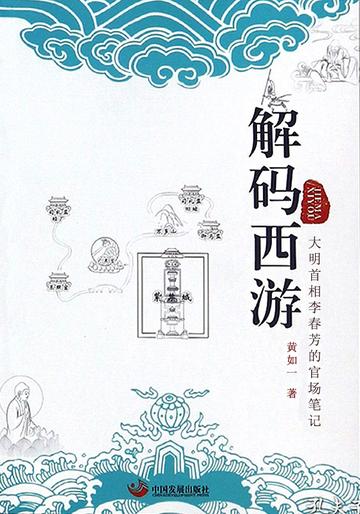
This book breaks the original simple understanding of "Journey to the West", deeply explores its profound ideological connotation, and restores the mythical and demonic stories in the book to historical facts that happened in the history of the Ming Dynasty. This book provides an in-depth analysis of important issues such as the officialdom of the Ming Dynasty, the process of Chinese civilization in which the Ming Dynasty was located, the power of the Ming Dynasty, and the social structure of China in the Ming Dynasty.
This book not only restores the coded metaphorical connotation of "Journey to the West" to clear codes, but also uses the story of Journey to the West to explain the shady things of the Ming Dynasty. It also decodes the various officialdoms into a vast social scroll of the evolution of feudal society with Chinese characteristics to the Ming Dynasty.
Through the representation of gods and demons in "Journey to the West" and closely following the historical facts of the Ming Dynasty, from the perspective of the author Li Chunfang rather than Wu Chengen, it reveals that the Jade Emperor (Emperor of the Ming Dynasty) carefully planned to send the eunuch Sun Wukong to escort the eunuch Tang Monk to Xitian (Xiyuan) to learn Buddhist scriptures, thereby fostering Buddhism (private ministers in the inner dynasty) and balancing Taoism (civilians in the outer dynasty).
By revealing the true identity of Subhuti, the true meaning of the Royal Horse Prison and the Peach Garden, the various techniques used by Buddhists and Taoists to extract benefits, and the nature of the game of interests between Buddha, Taoism, dragon clan, and human beings on the road to the scriptures, we can read history under the guidance of appreciating the novel, gain insights into officialdom, and survey the long river of social evolution.
Reader comments
This book is very interesting! It interprets the history and officialdom behind "Journey to the West", allowing me to see a more realistic Ming Dynasty. Especially the analysis of the Jade Emperor and those gods gave me a deeper understanding of their behavior. But what I hate the most are those greedy monsters who always try their best to seek personal gain. Overall, this book not only made me re-understand "Journey to the West", but also made me think more about history and society.
I have read many interpretations of Journey to the West, and there are many so-called interpretations that often piece together other people's opinions. However, this one is different. The author uses different perspectives and combines historical background to interpret Journey to the West.
When I first read it, I felt that the author's views were only at the level of a short video author. But as I continued reading, I found it more and more interesting! I suggest changing the title of the book to "Those Things in the Ming Dynasty: Journey to the West" [laughs][laughs][laughs]
The ideas are novel and the analysis is in place. The examples and comparisons are straightforward. Although a small part is a bit far-fetched, overall it is relatively systematic.
The structure of this book is reasonable, the analysis is very precise and clear, and it makes people like it very much. The author is in-depth and educated, and he is an engineering student. It is not easy.
Very good. In-depth interpretation from a new perspective. Combined with the history of the Ming Dynasty, it is like clearing the clouds and seeing the fog, and a candle illuminating the annals of history.
Both the relief and the relief are not fulfilled, and the four images intersect.
This is the most comprehensive book I have ever read on Journey to the West.


This book is very interesting! It interprets the history and officialdom behind "Journey to the West", allowing me to see a more realistic Ming Dynasty. Especially the analysis of the Jade Emperor and those gods gave me a deeper understanding of their behavior. But what I hate the most are those greedy monsters who always try their best to seek personal gain. Overall, this book not only made me re-understand "Journey to the West", but also made me think more about history and society.
I have read many interpretations of Journey to the West, and there are many so-called interpretations that often piece together other people's opinions. However, this one is different. The author uses different perspectives and combines historical background to interpret Journey to the West.
When I first read it, I felt that the author's views were only at the level of a short video author. But as I continued reading, I found it more and more interesting! I suggest changing the title of the book to "Those Things in the Ming Dynasty: Journey to the West" [laughs][laughs][laughs]
The ideas are novel and the analysis is in place. The examples and comparisons are straightforward. Although a small part is a bit far-fetched, overall it is relatively systematic.
The structure of this book is reasonable, the analysis is very precise and clear, and it makes people like it very much. The author is in-depth and educated, and he is an engineering student. It is not easy.
Very good. In-depth interpretation from a new perspective. Combined with the history of the Ming Dynasty, it is like clearing the clouds and seeing the fog, and a candle illuminating the annals of history.
Both the relief and the relief are not fulfilled, and the four images intersect.
This is the most comprehensive book I have ever read on Journey to the West.