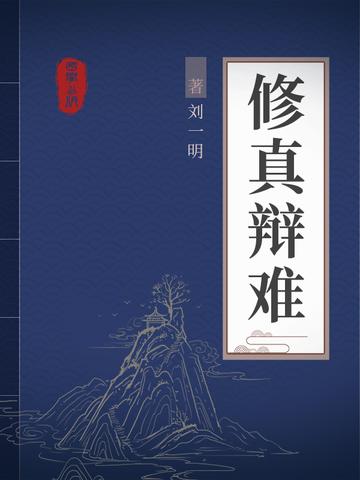
Qigong inner alchemy work, written by Liu Yiming in the Qing Dynasty. His book explains the principles of inner alchemy in the form of questions and answers between master and disciple. The author believes that inner elixir is formed by the condensation of life and life, so it is necessary to cultivate both life and life. He points out that the way of life and life are closely related to the way of yin and yang. Xing is principle, life is Qi, Qi is not separated from principle, and principle is not separated from Qi. Therefore, Xing is not separated from Ming, and Ming is not separated from Xing. They are integrated and cannot be separated. Cultivating one's nature can establish one's life, so practitioners must pay attention to cultivating one's nature. "If one cannot cultivate one's nature, how can one establish one's life? Benefiting one's nature is the source of one's life, and one's life is the survival of one's nature. Life is originally a family, so how can one not cultivate one's nature?" It is required to cultivate both one's nature and one's nature and focus on first one's nature and then one's destiny.
Reader comments
This book "The Dilemma of Cultivation" is very interesting! The author Liu Yiming has a profound understanding of Tao. Through conversations with his disciples, he explained the nature, use and changes of Tao in a simple and easy-to-understand way. I especially like what he said, "Use the heaven and the earth as a reverse journey, and the sun and the moon as a passer-by." I feel that it is very philosophical. Moreover, his explanation of Tao is also very comprehensive, allowing people to think more deeply about cultivation. However, the content in the book may be difficult for some people to understand and requires careful consideration. Overall, this is a book worth reading.
This has been translated by me and I can confirm that it is really beautiful.
This book "The Dilemma of Cultivation" is very interesting! The author Liu Yiming has a profound understanding of Tao. Through conversations with his disciples, he explained the nature, use and changes of Tao in a simple and easy-to-understand way. I especially like what he said, "Use the heaven and the earth as a reverse journey, and the sun and the moon as a passer-by." I feel that it is very philosophical. Moreover, his explanation of Tao is also very comprehensive, allowing people to think more deeply about cultivation. However, the content in the book may be difficult for some people to understand and requires careful consideration. Overall, this is a book worth reading.
This has been translated by me and I can confirm that it is really beautiful.