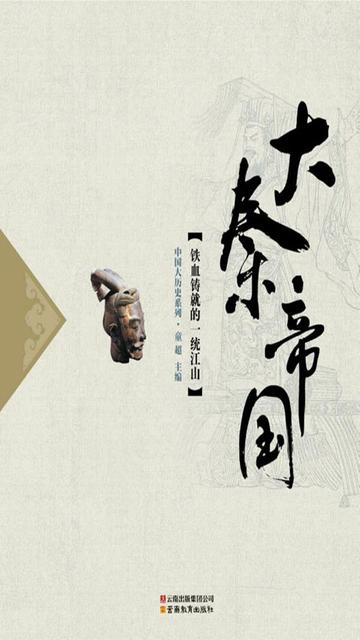
“The King of Qin swept across the Six States. How mighty his gaze! He swung his sword to scatter the clouds, and the feudal lords all came west.” Rising from a barren land, the people of Qin rode into the Central Plains, drenched in blood and tempered by battle, laying the foundations of the mighty Qin Empire. The Six Kings fell, and all under heaven was united. Qin established commanderies and counties, standardized writing and axle widths, and laid the groundwork for a unified empire. The emperor toured the four corners of the realm, held a ceremony at Mount Tai, visited Jieshi, and proclaimed his achievements to the heavens and the seas. With law as its teaching and officials as its instructors, the bureaucracy flourished as never before. Ying Zheng was a ruler of extraordinary ambition, but his rule over the people could also be called tyrannical. The Great Wall was built in the north, and the Baiyue were conquered in the south, while the people were driven into turmoil. The laws were harsh, and old customs were suppressed. The realm had suffered under Qin for too long. The magnificent Epang Palace and towering Mount Li ultimately bore witness to Qin's fall.
[Editor's Recommendation]
As an empire that embodied the spirit of its age, the Qin Empire gave concentrated expression to the Chinese people's tenacious spirit of survival. The Qin-era tradition of strength and resilience played a decisive role in enabling Chinese civilization to endure and flow onward like a great river. The Qin Empire rose amid the bloody competition of rival powers, embracing the vigor, simplicity, innovation, and pragmatism of its time. It championed the rule of law, pursued sweeping reforms, worked to build and unify the realm, and, after more than 160 years of resolute effort by six generations of leaders, completed a great imperial revolution. It established a powerful, unified empire and ushered in a new age of iron civilization, bringing about a profound transformation in China's agrarian civilization.
[Author]
Tong Chao was born in Xuzhou, Jiangsu, in 1938, and his ancestral home was Shaoxing, Zhejiang. He graduated from Peking University's History Department in 1961 and completed his postgraduate studies in history at Sichuan University in 1964. He served as a researcher and deputy director at the Institute of History of the Chinese Academy of Social Sciences, president and editor-in-chief of the journal Research in Chinese History, director of the History Department at the Graduate School of the Chinese Academy of Social Sciences, deputy secretary-general of the Chinese Society of Historians, and ...
The Qin Shihuang in the book is really both loveable and hateful. His talents are admirable, but his tyranny is also heartbreaking. This reminds me of my friends who are working hard to start a business. They will also encounter various difficulties and challenges in their pursuit of success, and sometimes have to make some difficult choices. However, just like the Great Qin Empire, as long as you have firm belief and unremitting efforts, you will be able to create your own glory. This book is really worth reading!



The Qin Shihuang in the book is really both loveable and hateful. His talents are admirable, but his tyranny is also heartbreaking. This reminds me of my friends who are working hard to start a business. They will also encounter various difficulties and challenges in their pursuit of success, and sometimes have to make some difficult choices. However, just like the Great Qin Empire, as long as you have firm belief and unremitting efforts, you will be able to create your own glory. This book is really worth reading!