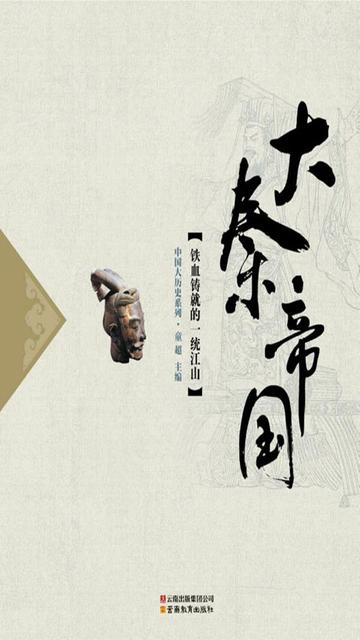
The king of Qin swept Liuhe, what a majestic sight! Swing your sword to cut through the floating clouds, and all the princes will come to the west. The Qin people, who rose up in the barbaric land, rode horses in the Central Plains, drank blood and drank swords, and gave birth to the great Qin Empire. The six kings are complete, and the four seas are one. Establishing prefectures and counties with the same writings and tracks, creating the basis for the unification of the empire; patrolling the four directions, sealing Mount Tai, and touching the Jieshi, announcing the achievements in the world; using the law as the teaching, and the officials as the teachers, the bureaucracy has become unprecedentedly developed. Winning political talents can be said to be tyrannical in governing the people. The Great Wall was built in the north, and Baiyue was conquered in the south, and the people were struggling for it; the usage was harsh, the old customs were intolerable, and the world suffered from Qin for a long time. The majestic Afang and the towering Li Mountain finally witnessed the fall of Qin.
Recommendation
As an empire where the spirit of the times gathered, the Qin Empire concentratedly embodied the strong survival spirit of the Chinese nation in that era. The reason why the entire civilization system of the Chinese nation can stretch like a rushing river is that the strong survival tradition established during the Qin Empire played a decisive role. The Qin Empire emerged from a fierce competition among great powers, and its tolerance embodies the vigorous, simple, innovative and realistic spirit of that era. She advocated the rule of law, radical change, hard work in construction, and unification of government orders. After more than 160 years and six generations of leaders' unswerving pursuit, she completed the greatest imperial revolution, established a powerful and unified empire, created a new era of iron civilization, and completed a great historical transformation of China's agricultural civilization.
Author
Tong Chao was born in Xuzhou, Jiangsu Province in 1938, and his ancestral home is Shaoxing, Zhejiang Province. He graduated from the History Department of Peking University in 1961 and graduated from the History Department of Sichuan University in 1964. He has successively served as researcher and deputy director of the Institute of History of the Chinese Academy of Social Sciences, president and editor-in-chief of the magazine "Chinese History Research", director of the History Department of the Graduate School of the Chinese Academy of Social Sciences, and deputy secretary-general of the Chinese Historical Society.
Reader comments
The Qin Shihuang in the book is really both loveable and hateful. His talents are admirable, but his tyranny is also heartbreaking. This reminds me of my friends who are working hard to start a business. They will also encounter various difficulties and challenges in their pursuit of success, and sometimes have to make some difficult choices. However, just like the Great Qin Empire, as long as you have firm belief and unremitting efforts, you will be able to create your own glory. This book is really worth reading!




The Qin Shihuang in the book is really both loveable and hateful. His talents are admirable, but his tyranny is also heartbreaking. This reminds me of my friends who are working hard to start a business. They will also encounter various difficulties and challenges in their pursuit of success, and sometimes have to make some difficult choices. However, just like the Great Qin Empire, as long as you have firm belief and unremitting efforts, you will be able to create your own glory. This book is really worth reading!