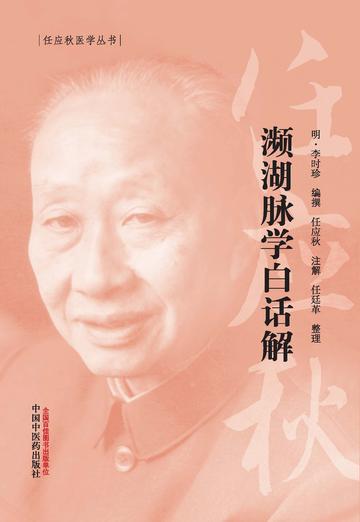
"Binghu Pulseology" was compiled by Li Shizhen in the Ming Dynasty. The essence of pulse theory from various schools is collected and summarized into 27 types of pulse conditions. The book not only briefly describes various pulse conditions, the identification of similar pulses, the relationship between pulse conditions and diseases, etc., But also adopts the style of verses (seven-character formulas) to facilitate recitation and memorization. It is a good book for learning pulse theory in traditional Chinese medicine and has always been highly praised by doctors.
However, because there are many ancient words and terms in the book, some contents are difficult to understand for modern readers, especially those who are new to Chinese medicine. To this end, Mr. Ren Yingqiu translated the book into Chinese based on the original book. In addition to clarifying the original meaning, he also added necessary explanations and annotations based on the author's experience and personal experience to facilitate reading. The original appendix at the back of the book is "The Essentials of Four Characters" written by Cui Jiayan of the Southern Song Dynasty, which was deleted and supplemented by Li Yanwen (Li Shizhen's father).
About the author: A famous contemporary Chinese medicine scientist and Chinese medicine educator. Born in Jiangjin County, Sichuan Province (now Jiangjin District, Chongqing City), he attended a private school at the age of 4. When he grew up, he entered the Jiangjin County Traditional Chinese Medicine Training Center to study Confucian classics. During this period, he studied under Liao Jiping, a master of Confucian classics. At that time, Liao Jiping was over seventy years old. He was very fond of his intelligence and eagerness to learn, so he gave careful guidance and taught him the methods of scholarship, which enabled Ren Yingqiu to lay a solid foundation in classics, exegesis, textual research, catalogue, etc., And laid a literary foundation for the future study of traditional Chinese medicine.
Reader comments
This book is very good! It is a good book for learning pulse theory in traditional Chinese medicine. It explains all ancient terms very clearly and is very friendly to beginners like me. I particularly like the pulse rhythm in it, which is easy to read and easy to remember. But I kind of hate those complicated and difficult-to-remember pulses, they feel so confusing! But overall, this book gave me a deeper understanding of TCM pulse theory, and I recommend it to you!
Nowadays, most people read Ruru as Ru, which is actually also called Ruruan. Ruru pulse and Ruruan pulse are two types of pulse conditions. The author of this book lists these, which is really profound.
I admire the author greatly!
It's easy to memorize, but it's a little different.
This book is very good! It is a good book for learning pulse theory in traditional Chinese medicine. It explains all ancient terms very clearly and is very friendly to beginners like me. I particularly like the pulse rhythm in it, which is easy to read and easy to remember. But I kind of hate those complicated and difficult-to-remember pulses, they feel so confusing! But overall, this book gave me a deeper understanding of TCM pulse theory, and I recommend it to you!
Nowadays, most people read Ruru as Ru, which is actually also called Ruruan. Ruru pulse and Ruruan pulse are two types of pulse conditions. The author of this book lists these, which is really profound.
I admire the author greatly!
It's easy to memorize, but it's a little different.