Stats
5.8Score
Synopsis
No synopsis yet.
We haven’t got an English blurb for this one. It appears once the source description has been translated.
We haven’t got an English blurb for this one. It appears once the source description has been translated.
The novel is darker and colder than the movie. The movie still made some tender adaptations. After reading the novel, I just felt that the truth of life is long loneliness.
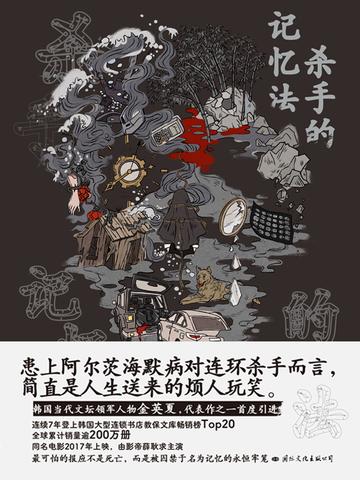
Because it was too uncomfortable to read the original version (I really haven't learned it yet) and it was very obscure, so I turned to the translated version, and the situation was somewhat relieved, but not much... The reader follows the protagonist's perspective, repeatedly experiencing his thoughts in his broken memory, and finally collides in the chaos with a devastating overturn. Who is he? Who did he kill? An adopted daughter, a nurse, a policeman, a young man with malicious intentions, a dog... It is terrifying to lose the memory of the future. In this weightlessness, you can't catch anything, you can only keep sinking, sinking, towards the end. It is too literary and has a strong Buddhist atmosphere. It may be more about exploring philosophical issues than the gimmicky version of the identity of the killer.
The early and middle stages give people a sense of letting go of their thoughts, and all kinds of plots in their minds can be piled on top. In the later stages, Officer An and Eun-hee are different, and they mistake her for her daughter, adding more neurosis. In the world of Alzheimer's disease, the serial killer weaves a story that can be enjoyed for himself, another serial killer who can be a target, and a daughter Eun-hee who does not exist but adds a lively voice to the lonely world.
The fragmented narrative corresponds to the fragmented memory and life of Alzheimer's disease. The ending of collapse is like powder floating away, and the cruelest person ends the cruelest life. An interesting novella in every aspect. Although the author is not the first to use fragmented narratives to present mental states, his anti-traditional narrative focus on shattering inheritance through "healing" is difficult to replicate. This is also a reasonable and clever use of the form of Alzheimer's disease. The language is short and powerful, and the translation is honest, with no signs of showing off skills or excessive effort. In the past, plain, simple and accurate translations of foreign books should be the basis. Now it can be used to boast about it, which is also a kind of unpopular thing. The starting point of the killer is like the "Diamond Sutra" and the ending is like the "Heart Sutra", which is a very interesting arrangement. Friends who have a little knowledge of Buddhist scriptures should understand the beauty of it, so I won't go into too much detail here. All in all, this book deserves a five stars. Another subjective opinion: Readers who treat this book as a suspense or reasoning and read it solely as a goal-oriented book will be disappointed. The book itself uses the ending to destroy the process, so in the ending, you actually can't find the exact answer at all.
The novel does not turn the story around to "this is all a delusion" at the end. But until the last drop of water floods the ocean of chaos that is on the verge of collapse We were only belatedly aware of the entire process of the rift.
I originally thought this book was the autobiography of a killer, but when I read it, it seemed like the words of a seventy-year-old suffering from Alzheimer's disease. The book reflects the "illness" of the protagonist Kim Byung-soo in the first paragraph. "I" is sick. I am a poet, I love my daughter very much, and I must kill the serial killer Park Joo-tae! I very much believe this. Later, when I watched it, my perception of "I" was overturned. Does this dog really exist? Did I kill my daughter? , She is not, you don't have a daughter. Where is Officer An? There is no such person. Reversal and reversal. "I" was very ill, and the protagonist seemed to have come to a parallel world and the identities of the characters around him were swapped repeatedly. Real and empty, sleeping in it.
It is quite a philosophical book. Generally speaking, in terms of suspense, the plot is left blank and the twists are a bit off. However, I quite like the character of the killer in the book. The Buddhism's rush of love and persistence, and the feeling of waiting for the heart to be empty are okay. I can feel the author's intentions and strong personal thoughts.
The most touching thing about the whole text is the protagonist's harsh words. He said that he did not feel any guilt, and faced Officer An, saying that he could not let the murderer go, and that he would not let him sleep well at night. In his heart, he slept well every night. In fact, he often suffers from nightmares, dreaming about his murdered father, and dreaming about the people buried in the bamboo forest greeting him with bright smiles. The dreams are psychological projections. He thinks about them day by day and dreams about them at night. I am afraid that he has been trapped in deep fear over the years. The woman he killed twenty-five years ago, and the promise he failed to keep, were regurgitated over and over again by him unknowingly in the days to come, and were eventually strengthened into shackles of fate. Alzheimer's made him more vulnerable, but it also allowed him to create a false illusion, a spiritual safe house where he could safely escape and avoid questioning from the dead. In the false illusion, he fulfilled his promise and took care of Eun-hee, and they lived a peaceful and peaceful life. But all this was ruined by another nasty serial killer. Subconsciously, he regarded the police as the murderer of Eun-xi, but in reality, it was the police who personally destroyed his ultimate illusion. He doesn't understand other people's crying and laughter, joy, anger and sadness, but at least he understands himself. The reason why he talks so hard and says that he doesn't feel guilty is because admitting that he is also in pain and fear is to pull himself down from the altar of arrogance and admit that he is no different from other people. Finally he admitted that he had lost, and the fear finally consumed him completely. Over the past thirty years, in the bamboo forest where the sunlight has been shining silently, those souls have actually been asking over and over again, are you also enduring pain? It makes me feel better to see you suffering too.
This book made me feel the coldness and loneliness of the killer, as well as his deep feelings for his adopted daughter Eun-hee. I can't help but think of my own feelings when I'm in love. Love is so powerful that it can make people desperate. The killer went to any lengths to protect Eun Hee. This kind of love moved me very much. This book not only has a tense plot, but also made me think more deeply about human nature and family.
"Then where will mom be now?" "I don't know, maybe it's somewhere very close to us?" For example, right in our yard. This paragraph is what shocked me. In the memory of the protagonist as he ages, the boundaries between good and evil disappear like this. It really cannot be viewed as pure reasoning. Many parts can only be viewed from a more philosophical perspective, but I think there are still some clues. Is the protagonist a veterinarian or a company employee? Is he the murderer of the three sons or the father of the three children? I am quite curious about this, and who is the police officer named An? There are many questions. Is the protagonist really the murderer? This is not to excuse him, but I just don't understand. The girl he pretended to adopt was actually his sister, right?
I thought it was a sporadic reflection of conscience before a murderer died. The result is a demon, a beast who lives his whole life and carries out the horror drama of life. Although he suffered from Alzheimer's disease, he wove an extremely dirty "song" for his obscene "last dance". Without watching the execution part, it was really hard to stay calm. But at least it was his own imagination, maybe because he was about to die, he made up the best reason for his sinful life.
I actually didn't understand this book very well, but the text was very readable and I finished it quickly. The protagonist's mind was confused, and I, who was reading the article, was also confused. The first person the protagonist kills is his father, in order to protect himself and his mother and sister; later, he kills people just for excitement and enjoyment, and it has become a "profession". He has enthusiasm, deep memory, and no guilt, just like a beast wearing human skin. This kind of memory is profound and is not affected by Alzheimer's disease. No, it was also affected. He also fantasized about living an ordinary life, so he had a "daughter", a child who had been killed long ago and had not grown up. At this time, his memory was confused. This "daughter" overlaps with the figures of two people, an orphan to whom he "keeps" his promise, a caring caregiver who takes care of him, and two victims who lost their lives at his hands. In fact, he probably never stopped killing people. He just pretended to be good and the state institutions were irresponsible and let him go. There are densely packed corpses in the yard and lush bamboo forests. The murderer's "professional ability" has always been there, skillful and precise. Even if I learn poetry, the words are still filled with the smell of blood. It has lost human emotions, yet endures imitation, and is filled with a sense of inhumanity. Is this the way you are born, or is it caused by the environment in which you were raised? The imaginary "daughter" is like an anchor, telling the reader that he is actually a good father, a poor man who has Alzheimer's and is about to be rejected. However, a scam is always a scam, and those who have tasted human blood will never go back. There is no good father, and there is no poor man, there is just an extremely vicious murderer who has killed countless people. A murderer who seems to be slowly losing his memory is finally caught, but may still escape punishment.
I can understand a little bit more with the last few explanations. I always wanted to cry while watching it. Maybe it was because I was too lonely. I don't know.
Overall pretty good
Half a mystery and a process
What I want to say contains some spoilers, so I'll just give it points.
I feel that the novel version is not as exciting as the movie version, but it is still interesting.
The plot has exciting twists and turns, and the writing is profound and thoughtful.