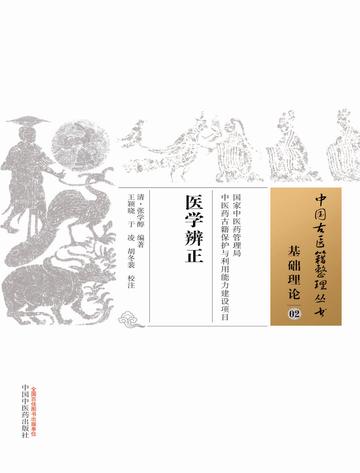
"Medicine Bianzheng" was written by Zhang Xuechun, a physician in the late Qing Dynasty. It was published in the Gengchen year of Guangxu in the Qing Dynasty (1880) and first published in the Xinsi year of Guangxu (1881). It is not divided into volumes and was edited by Xie Tinggepinsan of Kuaiji. The book was republished in the Bingshen year of Guangxu in the Qing Dynasty (1896), divided into four volumes, and edited by Zhang Keyuan, the son of Zhang Xuechun. The first volume is written by the author and is divided into twenty-eight medical treatises such as the theory of loss of vision, hearing, inquiry, and the theory of abnormal pulse diagnosis. The second volume is edited and annotated by the author. It mainly discusses the locations and main diseases of the twelve meridians, and lists the corresponding traditional Chinese medicines according to the different treatments of the twelve meridians. The third volume is compiled by the author, and discusses the various parts of the body, organs, orifices, main diseases of the five internal organs, and 29 chapters on various diseases such as stranguria and spermatorrhea. Volume 4 is compiled by the author and contains sixteen chapters on gynecology, malaria, cough, etc., As well as gynecology, pediatrics, carbuncle and other diseases. This book discusses diseases and treats mainly the deficiency and excess of yin and yang, and the prescriptions pay special attention to the difference between cold and heat. One hundred and sixty kinds of medicinal flavors were selected, divided into four qi and five flavors and listed after the twelve meridians. The prescriptions listed based on the experience of ancient people follow the purpose of the "Nei Jing" that "when wind is in the internal organs, treat it with pungent and cool, supplemented by bitter and sweet". All laws are listed under each disease.
About the author: Zhang Xuechun (biography unknown), courtesy name Xiaopu, was born in Shanyin (now Shaoxing, Zhejiang). Zhang Xuechun joined the army in his early years. After he was discharged and returned to the field, his mother was sick, so he studied mind medicine and devoted himself to the "Nei Jing".
Reader comments
This book "Medicine Correction" is very interesting. It corrects many of our misunderstandings about traditional Chinese medicine. I always thought Chinese medicine was mysterious before, but after reading this book, I have a clearer understanding of the theories and treatment methods of Chinese medicine. In particular, the book's discussion of the deficiency and excess of yin and yang reminded me of my own fatigue and exhaustion when delivering express delivery. It turns out that this can also be treated with traditional Chinese medicine methods. "The wind is inside, it is cured by pungent and cool, and supplemented by bitter and sweet." This sentence is really inspiring. I think this book is not only suitable for professionals to read, but also for those of us who are interested in traditional Chinese medicine.
This book "Medicine Correction" is very interesting. It corrects many of our misunderstandings about traditional Chinese medicine. I always thought Chinese medicine was mysterious before, but after reading this book, I have a clearer understanding of the theories and treatment methods of Chinese medicine. In particular, the book's discussion of the deficiency and excess of yin and yang reminded me of my own fatigue and exhaustion when delivering express delivery. It turns out that this can also be treated with traditional Chinese medicine methods. "The wind is inside, it is cured by pungent and cool, and supplemented by bitter and sweet." This sentence is really inspiring. I think this book is not only suitable for professionals to read, but also for those of us who are interested in traditional Chinese medicine.