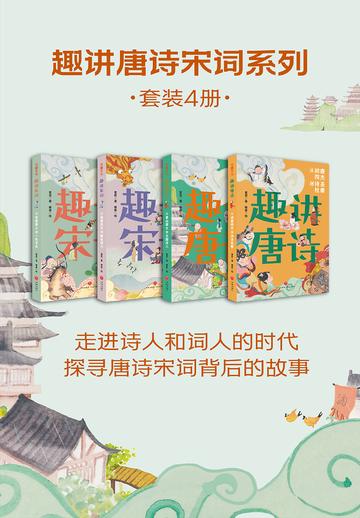
"Interesting Talks about Tang Poems and Song Ci Series" is a set of ancient poetry readings written for primary and middle school students by Mr. This series has a total of 4 volumes. It uses time as a clue to connect more than 70 representative poets and lyricists from the early Tang Dynasty to the Southern Song Dynasty. By telling the stories of poets and poets, it takes readers into the era of Tang poetry and Song poetry and understands the creative background of poetry, so that they can better understand and remember Tang poetry and Song poetry, and learn a lot of historical knowledge.
This series is rich in content, taking into account both fun and functionality. Each chapter is led by an interesting question, which can attract readers' interest in reading; the book also has additional content such as "Poetry Mini-Geography" and "Chinese Poetry Chinese Festival", which summarizes poems related to famous ancient cities in history and poems related to traditional Chinese festivals; and the book is equipped with a large number of cute and national-style hand-painted color illustrations, making it easier for readers to read.
"Interesting Talk about Tang Poetry: From the Four Masters of the Early Tang Dynasty to the Poet Saint Du Fu" introduces the representative poets from the early Tang Dynasty to the prosperous Tang Dynasty, including the Four Masters of the Early Tang Dynasty, the Poet Immortal Li Bai, the Poet Saint Du Fu, etc., And their representative poems, allowing readers to understand "who Not convinced that Wang Bo ranks first among the Four Heroes of the Early Tang Dynasty? "Why is Du Fu said to be a loyal fan of Li Bai?" And other interesting historical knowledge, and he learned nearly a hundred ancient poems such as "Giving Du Shaofu to Shuzhou", "Liangzhou Ci" and "Giving Wang Lun".
The volume "Interesting Talk about Tang Poetry: From Xiangshan Lay Scholars to Untitled Poets" introduces representative poets from the Middle Tang Dynasty to the Late Tang Dynasty, including Han Yu, Bai Juyi, Li Shangyin, etc., As well as their representative poems. It allows readers to understand interesting historical knowledge such as "Who ever joked about Bai Juyi's name?"
The volume "Interesting Talk about Song Ci: From the Empress of the Southern Tang Dynasty to the Drunkard Poem Writer" introduces the representative poets from the Tang Dynasty to the early Northern Song Dynasty, including Wen Tingyun, Li Yu, Liu Yong, Ouyang Xiu, etc., As well as their poetry works, allowing readers to understand "who writes lyrics and complains after failing the list" Annoyed the Emperor?" "Who was the prodigy prime minister of the Northern Song Dynasty?" And other interesting historical knowledge, and learned nearly a hundred ancient poems such as "Poppy Poppies (When Are the Spring Flowers and Autumn Moon)", "Crane Soaring to the Sky (On the Gold List)", "Huanxisha (A New Song and a Cup of Wine)".
The volume "Interesting Talk about Song Ci: From Lay Scholar Dongpo to a Generation of Talented Women" introduces representative poets from the mid-Northern Song Dynasty to the Southern Song Dynasty, including Su Dongpo, Li Qingzhao, Xin Qiji, Lu You, etc., And their poetry works, allowing readers to understand "why Su Shi was a super joker in the Song Dynasty? "Who is ugly but has a cute nickname?" And other interesting historical knowledge, and learned nearly a hundred ancient poems such as "Shui Diao Ge Tou (When Will the Bright Moon Come)" and "Ru Meng Ling (Last Night Rain and Wind Streaked)".
Reader comments
Poems, songs and rhymes are the treasures of culture and civilization of our Chinese nation. It is also my favorite to read. I have bought books such as Li Taibai and Du Gongbu Collection and Tang Poems, Song Ci and Yuan Qu. Even when I read Water Margin, I read more of Shi Naian's poems. Poems in books such as A Dream of Red Mansions are underlined. When reading martial arts novels, why do I like Liang Yusheng's the most? I just like to read the poems in it. I will never forget the poem written on the stone tablet by Li Jing, the Condor Heroes, taking Yang Guo up Mount Zhongnan, and the poem carved on the stone tablet by Taoist Qiu! I really hope to be like Taoist Qiu in his heart: to be able to escape the chaos of the Great Thousand and avoid the Creator Spirit!
Reciting poetry means loving the rhythm, interpreting poetry means lamenting the encounter. When I was young, I gambled on poetry and discussed winning or losing, but I didn't get confused by reading poetry and enjoying life.
The poet's anecdotes are very clear, great book.
A good book worth reading again.
The language is simple and easy to understand
I heard I don't want to rest anymore [laughing]
Increased knowledge, I like it very much
It is correct to add pinyin to rare words, why not Chinese pinyin! WIf you don't think about it, you can't fight without leaving XXX
I got to know many poets from the book and learned many of their stories. I learned some things I didn't know and gained a lot of insights. It's worth recommending!
This book uses simple and profound fluent narratives to explain the background stories of many famous Tang poems and Song lyrics. It is of great benefit to the majority of primary and secondary school students in learning, understanding and loving poetry!
Compared with boring recitation alone, this book is indeed much more interesting and worth reading.
Read it once, you will feel the feelings again and again, it is really worth reading
Poems, songs and rhymes are the treasures of culture and civilization of our Chinese nation. It is also my favorite to read. I have bought books such as Li Taibai and Du Gongbu Collection and Tang Poems, Song Ci and Yuan Qu. Even when I read Water Margin, I read more of Shi Naian's poems. Poems in books such as A Dream of Red Mansions are underlined. When reading martial arts novels, why do I like Liang Yusheng's the most? I just like to read the poems in it. I will never forget the poem written on the stone tablet by Li Jing, the Condor Heroes, taking Yang Guo up Mount Zhongnan, and the poem carved on the stone tablet by Taoist Qiu! I really hope to be like Taoist Qiu in his heart: to be able to escape the chaos of the Great Thousand and avoid the Creator Spirit!
Reciting poetry means loving the rhythm, interpreting poetry means lamenting the encounter. When I was young, I gambled on poetry and discussed winning or losing, but I didn't get confused by reading poetry and enjoying life.
The poet's anecdotes are very clear, great book.
A good book worth reading again.
The language is simple and easy to understand
I heard I don't want to rest anymore [laughing]
Increased knowledge, I like it very much
It is correct to add pinyin to rare words, why not Chinese pinyin! WIf you don't think about it, you can't fight without leaving XXX
I got to know many poets from the book and learned many of their stories. I learned some things I didn't know and gained a lot of insights. It's worth recommending!
This book uses simple and profound fluent narratives to explain the background stories of many famous Tang poems and Song lyrics. It is of great benefit to the majority of primary and secondary school students in learning, understanding and loving poetry!
Compared with boring recitation alone, this book is indeed much more interesting and worth reading.
Read it once, you will feel the feelings again and again, it is really worth reading