"History of Chinese Literature"
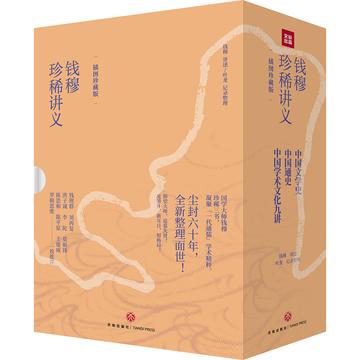
This book is the lecture notes of "History of Chinese Literature" taught by the master of Chinese studies Mr. Qian Mu from 1955 to 1956. It was compiled by Qian Mu's disciple Ye Long based on the lecture notes of that year. The book has a total of 31 chapters, which systematically and completely covers the book of songs from the Book of Songs to the chapter novels of the Ming and Qing Dynasties, focusing on the main context and basic characteristics of the development and evolution of Chinese literature.
As a master of Chinese studies, Mr. Qian Mu focuses on independent research. In this book, he has his own unique insights into the evolution of literature and literature at each stage. He uses historical papers to give a unique perspective on literature from a historical perspective. The whole book contains both high-level macro-discussions and scientific and rigorous historical research, as well as sharp comments on literati and wonderful appreciation of works, with a strong personal touch by Qian Mu.
"General History of China"
Mr. Qian Mu has taught "General History of China" three times: once at Peking University, secondly at Southwest Associated University, and thirdly at New Asia College in Hong Kong.
After teaching at Peking University for four years, many students came to listen, with nearly 300 people in each class. Everyone was sitting and standing, and the occasion was unprecedented. When he was teaching at Southwest Associated University, the lecture scene was so spectacular that Mr. Qian had no way to go to the podium and had to step on the students' desks to pass. After that, Mr. Qian Mu traveled to Hong Kong and resumed teaching the "General History of China" course. This book is based on the transcript of Mr. Qian Mu's third lecture at New Asia College in Hong Kong. It can be regarded as the "Classroom Edition of "Outline of National History"".
Lecture notes that have been dusty for many years, a more concise narrative. This book is compiled and published in a legendary way and is a rare and precious historical material.
At that time, a "National History Outline" drew the spiritual power of national rejuvenation and national transformation from the evolution of traditional culture, inspiring countless people to seek ways to resist the war and save the nation; now, with its dual responsibilities of historical pattern and cultural sentiment, this "General History of China" will give current readers new enlightenment and provide us with the possibility to look back on history, face the future, and reshape the personal knowledge pattern.
"Nine Lectures on Chinese Academic Culture"
This book collects nine speeches given by Qian Mu in Hong Kong, Taiwan and other places from the 1950s to the 1970s, covering various aspects such as thought, history, literature, culture, politics, and economy. It not only provides a macro overview of cultural history, but also includes cases of chronological research, as well as a display of case studies; it includes both ideological and cultural research and discussion of methodological significance - this is a small book that can provide a glimpse into Qian Mu's grand academic world.
If readers can understand Qian Mu's academic trajectory, clearly understand the vastness and subtlety of his intellectual system, and understand his consistent respect for Chinese culture, it will be helpful to guide current spiritual life and build confidence in national culture.
Reader comments
I finally found the simplified Chinese version of the National History Outline [Blow a kiss]
The collection of nine lectures is very good from beginning to end. It not only provides a macro overview of cultural history, but also includes cases of chronological research, as well as a display of case studies in academic history. Qian Lao emphasized that the study of national history should pursue objectivity and empirical evidence. He firmly believed that Chinese society, politics, and academics were always in a dynamic development process. He highlighted the core position of culture, attached great importance to Confucianism, and regarded the "scholar class" as the key to the inheritance of civilization. This is in stark contrast to the historical perspective that focuses on political and economic research. At the same time, we pay attention to the internal connections between various periods and avoid analyzing a single historical stage or event in isolation.
He advocated placing Chinese academic culture in the long history and believed that the academic culture of each era developed on the basis of inheritance from the previous generation and was affected by political and economic factors at that time, such as the rise of pre-Qin scholars and social unrest, and the relationship between the development of Confucian classics in the Han Dynasty and the pattern of unification. In addition, he emphasized that Chinese academic culture pays attention to practice and social function, and based on the Confucian concept of "cultivating oneself, harmonizing one's family, governing the country, and bringing peace to the world", he pointed out that scholars should promote social development and progress through academic research.

I finally found the simplified Chinese version of the National History Outline [Blow a kiss]
The collection of nine lectures is very good from beginning to end. It not only provides a macro overview of cultural history, but also includes cases of chronological research, as well as a display of case studies in academic history. Qian Lao emphasized that the study of national history should pursue objectivity and empirical evidence. He firmly believed that Chinese society, politics, and academics were always in a dynamic development process. He highlighted the core position of culture, attached great importance to Confucianism, and regarded the "scholar class" as the key to the inheritance of civilization. This is in stark contrast to the historical perspective that focuses on political and economic research. At the same time, we pay attention to the internal connections between various periods and avoid analyzing a single historical stage or event in isolation. He advocated placing Chinese academic culture in the long history and believed that the academic culture of each era developed on the basis of inheritance from the previous generation and was affected by political and economic factors at that time, such as the rise of pre-Qin scholars and social unrest, and the relationship between the development of Confucian classics in the Han Dynasty and the pattern of unification. In addition, he emphasized that Chinese academic culture pays attention to practice and social function, and based on the Confucian concept of "cultivating oneself, harmonizing one's family, governing the country, and bringing peace to the world", he pointed out that scholars should promote social development and progress through academic research.
The master of Chinese studies is well-deserved!