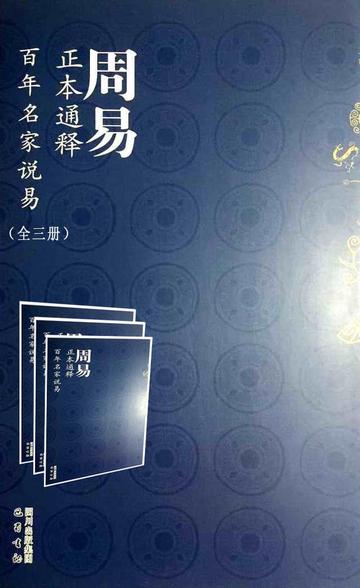
The "Comprehensive Interpretation of the Book of Changes" is the masterpiece of Comrade Chen Deshu who has studied "Yi" for many years. It can be said to be another clear proof that "the study of Yi is in Shu". Bashu Yi scholars have a tradition of paying attention to the xiangshu of the Zhouyi. The nine Yi pictures contained in the first volume of Zhu Xi's "Book of Changes" were actually collected by Cai Yuanding, a disciple of Zhu Xi, from Shu. In the Ming Dynasty, the most important work of the Shu Yi Dynasty was the Zhouyi Collected Commentary, which was written by Shu people to learn virtue. Its basic feature is that "the principles and principles are contained in Xiangshu". Wang Chuanshan, a famous Yi scholar during the Ming and Qing Dynasties, further elaborated on the relationship between meaning and image number. One said: "The number of images in "Yi" is the dharma image of heaven and earth"; the other said: "It is enough to believe firmly in the number of images of Wen (King) Zhou (Gong) and the way of the world"; the third said: "If there is no elephant, there is no Tu, if there is no Yao, if there is no word between non- and Yao, then the elephant, Tu, Yao, Ci, Zhan are all inseparable from the image painted." The Complete Book of Changes The body is in the image, and it is clear." Wang Chuanshan's famous conclusion is: "Words are used to express images, and images are used to create words. The two complement each other, and the meaning of the "Yi" is fully realized by the sage.