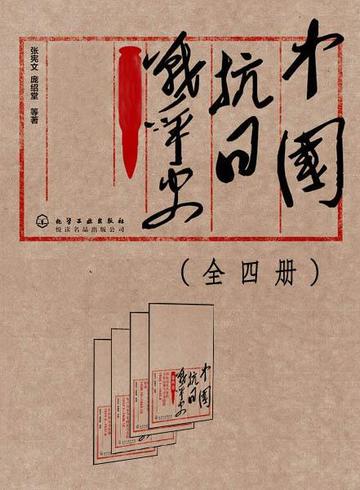
The four-volume "History of China's Anti-Japanese War" was led by Professor Zhang Xianwen, a famous and authoritative scholar on the history of the Anti-Japanese War, and was compiled by the Center for the History of the Republic of China. It contains millions of words and fully describes the history of the 14-year Anti-Japanese War from 1931 to 1945. It weaves a picture of the bloody war of the Chinese people and is a comprehensive, systematic, objective and scientific masterpiece on the history of the Anti-Japanese War. The first volume of "History of the Chinese Anti-Japanese War" spans September 1931 to June 1937. On September 18, 1931, the Japanese army conspired to plan and implement the September 18th Incident, and then launched a war of aggression against China. This volume mainly covers the fall of Northeast China, the Songhu War of Resistance, the establishment of the puppet Manchukuo, the Great Wall War of Resistance, the North China Incident, the Xi'an Incident, etc. It tells the story of Japan's continued invasion of China and China's local war of resistance. The second volume covers the period from July 1937 to October 1938. Beginning with the Marco Polo Bridge Incident, Japan kicked off its all-out war of aggression against China. At the same time, China also entered a period of all-out war of resistance. The content of this volume mainly covers the fall of Pingjin, the Battle of Songhu, the Great Victory of Pingxingguan, the Battle of Nanjing, the Battle of Xuzhou, the Battle of Zhongzhou, the Battle of Wuhan, etc. The all-out war of resistance continued to deepen and reach its climax. The third volume covers the period from October 1938 to December 1943. After the Wuhan Battle, China's War of Resistance Against Japanese Aggression shifted from the strategic defense stage to the strategic stalemate stage. The Nationalist Government took the opportunity to launch the largest counteroffensive on the frontal battlefield - the Winter Offensive; and the anti-Japanese guerrilla operations behind enemy lines led by the Communist Party of China also rose from the auxiliary status in the strategic defense stage to the main status. In addition, this volume focuses on the frontal battlefields before and after the outbreak of the Pacific War, covering the second and third battles of Changsha, Zaoyi, Changde, the U. S. Air Force's operations in China, and the Chinese Expeditionary Force's entry into Myanmar, etc. The fourth volume spans January 1944 to August 1945. As the Japanese army was retreating steadily on the Pacific battlefield, it launched an unprecedented major offensive in mainland China - "Operation No. 1." The defense of Luoyang, the defense of Changsha, the fierce battle at Hengyang, the counterattack in northern Burma and western Yunnan... The development of the war situation in 1944 had a vital impact on both China and Japan. From the spring of 1944 to the summer of 1945, a massive local counterattack was also launched on the battlefield behind enemy lines, inflicting a heavy blow to the enemy. At the same time, changes in the international situation accelerated the end of Japanese fascism.
Verifiable history