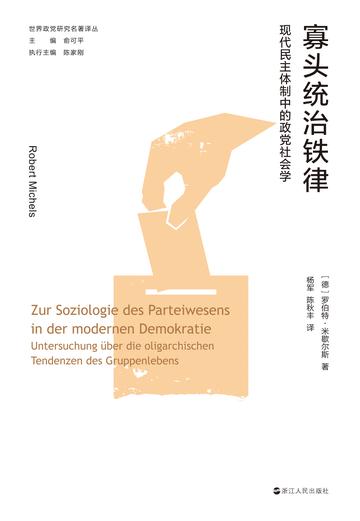
The Iron Law of Oligarchy: the Sociology of Political Parties in Modern Democracies
寡头统治铁律:现代民主体制中的政党社会学
- Status
- Completed
- Length
- 273k Words
- Updated
- 2y ago
- Source
- Fanqie
Stats
102Reads
9.2Score
10Chapters
8Listens
6.3kReads · all time
寡头统治铁律:现代民主体制中的政党社会学









Not bad. Michels's argument structure is very comfortable, but it has the obvious arrogance of the intellectual elite. Quoting from this book: "The masses need to be led. Without the guidance of authority from the outside and above them, they have no ability to act, and this is undoubtedly a heavy burden for leaders." The typical tragic narrative of the ruling class transforms structural weakness into the congenital defects of the group. Its observations are limited by the times and overly contemptuous of the initiative of the masses. For others, although the underlying framework of its analysis (organizations produce specialization, and specialization produces power inequality) is still valid, its analytical model is also limited by the times. Its model is static and teleological. To quote from this book: "The inherent weakness of the masses is clearly reflected in some facts: 1. Once a leader is lost in the struggle, the masses will scatter. They seem to be born without the ability to reorganize after being disturbed like an ant colony. Unless a new leader emerges, the masses will always be in disarray." He projected the power structure of the organization's maturity back to the entire process of organizational formation. What he observed was the professionalized party machine, and then he inferred that "the masses have always been like this", belittling the self-organizing ability of the masses.
A relatively objective analysis of the internal mechanisms and dynamics of political parties. 1. This book focuses on the German Social Democratic Party. 2. Is the causal relationship between political parties and bureaucracy correct? Bureaucracy is a methodological necessity. On this basis, it is the means for political parties to consolidate their rule. That is, whether oligarchs are consolidating their rule or not, bureaucracy will inevitably appear. 3. History is driven by the majority of people, that is, there seems to be no doubt that the people are the creators of history. But the historical initiative seems to be in the hands of a few people, that is, the final result of the power struggle of a few oligarchs is often the victory of the party that is in the interests of the people. In some cases, regardless of whether the winner's purpose is to serve the people wholeheartedly.
Very good, the most worth buying book📚