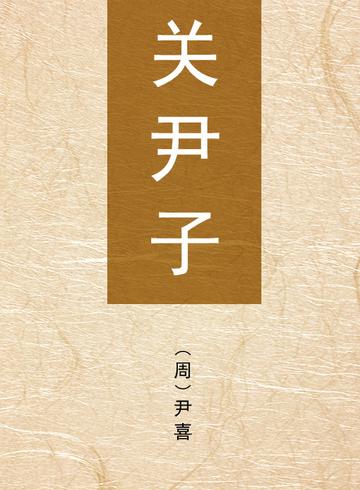
Guan Yinzi, one of the ten great figures in the world in the pre-Qin Dynasty, was a doctor, general, philosopher, and educator in the Zhou Dynasty. He was an important Taoist school among hundreds of pre-Qin scholars, the founder of the Louguan School and the Wenshi School of Taoism. His courtesy name is Gongdu and his given name is happy. He was once a Guan Ling at the same time as Lao Tzu. Laozi's "Tao Te Ching" of five thousand words was written at his request. Liu Xiang said: "Xi wrote nine chapters of Fan, named Guan Yinzi." "Hanshu·Yiwenzhi" records nine chapters of "Guan Yinzi", which were written by Zhou Yinxi under the old title. It is also known as Wenshi Zhenjing in later generations. This book should be written after Laozi's "Tao Te Ching", and Taoism is also similar. Therefore, "Zhuangzi Tianxia" narrates the ancient Taoism with Laozi and Guan Yinzi. The basic principle is to value God, be indifferent and do nothing, be quiet and self-sufficient, be alone in nothingness, and respond to things. Guan Yinzi's Guiqing thoughts had an important influence on the formation of the concept of Chinese Qing.
Reader comments
The book "Guan Yinzi" is very inspiring! It emphasizes the universality and transcendence of Tao and reminds me that various things in life have their own meaning and value. We should look beyond superficial differences to understand the essence of things. As the book says, "There is no Tao, and the sage does not see that A is the Tao and B is not the Tao." We cannot easily label things or draw boundaries. This book also encourages us to pursue inner freedom and tranquility, just like "the heart is graceful and uninhibited." It reminds us not to be swayed by external interference and to maintain inner clarity. Overall, this is a good thought-provoking book!
The book "Guan Yinzi" is very inspiring! It emphasizes the universality and transcendence of Tao and reminds me that various things in life have their own meaning and value. We should look beyond superficial differences to understand the essence of things. As the book says, "There is no Tao, and the sage does not see that A is the Tao and B is not the Tao." We cannot easily label things or draw boundaries. This book also encourages us to pursue inner freedom and tranquility, just like "the heart is graceful and uninhibited." It reminds us not to be swayed by external interference and to maintain inner clarity. Overall, this is a good thought-provoking book!