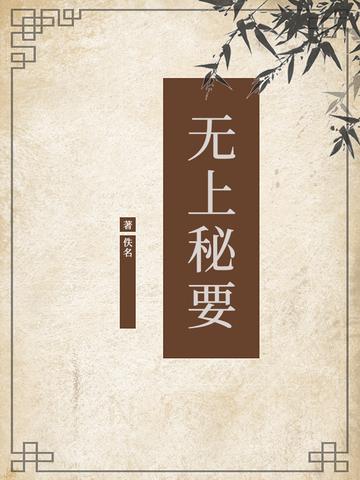
"The Supreme Secret Essentials" is the earliest known Taoist book. It was compiled by Yuwen Yong, Emperor Wu of the Northern Zhou Dynasty. According to records, Yu Wenyong summoned Taoist priests, famous monks, and civil and military officials seven times to determine the pros and cons of Confucianism, Buddhism, and Taoism. He tried hard to put Taoism above Confucianism and Buddhism, but failed because of the opposition of ministers and monks. It was later decided that Confucianism should come first, Taoism should come second, and Buddhism should come last. However, Buddhists still held objections, and the debate between monks and Taoists was unprecedentedly fierce. In the third year of Jiande (AD 574), Buddhism and Taoism were abolished, and monks and Taoists were ordered to return to secular life. Because of his belief in Taoism, he issued an edict to establish the Taoist Temple and set up bachelors. He selected 120 famous Taoists and monks to study "Laozi", "Zhuangzi" and "Book of Changes" at the Taoist Temple. He also ordered the Taoist priest Wang Yan to sort out the sutra pictures of the three caves and write the "Zhu Nang Sutra Catalog". According to the "Continued Biography of Eminent Monks: Biography of Shi Yancong", after the Qi Dynasty was overthrown in the sixth year of Jiande, Zi Wenyong, with the help of Daoguan Taoist priests, "reproduced a Taoist book titled "Supreme Secret Essentials"".
"Supreme Secret Essentials" is a masterpiece among many Taoist books in the Wei, Jin, Southern and Northern Dynasties and has high documentary value. It is an indispensable reference for studying Taoism and Taoist scriptures in the Wei, Jin, Southern and Northern Dynasties, and an important basis for collating early Taoist books.
"Supreme Secrets" does have its shortcomings. For example, the selection of some classics is not typical and incomplete, and the selection may not be very appropriate. However, it closely adheres to the order of Taoist practice and cultivation, and its vast number of items shows that the editor is trying to cover all the essence of Taoism. The classics it selects are mainly early Taoist classics, with few Buddhist elements. This not only reflects the important role of early Taoist scriptures in the practice of Taoism, but also shows that the author is trying to reflect the traditional teachings of Taoist scriptures. A careful study of "The Supreme Secret" will prevent our understanding of Taoism in the Six Dynasties from overgeneralizing misunderstandings due to the excitement of the academic community at a certain period. The current version of "The Supreme Secret" is not complete, only two-thirds of the original content remains. The book begins with "Da Dao Pin" and ends with "Dong Ming Ji Pin" (written as "Gui Jing Ji Pin"). It picks up the essence of the three caves and four supplements and compiles them into categories. Its content covers Taoist cosmology, outlook on life and death, ethical and political opinions, belief in gods, thoughts, rules and methods of cultivating Taoism and becoming immortals, etc. It can be roughly divided into the following parts:
The first part includes Tao, Qi, people in heaven and earth, calamity, emperors, states, virtues, cautious soldiers, following things to lose true, good and evil, all difficulties, all kinds of troubles, the intersection of Yin and Yang, elucidating that "the ultimate Tao is invisible, mixed into a body", "changes from nothing to existence, all based on Qi"; "the division of Qi, birth of heaven and earth", "the transfer of all categories" , the cycle is endless"; "The fortunes of disasters are intertwined, and the territory is prosperous"; "Only a king can build a country, dominate the world, and establish a good government, and he must be careful with his troops"; "Human nature has its own limitations, and if you violate the broad requirements, you will be perverse and hurt your nature", as well as thoughts such as good and evil, good and bad luck, etc., Explain the popularity of the Tao and the basis for the establishment of the religion.
The second part describes the belief in immortals, including the rewards and punishments of the three realms such as Tiancao Kedi, Disi Examination, Water Official Information Slips, the promotion and demotion of spiritual officials, the meeting of all saints, life and death, hell, holy responses and light, the movement of true spirits, the original traces of immortals, the crowns and robes of saints, and the governance of Gele Palace.
The third part describes the pictures and texts of Taoist scriptures, including the true text of the Three Treasures, the auspicious heaven and earth, the talisman and seal chant, the source of the scriptures, the different names of the scriptures, the virtues of the scriptures, the preservation and deletion of the scriptures, the points of encountering the scriptures, the teachings and the order of the transmission of the scriptures, etc.