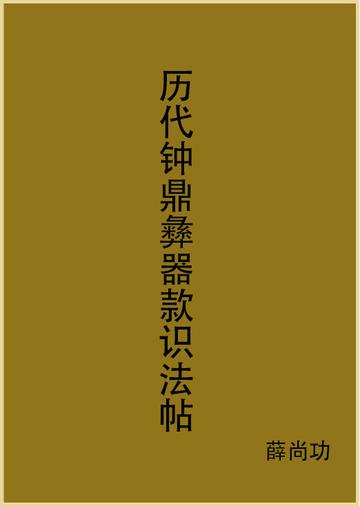
Ancient epigraphy works. Written by Xue Shanggong. It is designed to identify calligraphy, so it is called "Fa Tie". Later generations paid more attention to it because it was the richest collection of rubbings containing bronze inscriptions in the Song Dynasty. The stone carving of this book was completed in the 14th year of Shaoxing in the Southern Song Dynasty (1144). The remaining leaves of the stone carving are now in the Shanghai Museum, the Institute of History and Philology of Academia Sinica in Taiwan, and the Institute of Archeology of the Chinese Academy of Social Sciences. Among the wooden versions, the best one was made by Zhu Mouzong in 1633, the sixth year of Chongzhen reign in the Ming Dynasty. In 1983, Zhonghua Book Company re-photocopied the 1935 photocopy of Shengwu, which has been circulated throughout the world. The book has 20 volumes in total. It records 510 pieces of Yi artifacts from past dynasties, and their texts are copied and explained. Those with inscriptions on the bronzes produced in the Song Dynasty earned seventy-eight percent. Today, only the remaining leaves of Song Tuo paintings remain. The woodcut version is better than the one published by Zhu Mou in the sixth year of Chongzhen in the Ming Dynasty.
Reader comments
Just like the textual research on seal script in the book, it gave me a deeper understanding of ancient culture. Moreover, the author Xue Shanggong is really knowledgeable. I admire him very much for his ability to combine the strengths of various schools of thought and correct errors in the publication. I think this book is a good book worth reading for people who like ancient culture.

Just like the textual research on seal script in the book, it gave me a deeper understanding of ancient culture. Moreover, the author Xue Shanggong is really knowledgeable. I admire him very much for his ability to combine the strengths of various schools of thought and correct errors in the publication. I think this book is a good book worth reading for people who like ancient culture.