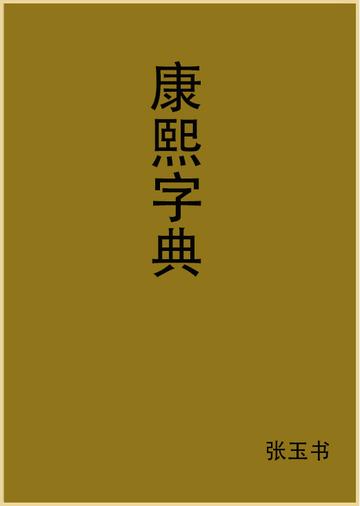
During the Kangxi period of the Qing Dynasty, Zhang Yushu and others were ordered to compile it. Forty-four volumes. The collected characters are 47,355, and an additional 1,995 ancient characters are attached. It is divided into twelve episodes according to the heavenly stems, and each episode is divided into three volumes: upper, middle and lower volumes. Arranged according to 240 radicals, those with the same radical are in order of strokes. Characters in ancient styles are listed under the main text, while Chongwen, other styles, vulgar characters, and wrong styles are appended after the explanation. Each character is first listed in the important rhyme books of the past dynasties, Fanqie, and the direct pronunciation is added. Then paraphrase. First the original meaning and then the extended meaning. If there are different sounds and different meanings, they are also listed. Add citation. The editor adds the word "press" to distinguish it. At the end, there is an "Addition" volume, which collects rare characters; and a "Preparation" volume, which collects characters whose pronunciation has no meaning or whose pronunciation and meaning are not correct. It contains many words and abundant citations, and focuses on interpreting ancient meanings. Moreover, because it is an official document, it was widely circulated in the old days and had a greater influence. However, its system is complicated, its proofreading is not precise, and there are many errors and inaccuracies. The King of the Qing Dynasty quoted "Kangxi Dictionary Research" and pointed out more than 2,500 citation errors. There are many editions of this book, the most important ones include the edition printed in the early 55th year of Kangxi's reign, the Shanghai Hongbaozhai stone-printed edition with seal characters added to the header, the Commercial Press's 1933 copperplate edition with "Kangxi Dictionary Research" and "Four Corner Number Index" at the end, the World Book Company's 1936 edition with "Stroke Check Index", "Seal Script Map" and "Kangxi Dictionary Research", and the 1958 photocopy of Zhonghua Book Company.
Reader comments
I am a middle school student facing an exam. Because of the exam reform, I decided to read more books about writing to prepare for the exam. With a swipe of my finger, I added all the good books to the bookshelf. Unfortunately, after I opened the book with confidence, there were actually many words to look up in the dictionary on one page, which shattered my self-esteem. I was shattered, and at the same time I deeply felt that any culture that can make a nation proud is more than just the "broad and profound" spoken of. Although I feel frustrated, I also understand these truths. If you have the chance to read this paragraph of mine, I hope you can recommend some books suitable for me to read at this stage. I would be very grateful. At the same time, I was once again amazed by the culture of my ancestors [exploration][blowing kiss][blowing kiss]
This "Kangxi Dictionary" is like a treasure house of knowledge, which contains a large number of Chinese characters, as well as rich explanations and quotations. It reminds me of "Shuowen Jiezi", the kind of books that can give people a deep understanding of Chinese characters. However, the "Kangxi Dictionary" is more like an official dictionary, so it may be more widespread and influential. Although it also has some problems with complicated systems and poor verification, it is still very valuable in general. For those who like to study Chinese characters, this is definitely a book worth owning.
I am a middle school student facing an exam. Because of the exam reform, I decided to read more books about writing to prepare for the exam. With a swipe of my finger, I added all the good books to the bookshelf. Unfortunately, after I opened the book with confidence, there were actually many words to look up in the dictionary on one page, which shattered my self-esteem. I was shattered, and at the same time I deeply felt that any culture that can make a nation proud is more than just the "broad and profound" spoken of. Although I feel frustrated, I also understand these truths. If you have the chance to read this paragraph of mine, I hope you can recommend some books suitable for me to read at this stage. I would be very grateful. At the same time, I was once again amazed by the culture of my ancestors [exploration][blowing kiss][blowing kiss]
This "Kangxi Dictionary" is like a treasure house of knowledge, which contains a large number of Chinese characters, as well as rich explanations and quotations. It reminds me of "Shuowen Jiezi", the kind of books that can give people a deep understanding of Chinese characters. However, the "Kangxi Dictionary" is more like an official dictionary, so it may be more widespread and influential. Although it also has some problems with complicated systems and poor verification, it is still very valuable in general. For those who like to study Chinese characters, this is definitely a book worth owning.