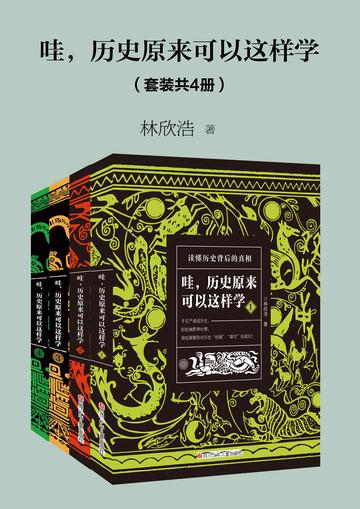
"Wow, this is how you can learn history 1"
Among the world's major ancient civilizations, only China's history is uninterrupted. In the vast land of the motherland, there are fascinating places of interest and unearthed cultural relics everywhere. Thousands of years of history have left us with a wealth of historical books and materials, covering all aspects of life. The content of this volume focuses on a detailed introduction to the historical changes in China from primitive society to the Wei, Jin, Southern and Northern Dynasties, and basically covers half of ancient Chinese history.
"Wow, this is how you can learn history 2"
The content of this volume is the second half of ancient history, focusing on the historical events from the Sui and Tang Dynasties to the establishment of the Qing Dynasty.
From the Sui Dynasty to the Qing Dynasty, you can find answers to all kinds of weird questions you want to know in this book.
"Wow, this is how you can learn history 3"
This book uses humorous language to describe the decades of history from the Opium War of the late Qing Dynasty to the Sino-Japanese Sino-Japanese War of 1894-1894. It details the transformation process of the Qing Dynasty from the "Celestial Kingdom" to the "Sick Man of East Asia" and provides an in-depth analysis of the underlying reasons behind the transformation.
"Wow, history can be learned like this 4"
This book begins with the Reform Movement of 1898 and continues to the outbreak of the Revolution of 1911. This is a history of the late Qing Dynasty when the Qing government awakened from its dream to save the nation but ultimately failed. The author uses humorous writing and easy-to-understand examples to explain to readers why the Qing Dynasty was destined to perish.
Reader comments
Moreover, the language in the book is very humorous, and the author's interpretation of history is easy to understand, which made me understand the ins and outs of many historical events at once. For example, the cave people on the top of the mountain are not our ancestors, the people in Beijing know how to use fire, etc. I think this book is not only suitable for children, but also for us adults to read. It can help us better understand the history of China.
Moreover, the language in the book is very humorous, and the author's interpretation of history is easy to understand, which made me understand the ins and outs of many historical events at once. For example, the cave people on the top of the mountain are not our ancestors, the people in Beijing know how to use fire, etc. I think this book is not only suitable for children, but also for us adults to read. It can help us better understand the history of China.