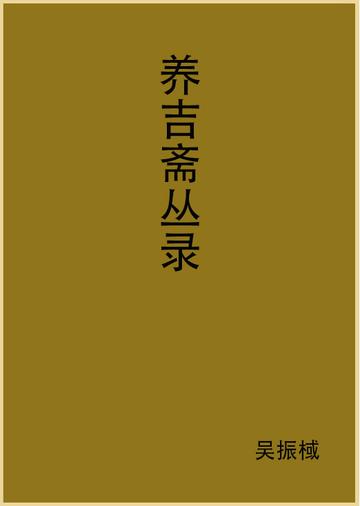
Compiled by Wu Zhenfeng of the Qing Dynasty. Wu Zhenfeng, courtesy name Yifu and nickname Zhongyun. A native of Qiantang, Zhejiang (now Hangzhou City). Jiaqing Jinshi. He was awarded the title of editor of the Hanlin Academy and served as governor of Yunnan. There are a total of 36 volumes of his books, including 26 volumes of Conglu and 10 volumes of remaining records, which record the rules and regulations of the court and administrative agencies of the Qing Dynasty before Tongzhi. This book is not divided into outlines, but is divided into categories. It lists the origins of the Eight Banners, the cabinet, the six Cao Cao, the provinces, the military preparations, the imperial examinations, and even the palaces, gardens, hunting tours, etc. In order, and records many valuable historical materials. For example, the data on the acres of private land enclosed in the early Qing Dynasty, the division of ministers between Manchu and Han Dynasties, the handling of official documents of the Lifan Yuan, and the records of officials appointed during the Yongzheng period did not follow the system. Some of them were not recorded in detail in the "Qing History Manuscript" or "Qing Huidian", while others were recorded with similarities and differences. Therefore, this book is an important book for in-depth examination of the Qing Dynasty's laws and regulations. It is Book 11 that records Injo (Jiaqing) The scale and process of the sixty-year-old birthday ceremony. Volume 12 records the names of the holy temples, the posthumous names of the saints, the posthumous names of the queens, and the posthumous names of concubines, princes, and beile. Volumes 13 and 14 record the opening ceremony held in the Yangxin Hall. The Ceremony of the Brush Pen, the emperor's Nine-knocking Ceremony to Welcome the Spring held in the Yanqing Hall on the first day of spring, the standing pole ceremony held in the Kunning Palace on the first day of February, the Buddha Bathing on April 8th, the Mid-Autumn Festival Moon Sacrifice, the Chonghua Palace Tea Banquet, Bingxi and other palace etiquette and games, Volume 15 records various banquets in the palace, Volume 16 records the emperor's tour, Volume 17 records the location and purpose of each palace, Volume 18 records Xiyuan Palace, etc. These are all direct materials of the palace and architecture of the Qing Dynasty. Together with the Qing palace spring couplets, tribute items list, champion thank you form, etc. Contained in the book, they can be used as a reference for studying the life and etiquette regulations of the Qing palace. This book is a careful collection of materials, and does not make comments or adopt the novelist's words. Occasionally some legends are used, and the attitude is also very cautious. However, the source of the quoted information is not indicated. There is only one printed version of this book during the Guangxu period of the Qing Dynasty. In 1983, Beijing Ancient Books Publishing House published a typed version based on this proofreading. There are currently only seventeen volumes.
Reader comments
This book is rich in content and records many regulations, systems and court life of the Qing Dynasty. It is an important material for studying Qing history. The author Wu Zhenfeng has rich experience and broad knowledge, and many of the examples recorded in the book are very valuable. Moreover, this book is rigorously compiled and has great reference value, but it is a pity that the source of the cited materials is not indicated.
This book is rich in content and records many regulations, systems and court life of the Qing Dynasty. It is an important material for studying Qing history. The author Wu Zhenfeng has rich experience and broad knowledge, and many of the examples recorded in the book are very valuable. Moreover, this book is rigorously compiled and has great reference value, but it is a pity that the source of the cited materials is not indicated.