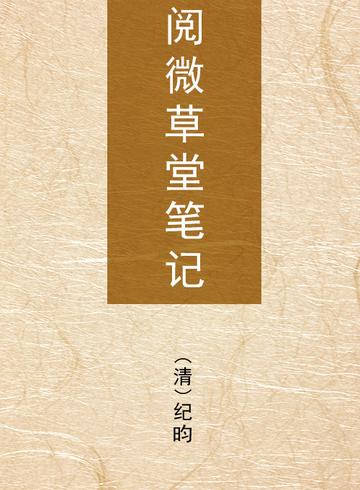
"Notes on Yuewei Thatched Cottage" is a collection of notes and novels written by Ji Yun, a famous scholar in the Qing Dynasty, during his exile in Urumqi. The book mainly records stories of foxes, ghosts and ghosts, with the purpose of admonishing good and punishing evil. Although there is no lack of preaching about karma, through various descriptions, it reflects the decay and darkness of the last days of feudal society. He deliberately imitated the simple and simple writing style of the Asian Song Dynasty's notebook novels, which are "graceful and elegant, full of natural interest", "meaningful and witty words, timely and timely to understand" (Lu Xun's "A Brief History of Chinese Novels"). Therefore, every time a manuscript was completed, it was passed on, copied, and printed by relatives and friends. For a time, it enjoyed a high reputation at home and abroad along with "A Dream of Red Mansions" and "Strange Stories from a Chinese Studio".
It is a pity that this legendary work suffered a major disaster due to some historical reasons, and the original manuscript was lost. Ji Yun relied on his own memory to rewrite it. Although it became "Yuewei Thatched Cottage Notes", there were a lot of omissions in the end. From today's perspective, this disaster can be regarded as one of the more tragic in the history of Chinese literature. Judging from the table of contents of "Yuewei Thatched Cottage Notes", it is divided into Luanyang Xiaxia Lu, I heard it like this, Huaixi Magazine, I just listened to it, and Luanyang continued to record several chapters. Whether the records in the book are true or false, it seems that they are only used to reflect the corruption, darkness and depravity of the officialdom at that time through these strange descriptions, and then oppose the Song Confucianism's empty talk about rationality and neglect of practical philosophy of rationality and Qi.
However, Ji Yun also expresses deep sympathy and compassion in his writing style for the miserable life of the vast number of people at the bottom of society. At the end of each story, the author always comes up with a few phrases to judge the story in a balanced tone, the ins and outs of the story, and whether it is reasonable or not. These comments are always thought-provoking. Lu Xun spoke highly of "Yuewei Thatched Cottage Notes" in "A Brief History of Chinese Novels": "Ji Yun's writing style is long, he is often seen as a secretary, and he has a broad mind. Therefore, he can detect the moods of ghosts and gods and reveal the subtleties of the human world. The fox ghost expresses his own opinions, and his witty words are timely to explain. His narration is graceful and elegant, and full of natural interest. Therefore, no one can take his place later, and it is certainly not just someone who has high reputation and passed on it. "
Reader comments
I especially like the stories about foxes, ghosts and monsters, each character is vividly drawn. Ji Yun's writing style is simple and elegant. He reflects the darkness of society through stories, and at the same time expresses sympathy for the lower class people. It truly deserves to be a classic as famous as "A Dream of Red Mansions" and "Strange Stories from a Chinese Studio"!
I especially like the stories about foxes, ghosts and monsters, each character is vividly drawn. Ji Yun's writing style is simple and elegant. He reflects the darkness of society through stories, and at the same time expresses sympathy for the lower class people. It truly deserves to be a classic as famous as "A Dream of Red Mansions" and "Strange Stories from a Chinese Studio"!