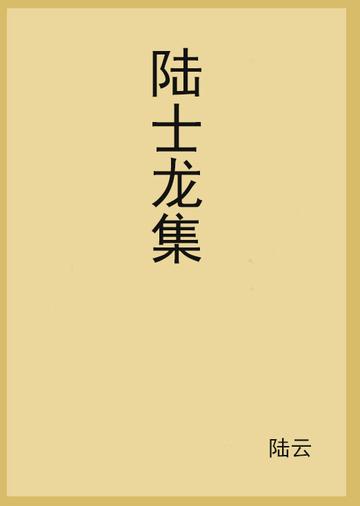
Ten volumes. Written by Jin Luyun (262-303). Lu Yun, courtesy name Shilong, was born in Huating, Wu County (now Shanghai). Lu Ji's younger brother. The young master is as famous as his brother Lu Ji, and his nickname is "Er Lu". Shi said that his articles were not as good as Lu Ji's, but his arguments exceeded them. After entering Luo, there was a rumor that "two pieces of land enter Luo, and the price of three pieces will be reduced". For the dredging ritual order. After he was removed from office, the common people used his image to distribute food to the county community. Later, Wang Yingbiao of Chengdu became the historian of Qinghe Nei, and became the general of Yousima. Lu Ji died and Lu Yun was also killed. Lu Yun's writing is gorgeous in terms of words and profound in purpose. He wrote 349 poems and essays, which were collected into twelve volumes. "Sui Shu·Jing Ji Zhi" also wrote ten "New Books", which are published in the world. Today's view focuses on all the enlightenments. Their speeches are admonishing, their opinions are insightful, and their sincerity is close to Yun Yizhi. As for his gorgeous words and profound and elegant purpose, he is on par with Lu Ji. Ping Wu Erjun, it is not easy to be good or bad. "Sui Shu·Jing Ji Zhi" records that Lu Yun collected twelve volumes, also known as Liang Shijuan, and recorded one volume. It was the original version handed down at that time, and has similarities and differences. "New Book of Tang·Yiwenzhi" only contains ten volumes, so the so-called twelve volumes are no longer seen. By the Southern Song Dynasty, the ten volumes were gradually lost. During the Qingyuan period, Xu Minzhan of Xin'an obtained it from the Secretariat, and published it together with Lu Jiji. However, no Song engravings have been seen today. This book has been handed down from generation to generation including "Collection of Famous Masters of the Han, Wei and Six Dynasties", "Collection of Famous Masters of the Han, Wei and Six Dynasties", "Collection of Famous Masters of the Han, Wei and Six Dynasties", and "Si Bu Yao".