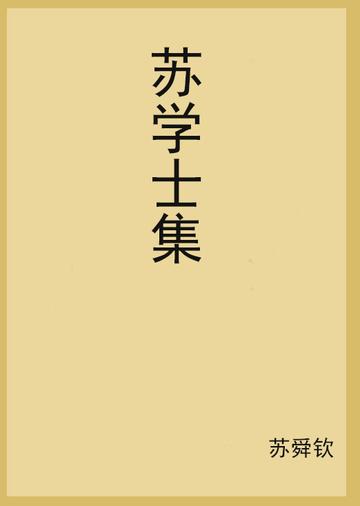
A collection of poems from the Song Dynasty. 16 Volumes. Written by Su Shunqin. According to Ouyang Xiu's "Preface": "Four years after Su Zimei's death, the manuscripts of Su Zimei's life articles were found in the home of Prince Du Gong and collected into fifteen volumes." Chen Zhensun's "Zhizhai Shulu Jieti" said that there were 15 volumes of "Canglang Collection". This book currently consists of 16 volumes. Volumes 1 to 5 contain 96 ancient poems, and volumes 6 to 8 contain 114 metrical poems. Volumes 9 and 10 contain 14 chapters, Volume 11 contains 9 epilogues, Volume 12 contains 12 chapters, Volume 13 contains 16 prefaces, Volumes 14 and 15 contain 14 epigraphs, and Volume 16 contains 5 deeds, laments, and memorials. Su Shunqin's poems are full of emotion and often use natural scenery to express the uprightness and injustice in his heart. The early poems have strong political commentary, such as "The Defeat of Qingzhou", "The Great Drought in Wu", etc. "History of the Song Dynasty·Biography of Su Shunqin" states that "I often write poems with anger and resentment, and their style is bold and often astonishing", such as "The mountains embrace the Huaihe River and twist and turn, and the clouds wandering the wild fields are clear and overcast" ("Shouyang Xianwang Feelings"); "The old pines are standing proudly, and the flying springs are as if they are avoiding people" ("Yunmen Temple in Yuezhou"). They use artistic images to express their own temperament and understanding of social reality. Some small poems are quiet and beautiful, and have always been praised by people, such as "Moving at Dutou in Huaizhong in the Evening": "The wild grass is green in the spring shade, and sometimes there are flowers and trees. I am moored in a lonely boat under the ancient temple at night, watching the wind and rain in the river." Su's prose is often sharp in words and heated in discussion. In the early period, most of them were political essays with a strong combat nature, while in the later period, there were more prose poems expressing feelings about landscapes, such as "The Story of Canglang Pavilion" and other famous prose works. There are editions published by Emperor Kangxi of the Qing Dynasty, editions of "Sibu Congkan", and editions of "Sikuquanshu". Shanghai Ancient Books Publishing House published Shen Wenzhuo's collated edition in 1981, titled "The Collection of Su Shunqin".
Reader comments
This "Collection of Su Xueshi" contains many poems by Su Shunqin. His poems are bold and uninhibited, and his prose is sharp. I especially like his "Huaizhong Evening Port Dutou", which reminds me of my own experience of taking my children out to play. Su's discussion of current affairs in the book resonated with me very much. I felt like he was an old friend of mine and we could discuss many topics together. However, I don't like his overly radical rhetoric in the book, maybe because I am more pursuing peace now. Overall, this is a book well worth reading.
This "Collection of Su Xueshi" contains many poems by Su Shunqin. His poems are bold and uninhibited, and his prose is sharp. I especially like his "Huaizhong Evening Port Dutou", which reminds me of my own experience of taking my children out to play. Su's discussion of current affairs in the book resonated with me very much. I felt like he was an old friend of mine and we could discuss many topics together. However, I don't like his overly radical rhetoric in the book, maybe because I am more pursuing peace now. Overall, this is a book well worth reading.