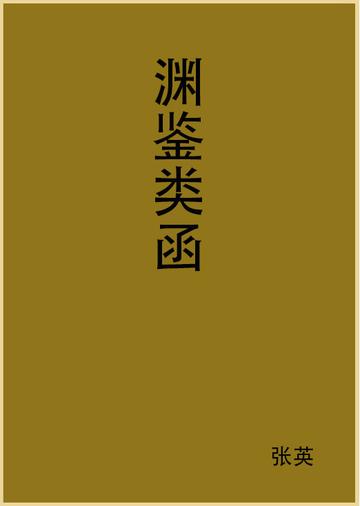
This book was written by the emperor of the Qing Dynasty and edited by Zhang Ying, Wang Shizhen and others. There are 450 volumes, 45 volumes, and more than 2,500 subcategories. It expanded the "Tang Lei Han" written by Yu An of the Ming Dynasty, extensively collected books such as "Taiping Yulan", "Yuhai", "Shantang Kaosuo", "Tianzhong Ji" and other books, and widely collected articles and deeds from the Song, Yuan and Ming dynasties. The order of the 45 parts is: heaven, age, earth, emperor, concubine, palace, emperor's relative, official appointment, title, politics, etiquette, music, literature, martial arts, frontier, people, Buddhism, Taoism, supernatural powers, alchemy, and skill. Arts, capitals, prefectures and counties, residences, industries, fire, treasures, cloths, ritual ornaments, clothing, utensils, boats, carts, food, royal grains, medicines, vegetables, fruits, flowers, grass, wood, birds, beasts, scales, and insects. Each part is divided into several sub-categories, and each sub-category describes five categories of content: name, general introduction, evolution, origin; allusions; parallels; excerpts; poems. If the subheading does not contain these five items, it will be left blank. Each type of content is divided into two parts: "original" and "added", which respectively represent the Tang Dynasty books compiled by "Tang Leihan" and the additions made by the Qing people when they compiled this book. "Yuanjian Leihan" integrates the functions of collection, division, classification and tailoring. "It contains twice as much content as "Yu Lan". ... Together with "Pei Wen Yun Fu" and "Pianzi Lei Bian", they are all unprecedented masterpieces and are not inferior to the three or four great books of the Song Dynasty" ("Summary of the General Catalog of Sikuquanshu"). However, because the book was written by many hands, there are also many errors and omissions in citations. "Yuanjian Leihan" was written in the 49th year of Kangxi's reign (1710). It has a version published by the Imperial Government, a lithographic version published by Shanghai Tongwen Bureau in 1887, and a photocopied Tongwen Bureau version published by Beijing China Bookstore in 1985.
Reader comments
I especially like the historical stories and literary classics in it, and I gain new insights every time I read it. Moreover, the compilation of this book is very careful and clear, making it easy to understand at a glance. All in all, I think this is a book worth reading and I recommend it to everyone!
I especially like the historical stories and literary classics in it, and I gain new insights every time I read it. Moreover, the compilation of this book is very careful and clear, making it easy to understand at a glance. All in all, I think this is a book worth reading and I recommend it to everyone!