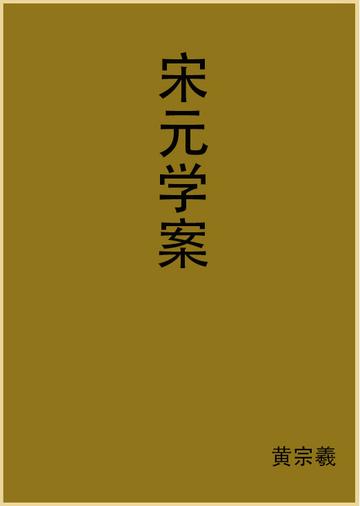
"Song and Yuan Academic Cases", a total of 100 volumes, was first compiled by Huang Zongxi in the late Ming and early Qing dynasties. In the fifteenth year of Kangxi (1676), Huang Zongxi completed the "Confucianism Cases of the Ming Dynasty" and subsequently revised the book. It only became 17 volumes with a preface. His son Huang Baijia continued it and wrote another 8 volumes. Later, in the 10th year of Qianlong's reign, his disciples Quan Zuwang, Yang Kaiyuan, Gu Juan and others completed it. In the second to twentieth year (1747-1755), Quan Zuwang completed it one year before his death and died without printing. Later, the manuscript was kept by Lu Hao (Yue Chuan), a disciple of the Lu family's Baojing Hall in Yin County, and the remaining copies were returned to the Chiang family. Sun Huang Zheng, the sixth generation of Zongxi, and Huang Zhige, the seventh generation of Zongxi, added it to 86 volumes. During the Daoguang period, it was transferred to the Zhejiang academic and political Chen Shaozong. In the 18th year of Daoguang's reign (1838), Wang Zicai and Feng Yunhao were entrusted by the inspector He Linghan to sort out the corruption and complete the 100-volume "Supplement to the Academic Cases of Song and Yuan Dynasties", with a total of about 700 to 800 supplements. The preface to Wang Zicai's "Supplement to the Song and Yuan Academic Cases" reads: "I and Wuqiao extensively edited the legacy of the Song and Yuan Dynasty Academic Cases, and found two volumes in every forty years... Wuqiao believed in learning, and his family had a Zui Jing Pavilion. Each of the four collections of classics and history belonged to his group. There were hundreds of Confucian anthologies of the Song and Yuan Dynasties. They used it to compile the "Xue An" in detail, without needing to borrow it. This is the compilation of the "Supplement", and it is also the result of the pavilion." After the completion of the draft, it was stored in Tu Yongxi's home. "Song and Yuan Dynasty Academic Cases" is divided into 87 academic cases and 2 academic strategies ("Jing Gong's New Academic Strategy", "Su Shi Shu Xuexue"), and 2 party cases ("Yuanyou Party Case", "Qingyuan Party Case"). The book starts with the Anding and Taishan academic cases, and ends with the academic cases of Xiao Tong in Volume 95. More than 2,000 scholars of the Song and Yuan Dynasties are recorded in total. Among them, the "Sushui Study Case" headed by Sima Guang, Shao Yong's "Baiyuan Study Case", Zhou Dunyi's "Lianxi Study Case", Cheng Hao's "Mingdao Study Case", Cheng Yi's "Yichuan Study Case", Zhang Zai's "Hengqu Study Case", Zhu Xi's "Huiweng Study Case", Ye Shi's "Shuixin Study Case", etc. Are all described in detail in two volumes. It was published in Zhejiang in the 18th year of Daoguang's reign (1838), but was destroyed by the Opium War. In the fifth year of Guangxu (1879), Zhang Rulin once again took the lead and reprinted it in Changsha to form the 100-volume "Song and Yuan Dynasty Academic Cases". It took more than 200 years from the initial creation to the completion, printing and circulation. Hu Shi wrote the "Forty-two Volume Postscript to the Supplement to the Academic Cases of the Song and Yuan Dynasties". This book is a preliminary understanding of the lives of the two acting scholars and philosophers of the Song and Yuan Dynasties. It has general thoughts. The first title of the book is "Text", which is a historical account of the beginning and end of the book, followed by "Preface" and then the text of the academic case. It also excerpts articles on Confucianism in the Song and Yuan dynasties.
Reader comments
This book records in detail the thoughts of many Neo-Confucianists and philosophers of the Song and Yuan dynasties, and the content is very rich! Huang Zongxi is really amazing. The book says, "Stability and deepness make Taishan wise, stability is solid, Taishan is strong, and everyone is close to their own nature." This sentence impressed me deeply, and it describes the characteristics of stability and Taishan very well. I particularly like what Yang Wenjing said: "Buddha has been in China for more than a thousand years, and Dukes Qi, Han and Ou have been able to establish their ears." This sentence is really insightful! But I kind of hate people who pretend to be academically sophisticated. Overall, this is a great book worth reading!
"Song and Yuan Academic Cases" is an academic history work written by Huang Zongxi during the Ming and Qing Dynasties, with a total of 100 volumes. This book synthesizes more than 600 years of academic history during the Song and Yuan dynasties, and is considered one of the largest academic history works in Chinese history. Huang Zongxi divided the remarks and deeds of Song Dynasty scholars into different "study cases" according to the teacher-student relationship, and discussed each "study case" in detail. In the book, he not only sorted out and summarized the thoughts of Song Dynasty scholars, but also evaluated their academic achievements. At the same time, he also analyzed and evaluated the debates and differences among Song Dynasty scholars, showing the diversity and complexity of Song Dynasty scholarship.
The writing style of "Song and Yuan Academic Cases" is concise and clear, the logic is strict, and it is highly readable. Although its plot is not as ups and downs as the novel, it shows the development process and characteristics of Song Dynasty scholars through the introduction of their thoughts and academic achievements. In terms of theme and tone, "Song and Yuan Studies" emphasizes the interpretation and development of Confucian classics by scholars in the Song Dynasty, as well as their thinking and exploration of issues such as morality, human nature, and natural principles. Its characters have distinct images and different personalities. Through the discussion of different "study cases", it shows the thoughts and academic achievements of scholars in the Song Dynasty.
In general, "Song and Yuan Studies" is a very important academic history work. It not only combs and summarizes the development process of Song Dynasty studies, but also has a profound impact on the study of ancient Chinese academic history. Its writing style is concise and clear, its logic is strict, and it is highly readable. At the same time, it also displays the thoughts and academic achievements of Song Dynasty scholars, as well as their thinking and exploration of issues such as morality, human nature, and natural principles.



This book records in detail the thoughts of many Neo-Confucianists and philosophers of the Song and Yuan dynasties, and the content is very rich! Huang Zongxi is really amazing. The book says, "Stability and deepness make Taishan wise, stability is solid, Taishan is strong, and everyone is close to their own nature." This sentence impressed me deeply, and it describes the characteristics of stability and Taishan very well. I particularly like what Yang Wenjing said: "Buddha has been in China for more than a thousand years, and Dukes Qi, Han and Ou have been able to establish their ears." This sentence is really insightful! But I kind of hate people who pretend to be academically sophisticated. Overall, this is a great book worth reading!
"Song and Yuan Academic Cases" is an academic history work written by Huang Zongxi during the Ming and Qing Dynasties, with a total of 100 volumes. This book synthesizes more than 600 years of academic history during the Song and Yuan dynasties, and is considered one of the largest academic history works in Chinese history. Huang Zongxi divided the remarks and deeds of Song Dynasty scholars into different "study cases" according to the teacher-student relationship, and discussed each "study case" in detail. In the book, he not only sorted out and summarized the thoughts of Song Dynasty scholars, but also evaluated their academic achievements. At the same time, he also analyzed and evaluated the debates and differences among Song Dynasty scholars, showing the diversity and complexity of Song Dynasty scholarship. The writing style of "Song and Yuan Academic Cases" is concise and clear, the logic is strict, and it is highly readable. Although its plot is not as ups and downs as the novel, it shows the development process and characteristics of Song Dynasty scholars through the introduction of their thoughts and academic achievements. In terms of theme and tone, "Song and Yuan Studies" emphasizes the interpretation and development of Confucian classics by scholars in the Song Dynasty, as well as their thinking and exploration of issues such as morality, human nature, and natural principles. Its characters have distinct images and different personalities. Through the discussion of different "study cases", it shows the thoughts and academic achievements of scholars in the Song Dynasty. In general, "Song and Yuan Studies" is a very important academic history work. It not only combs and summarizes the development process of Song Dynasty studies, but also has a profound impact on the study of ancient Chinese academic history. Its writing style is concise and clear, its logic is strict, and it is highly readable. At the same time, it also displays the thoughts and academic achievements of Song Dynasty scholars, as well as their thinking and exploration of issues such as morality, human nature, and natural principles.