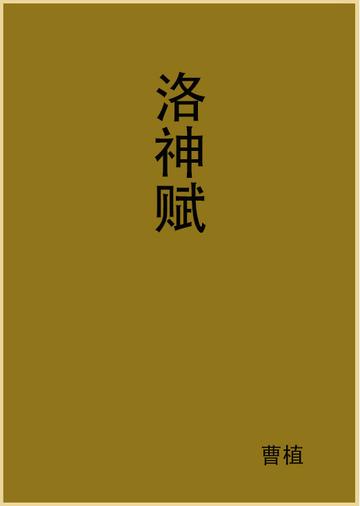
Famous poems and poems. Written by Cao Zhi of Wei Dynasty in the Three Kingdoms. "Selected Works" and "Art and Literature Collection" can be found in it. This fu is dated to the fourth year of Huangchu (223). When Cao Zhizhi returned to his fiefdom and passed through Luoshui after the imperial court, he thought of the legend of Mi Fei, the goddess of Luoshui. Inspired by Song Yu's "Ode to the Goddess", he invented the tragedy of the love between humans and gods to express his emotions. The poem revolves around the main line of love between man and God and is divided into six layers. First, he writes about the discovery of Luoshen; secondly, he writes about the beauty of Luoshen's body and appearance. This is the most exciting part of the whole text. The author fully presents the charm of the goddess from five aspects: beauty of posture, beauty of appearance, beauty of mood, beauty of clothing, and beauty of behavior. Mu is the foreshadowing; secondly, it writes about the king's admiration for Luoshen; secondly, it writes about Luoshen being moved and deeply admiring the king, pushing the love between man and god to a climax; secondly, it writes about the tragedy of Luoshen being forced to leave; and finally, it describes leaving Luochuan, echoing the first paragraph.
There are two opinions on the creative intention of this poem. The first is the theory of "Gan Zhen", see Li Shan's annotation in "Selected Works" quoting "Ji": Zhen Yi was originally begged by Cao Zhi, and later acquired by Cao Pi. After her death, Cao Pi placed her on Cao Zhi's bed, and she went to Luoshui and wrote "Gan Zhen Fu". Emperor Wei Ming changed it to "Luo Shen Fu". Later generations did not adopt this theory. The second is the theory of the King of Hearts. Fu Wen said, "Although he is latent in Taiyin, he always places his heart on the king." The theme of this article should be the tragedy of "separation between man and God", which expresses the unfortunate life experience of being unable to try and achieving ambition. The description in the poem is delicate and vivid, like describing the beauty of a goddess, with extensive metaphors, multi-faceted contrasts, and exhaustive descriptions. This poem is a rare masterpiece in the history of Chinese literature. It best reflects Cao Zhi's creative characteristics of "rich literary talent" and has a huge influence. The calligrapher Wang Xianzhi of the Jin Dynasty once wrote the "Luo Shen Fu", and the painter Gu Kaizhi also had the "Luo Shen Fu Tu" handed down from generation to generation.
Reader comments
"Luo Shen Fu" has gorgeous diction and is full of romanticism, which reminds me of the sweetness when my wife and I were in love. The description of Luo Shen in the article is simply too beautiful, "as graceful as a startling giant, as graceful as a swimming dragon". This beauty lies not only in appearance, but also in its temperament. Just like my wife, she is not only beautiful on the outside, but also very kind on the inside. This book made me feel the beauty of love and made me cherish the people around me more.

"Luo Shen Fu" has gorgeous diction and is full of romanticism, which reminds me of the sweetness when my wife and I were in love. The description of Luo Shen in the article is simply too beautiful, "as graceful as a startling giant, as graceful as a swimming dragon". This beauty lies not only in appearance, but also in its temperament. Just like my wife, she is not only beautiful on the outside, but also very kind on the inside. This book made me feel the beauty of love and made me cherish the people around me more.
No one doubts his talent