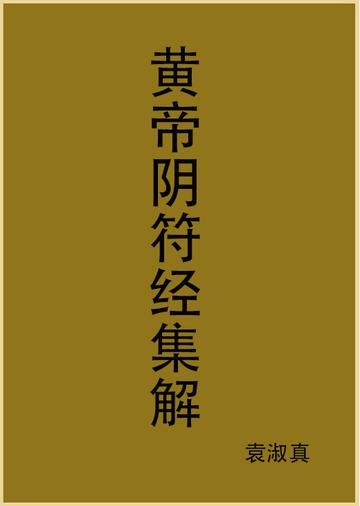
Three volumes. Written by Yuan Shuzhen of Song Dynasty. The original title of the book is "Explanation of Yuan Shuzhen, Chief Secretary of Changsha County in Chao Sanlang's Travel to Tan". "Yellow Emperor Yin Fu Jing Ji Jie", referred to as "Yin Fu Jing Jie Jie", also known as "Yin Fu Jing Shu". There were two annotated versions of Yin Fu Jing in the Tang Dynasty, which were passed down through the generations. That is, the 300-character version by Li Quan of the Tang Dynasty and the 400-character version by Zhang Guo. Yuan Shuzhen took Li Quan's 300-character version and divided it into three chapters. The style includes notes and sparse.
The annotation focuses on the word "ji" and believes that the saint must understand the movement of heaven and the changes of yin and yang, and make his behavior consistent with it, which will be beneficial to the law of governing the country and the people, and consolidating the art of health preservation. The quotations mostly use Taigong and other family dialects and the sayings of Lishan Laomu's Baiyan Yuan Tao, Baiyan Yanfa, and Baiyan Yanshu. At the end of the volume, there are fifty-eight characters after "The Way of Nature is Quiet", which is different from his original version, and these fifty-eight characters are not explained. The "Yin Fu Jing Ji Jie" is recorded in later history books. This book spread to the Yuan Dynasty and formed two versions. One is called "Yin Fu Jing Shu" in three volumes, and the other is called "Yin Fu Jing Ji Jie". The original annotations of "Tao Zang" of the Ming Dynasty were combined into one. It was entered into the Taoist Catalog in the "Summary of the General Catalog of Sikuquanshu" of the Qing Dynasty. There are also three volumes of "Yinfu Jingshu" in "Tao Zang", titled Li Quan Shu. Except for the preface, the content is basically the same as this volume. Modern scholars suspected that it was written by Yuan and mistakenly titled it Li Quan. Since there are slight differences between the two versions, they can be reviewed against each other. The existing copy of the Ming Dynasty's "Tao Zang" is titled "Anthology of the Yellow Emperor's Yin Fu Sutra".
Reader comments
In order to save people, the character Huang Di spread the essentials of the Jian Ji to the world, which is very admirable. The "Tao", "Dharma" and "Skills" mentioned in the book are also very enlightening. However, I don't really like those conservative Confucian scholars who have not conducted in-depth analysis of the Yin Fu Jing. Overall, this is a book worth reading that can give people a deeper understanding of Taoist thought.
In order to save people, the character Huang Di spread the essentials of the Jian Ji to the world, which is very admirable. The "Tao", "Dharma" and "Skills" mentioned in the book are also very enlightening. However, I don't really like those conservative Confucian scholars who have not conducted in-depth analysis of the Yin Fu Jing. Overall, this is a book worth reading that can give people a deeper understanding of Taoist thought.
Not bad, worth recommending