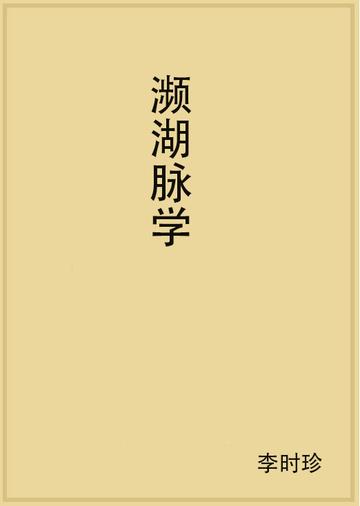
"Binghu Pulsology", Pulsology Works, 1 volume.
Written by Li Shizhen of the Ming Dynasty in the 43rd year of Jiajing (1564), pulseology is highly valued in traditional Chinese medicine.
After Wang Shuhe of the Jin Dynasty wrote the "Mai Jing", Gao Yangsheng of the Five Dynasties wrote the "Mai Jue", which was widely disseminated because it was easy to understand and easy to memorize, but it also contained many fallacies.
Li Shizhen inherited the orthodox pulse theory, learned from the strengths of various schools in the past, and gave full play to the meaning of the classics. As he pointed out, cutting the pulse is only based on the qi of the five internal organs, rather than cutting according to the body of the internal organs and meridians for thorough analysis.
On the basis of the 24 pulses in the "Mai Jing", he added 3 types of pulses, bringing the number of TCM pulse conditions to 27, namely floating, sinking, slow, several, slippery, astringent, empty, solid, long, short, flood, slight, tight, slow, stringy, leathery, firm, wet, weak, loose, thin, volted, moving, quick, knotted, and generation.
He wrote a "Physical Poetry" with catchy and easy-to-remember seven-character poems, and gave a vivid description of each pulse condition. For example, he said: "The floating pulse only goes up from the flesh, like following the elm pods as light as hair. When you are born in the third autumn, you know you are fine, but when you encounter a long-term illness, you are shocked." In just four sentences, the pulse position, pulse condition, and clinical significance of the floating pulse are clearly expressed.
He also used "similar poems" and "main disease poems" to summarize various pulses of the same type and elucidate their intentions in diagnosing diseases and syndromes.
This is the entire content of "Binhu Pulseology". Although it is not long, it plays an important role in the development history of TCM pulseology and has become a must-read for studying pulseology.
Reader comments
The pulse theory written by Li Shizhen is easy to understand and remember. He uses verses to describe pulse conditions with vivid images that people can remember at once. And he also pointed out some mistakes to avoid us taking detours. I think this book is not only suitable for professionals, but also for friends who are interested in traditional Chinese medicine. Just like my cousin who knows nothing about Chinese medicine, she can have a general understanding of pulse conditions after reading this book. However, Chinese medicine is still quite profound. If you want to truly learn it, you have to practice it more!


The pulse theory written by Li Shizhen is easy to understand and remember. He uses verses to describe pulse conditions with vivid images that people can remember at once. And he also pointed out some mistakes to avoid us taking detours. I think this book is not only suitable for professionals, but also for friends who are interested in traditional Chinese medicine. Just like my cousin who knows nothing about Chinese medicine, she can have a general understanding of pulse conditions after reading this book. However, Chinese medicine is still quite profound. If you want to truly learn it, you have to practice it more!
The expression is accurate, precise, great!