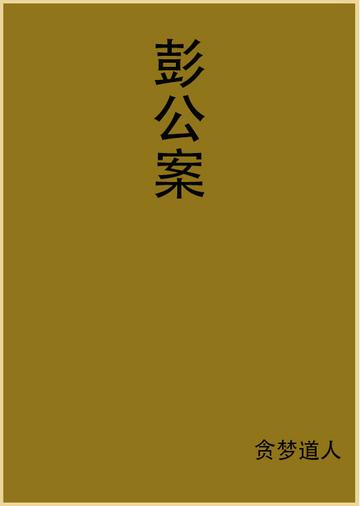
"Peng Gongan" is another chivalrous public case novel after "Shi Gongan" and "Three Heroes and Five Righteousness". The protagonist Peng Peng in the book is actually Peng Peng during the Kangxi period. His courtesy name was Fensi, his nickname was Wushan, and his number one was Gu Yu. A native of Putian, Fujian. From the magistrate to the governor, he wrote "The Words of the Ancient Fool". "Peng Gongan", like other publican novels, is a biography of an upright official, starting from his birth and ending with "a highly respected official", and finally he was awarded a reward by the emperor and became a minister of the Ministry of War. The first chapter of "Peng Gong's Case" is "Peng Gong was appointed to Sanhe County". In his official appointment, Peng Peng took "loyalty to the country and eliminating harm to the people" as his mission. Whenever he goes to a place, he must pay attention to capture thieves. "The good ones will persuade them to correct their evil ways, and the bad thieves will be punished on the spot." He got rid of the powerful Zuo Kui and Wu Wenhua; suppressed the bandit Zhou Yinglong who "disobeyed the emperor's control"; investigated the rebellion of Datong general Fu Guoen and others... These were all political achievements he made through the use of knights, such as Li Qihou, Zhang Yaozhong, Ouyang De, etc. It was with their protection and assistance that he was able to ask for merit and rewards from the emperor, and bestowed a plaque with the words "loyal ministers love the people" and a gold medal with the words "I am here in person".
The novel praises Peng Peng as an upright official and virtuous minister who "repays the kindness of the emperor and brings peace to the people"; it also praises the servility of the knights. For example, the knight Gao Hengnian was eighty years old. In order to protect Peng Peng, he explored Hanquan Cave alone to obtain gold medals, and eventually died. There are many stories about the real person Peng Peng among the people. Although most of them are based on attachment, they are "not necessarily Zixu". (Jiang Ruizao: "Chaohuahua Notes") The book also intersperses the story of Huang Santai being given a yellow mantle after fighting a tiger in Beijing to rescue a driver; there is also the story of Yang Xiangwu stealing the Kowloon Cup; the story of Gao Heng and his son Hanquan fishing for seals, etc. Falling into the cliché of "a wise minister does little, but a hero steals treasures". The writing style of the novel is not good, and it falls behind most of its predecessors.
Reader comments
What a wonderful book! The characters in the story are all very vivid. The righteous people like Peng Gong are admirable, but the villains are really annoying. The author's writing style is concise and lively, and his writing style is smooth and enjoyable to read. It feels like you're chatting with a friend, and it's easy to get sucked into the story. Recommended to you, worth reading!
I like it very much, thank you
Very nice, highly recommended
The plot has ups and downs, and the wonderful scenes of Green Forest Heroes are very interesting. I like it.

What a wonderful book! The characters in the story are all very vivid. The righteous people like Peng Gong are admirable, but the villains are really annoying. The author's writing style is concise and lively, and his writing style is smooth and enjoyable to read. It feels like you're chatting with a friend, and it's easy to get sucked into the story. Recommended to you, worth reading!
I like it very much, thank you
Very nice, highly recommended
The plot has ups and downs, and the wonderful scenes of Green Forest Heroes are very interesting. I like it.