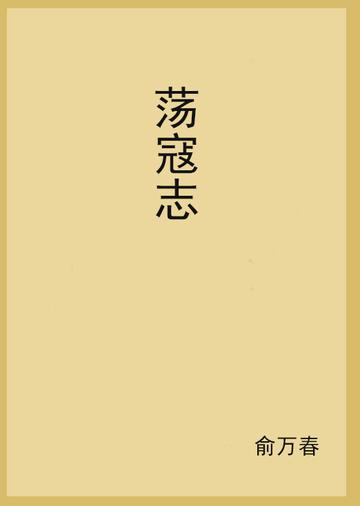
A long chapter-chapter novel from the Qing Dynasty, also known as "Continued Water Margin", with a total of 140 chapters, and one chapter with "Jiezi". The author Yu Wanchun (1794~1849), whose courtesy name was Zhonghua, also known as Hulai Taoist, was a native of Shanyang, Zhejiang. "Dang Kou Zhi" was first written in the Bing year of Daoguang (1826) and completed in the Dingwei year of Daoguang (1847). The whole book continues the 70 chapters of Jin Shengtan's "Water Margin". It is narrated that Chen Liqing, the daughter of Chen Xizhen, who was in charge of the imperial court, was forced by Gao Yanei and fled Kyoto. The father and daughter went to live with their relative Liu Guang, and met Yun Tianbiao, Liu Guang's military general. Due to the persecution of traitorous officials, they had no choice but to "fall off grass" in Yuanbi Village. However, they "respected the king and opposed the bandits" and specially colluded with the officers and soldiers to attack and kill the Liangshanbo uprising army when the people were trapped. Later, under the recommendation of Yun Tianbiao, he was hired by the imperial court. Finally, together with Zhang Ye's troops, he broke through the water in Boliang Mountain and captured 108 generals, who were either dead or executed. The novel goes to great lengths to slander the Liangshan Peasant Rebel Army, charging them with charges such as "advocating to be the leader of thieves, harboring secret conspiracies, being persistent in evil, and committing heinous crimes." He denounced them as "murderers and arsonists who cleanse the people." However, they tried their best to beautify Chen Xizhen, Zhang Shuye and others. The men are immortal and dignified in appearance; the women are unparalleled in beauty and beauty. They are superior in ability and invincible. "Dang Kou Zhi" fully expresses the thoughts and feelings of the landlord class and caters to the needs of the ruling class. It was immediately regarded as a classic as soon as it came out. Favored and praised by the ruling class, it is a representative work that denies and hates the peasant uprising. Although the plot is dull and the artistic effect is unreal, the writing is precise, smooth, and the characters are vivid. This book was first published in the third year of Xianfeng (1853), and was later reprinted in 1981 by Dai Hongsen.
Reader comments
The plot of the book "Dang Kou Zhi" has ups and downs and is exciting. The author Yu Wanchun's writing style is vivid and makes people feel like they are immersed in the scene. Lu Junyi's dreams in the book are so wonderful, and it made me feel his inner struggle. The sentence "I don't know when the recruitment will be launched" also reflects Lu Junyi's helplessness. Overall, this is a great book worth reading!
Enjoy the wonderful articles together, the writing style is transcendent


The plot of the book "Dang Kou Zhi" has ups and downs and is exciting. The author Yu Wanchun's writing style is vivid and makes people feel like they are immersed in the scene. Lu Junyi's dreams in the book are so wonderful, and it made me feel his inner struggle. The sentence "I don't know when the recruitment will be launched" also reflects Lu Junyi's helplessness. Overall, this is a great book worth reading!
Enjoy the wonderful articles together, the writing style is transcendent