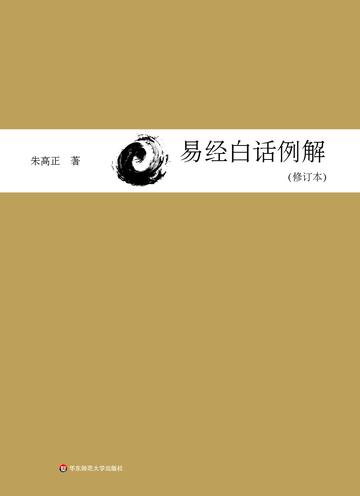
Dr. Zhu Gaozheng is not only familiar with Western philosophy, but also loves Chinese culture. He has devoted himself to studying "The Book of Changes" for many years. In order to promote the Dao of Yi, he consulted the ancient and modern annotations of "The Book of Changes", adopted the facts and discarded the exaggerations, and wrote "Explanations of the Book of Changes in Vernacular" as an enlightenment textbook for fans of "The Book of Changes" to observe imagery and play with rhetoric. This book has two major characteristics: First, it carries forward the humanistic tradition of Confucian interpretation of the Yi, using the Zhouyi as a guide for cultivating oneself and governing others, increasing life wisdom and improving self-cultivation. For this purpose, the sixty-four hexagrams are annotated. The second is to treat the hexagrams, lines and hexagrams as a whole according to the principles of "unity" and "seeking common ground". Each hexagram embodies a central concept and runs through each line, thereby clarifying the philosophy of life contained in the sixty-four hexagrams. This style of studying Yiyi is to carry forward the fine tradition of predecessors, which is really commendable. The interpretation of scriptures in this book strictly follows the style of "Yi Zhuan" and does not follow various regulations proposed by later Yi scholars. It has the courage to seek innovation without violating ancient precepts. The writing strives to be simple, clear, concise and lively, straight to the point and without citations, which makes people feel formidable. It also combines historical and practical issues to elucidate the meaning of the scriptures, making it suitable for contemporary scholars to read and draw wisdom from it. This book provides a new way to spread Yi Dao. "The Vernacular Examples of the Book of Changes" (Revised Edition) is a popular academic work that provides a modern explanation of the "Tai Chi thinking" contained in the hexagrams and lines of the "Book of Changes". It strives to provide enlightenment to today's people from aspects such as the improvement of cultivation, the acquisition of understanding, the exploration of the meaning of life, and the realization of Zhongji's return. The whole book divides the sixty-four hexagrams into two parts: "Zhouyi Shang Jing" and "Zhou Yi Xia Jing". Each hexagram first explains the meaning of the hexagrams and line words, and then gives examples of historical events and historical figures in the "Explanation" column to illustrate the practical significance of the philosophy of the hexagrams and line words. This revised version has been published, and the author has made further processing. About the author Zhu Gaozheng was born in Yunlin, Taiwan in 1954. The 26th generation descendant of Song Dynasty Neo-Confucian Zhu Xi. Graduated from the Law Department of National Taiwan University in 1977. Obtained a doctorate in philosophy from the University of Bonn, Germany, in 1985. In 1987, he was elected as a "legislator" in Taiwan. He is one of the politicians in Taiwan who supports cross-strait reunification. In 1998, he was appointed as a distinguished professor by the Graduate School of the Chinese Academy of Social Sciences. He is proficient in Yi studies and Neo-Confucianism, and has written "Comprehensive Interpretations of the Sixty-Four Hexagrams of Zhouyi", "Explanations of Vernacular Examples of the Book of Changes", "Comprehensive Interpretations of Jinsi Lu", etc.
Reader comments
This book is very interesting! Mr. Zhu Gaozheng explains the "Book of Changes" very clearly and is easy to understand. I particularly like his vivid examples of historical events and figures. However, I don't really like some of the ancient sayings in the book, which feel a bit obscure. Overall, this is a book worth reading and one can learn a lot of life wisdom from it.
It's so friendly to scholars without basic knowledge! Praise! Good contribution
This book is very interesting! Mr. Zhu Gaozheng explains the "Book of Changes" very clearly and is easy to understand. I particularly like his vivid examples of historical events and figures. However, I don't really like some of the ancient sayings in the book, which feel a bit obscure. Overall, this is a book worth reading and one can learn a lot of life wisdom from it.
It's so friendly to scholars without basic knowledge! Praise! Good contribution