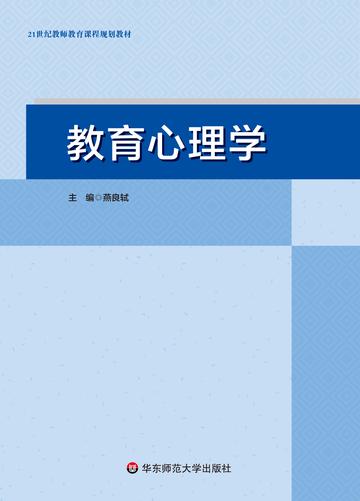
"Educational Psychology" has three major features: 1. Clear organization and detailed content. It is divided into two main lines: learning psychology and teaching psychology, and the important research results are selected to sort out and summarize. 2. The author lineup is strong. The person responsible for writing the content is a leader in the field of educational psychology in China, and each gave an in-depth and simple explanation of their respective research fields. 3. It has practical guidance. The selected topics are closely related to the practice of front-line teachers, such as the transformation of students with poor academic performance, the cultivation of students' creative thinking, the stimulation of learning motivation, etc.
This book is an important reference book for researchers in the field of educational psychology, and can also provide guidance for front-line teachers in their education and teaching work. Recommended by celebrities: The book "Educational Psychology", edited by Professors Wu Qinglin and Hu Yi, focuses on the core themes in the field of educational psychology, systematically and in detail explains relevant theoretical perspectives, empirical research and applications at home and abroad, and clearly outlines the development context, characteristics and trends of each research topic. At the same time, it also pays full attention to many research hotspots such as brain plasticity and technology-integrated teaching. What is particularly outstanding is that this book sorts out and summarizes important research and results in the field of educational psychology in my country, and objectively analyzes the role and enlightenment of educational psychology research in deepening China's educational reform. This is a rare book on educational psychology. It refines, integrates and extracts the essence of various related studies, providing readers with relevant guidance on educational psychology research. It is a must-have for researchers in the field of education and psychology. ——Chen Yinghe, Chairman of the Degree Committee of the School of Psychology, Beijing Normal University, Professor and doctoral supervisor of the Institute of Development and Educational Psychology, School of Science, Beijing Normal University
Educational psychology in my country has developed rapidly in the past thirty years and has formed some characteristic fields and achievements, which are summarized in this book. Specifically, it has the following characteristics: First, the theme is clear and problem-oriented. The whole book focuses on the two major themes of learning psychology and teaching psychology, which can be said to have a clear theme. Many important issues in the two major themes are discussed in the special discussions, highlighting the problem-oriented characteristics. Second, the combination of history and development demonstrates the basic direction of the discipline. The whole book not only selects relevant topics (issues) from a historical perspective, but also reflects the recent development of each topic, providing enlightenment. Third, it takes into account both theory and application, and has dual value in theory and application. In short, this book is a masterpiece of educational psychology with distinctive features, both theoretical depth and broad application. ——Zhang Dajun, professor at Southwest University, doctoral supervisor in developmental and educational psychology, academic leader of Chongqing Science and Technology (Development and Educational Psychology)
Reader comments
I have read Chapters 1 to 6 and summarized: systematic and hierarchical definitions of learning process, learning strategies, learning theories (various types of learning), cognitive strategies, metacognitive strategies, knowledge definition types, learning transfer (transfer), problem definition types, and innovation and analysis; and analyzed the theory of learning, trying to restore the complex nature of human learning. In this process, behaviorism, cognitivism, information processing, constructivism, and humanism emerged. They are all of great reference significance. The whole process also involves neuroscience (brain science), AI Artificial intelligence, a small amount related to ancient China; related concepts in the field of artificial intelligence also have relevant definitions here, such as: reinforcement learning;
I think of a friend of mine who is a primary school teacher and often shares with me some of her confusions in educational practice. The contents mentioned in this book about the transformation of students with poor academic performance and the stimulation of learning motivation should be able to give her some inspiration. Moreover, the content in the book is clear and easy to understand, and even non-professionals can understand it. I think it is a bit like the book "Why Children Fail", which is based on practice and explores issues in education. However, "Educational Psychology" focuses more on theory, while "Why Children Fail" focuses more on case analysis. All in all, this is a valuable book!
A good book. You can borrow a visa for personal study or educating children.
It's a good idea to improve your foundation in educational psychology.


I have read Chapters 1 to 6 and summarized: systematic and hierarchical definitions of learning process, learning strategies, learning theories (various types of learning), cognitive strategies, metacognitive strategies, knowledge definition types, learning transfer (transfer), problem definition types, and innovation and analysis; and analyzed the theory of learning, trying to restore the complex nature of human learning. In this process, behaviorism, cognitivism, information processing, constructivism, and humanism emerged. They are all of great reference significance. The whole process also involves neuroscience (brain science), AI Artificial intelligence, a small amount related to ancient China; related concepts in the field of artificial intelligence also have relevant definitions here, such as: reinforcement learning;
I think of a friend of mine who is a primary school teacher and often shares with me some of her confusions in educational practice. The contents mentioned in this book about the transformation of students with poor academic performance and the stimulation of learning motivation should be able to give her some inspiration. Moreover, the content in the book is clear and easy to understand, and even non-professionals can understand it. I think it is a bit like the book "Why Children Fail", which is based on practice and explores issues in education. However, "Educational Psychology" focuses more on theory, while "Why Children Fail" focuses more on case analysis. All in all, this is a valuable book!
A good book. You can borrow a visa for personal study or educating children.
It's a good idea to improve your foundation in educational psychology.