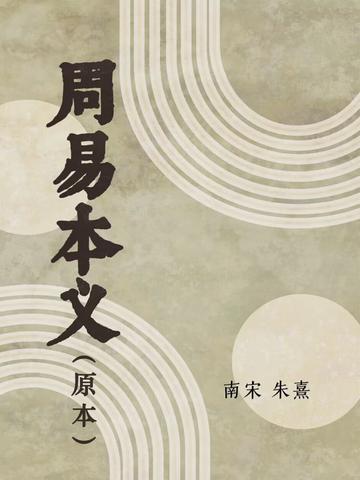
The Book of Changes is the source of Confucius' philosophical thoughts. The "Original Meaning of the Book of Changes" annotated by Zhu Xi is an interpretation of Confucius' philosophical thoughts: those who are soft and tend to be hard will retreat from the extreme and advance.
"The Book of Changes" was originally used for divination, but it is also a work containing rich philosophical thoughts. Confucius wrote "Ten Wings" to further elaborate on the philosophical thoughts contained in "The Book of Changes". Wang Bi's "Notes on the Book of Changes" and "Short Examples of the Book of Changes" also further elaborated on the meaning of the "Book of Changes".
Zhu Xi inherited Cheng Yi's philosophical thoughts and was known as "Cheng Zhu" in the world, but his "Yi" thought was different from Cheng Yi's. Cheng's study of "Yi" follows the path pioneered by Wang Bi and understands "Yi" based on its meaning; Zhu Xi believes that "Yi" is a book of divination, and writing "Original Meaning of Zhou Yi" is to restore the original appearance of "Yi".
Reader comments
Wow, this book "The Original Meaning of the Book of Changes" is really interesting! I particularly like the explanations of the hexagrams and lines. It feels very mysterious but also very reasonable. Moreover, through this book, I also learned about Zhu Xi's unique views on the "Book of Changes". He believed that the "Book of Changes" is a book of divination, and it is necessary to restore the true nature of the "Book of Changes". This view is very novel! I think this book is a book worth reading for those who like to study philosophy and traditional Chinese culture!
Zhu Xi's insight is not as profound as Kong Yingda's.

Wow, this book "The Original Meaning of the Book of Changes" is really interesting! I particularly like the explanations of the hexagrams and lines. It feels very mysterious but also very reasonable. Moreover, through this book, I also learned about Zhu Xi's unique views on the "Book of Changes". He believed that the "Book of Changes" is a book of divination, and it is necessary to restore the true nature of the "Book of Changes". This view is very novel! I think this book is a book worth reading for those who like to study philosophy and traditional Chinese culture!
Zhu Xi's insight is not as profound as Kong Yingda's.