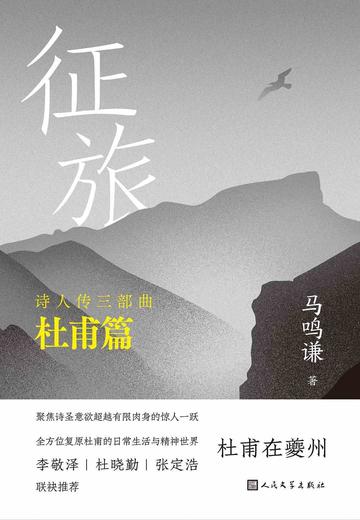
"The Journey" is the first part of the "Trilogy of Poet's Biography" by the novelist Ma Mingqian. The full text is 400,000 words. It captures the most important years of Du Fu's later life, starting from his arrival in Kuizhou from Yun'an in the late spring of the first year of the Dali calendar (766), and ending with his boating out of the gorge in the first month of the third year of the Dali calendar (768), first to Jiangling, and then to his wandering in Huxiang. After living in Kuizhou for nearly two years, his health was worrying and he had to work hard to make a living. However, Du Fu ushered in the peak period of his creation. In the two autumns before and after, he was very productive in creation, almost playing one song a day. It can be said that these two years were not only a very important two years in Du Fu's personal creative life, but also a very important two years in the history of ancient Chinese poetry. Ma Mingqian has been preparing this work for many years. Based on a solid academic foundation, he uses detailed and vivid brushwork to present Du Fu's time in the gorge. After reading the entire book, I was deeply immersed in the atmospheric world of Du Fu's poems. The barriers that originally stood in front of me between the ancients and the present, the past and the present, idols and readers, poetry and life no longer exist. Du Fu is no longer a fixed label, an idolized great poet. He has become a contemporary that I can perceive, contact, and understand.
Reader comments
This book is based on Du Fu's later life, allowing me to see a more real and vivid Du Fu. The author's writing style is delicate and vivid, as if it can take me through time and space, and experience those difficult years with Du Fu. The characters in the book are all very realistic, and their actions and decisions are consistent with the historical background of the time. I really like this writing style that presents historical figures in the form of stories. I find it particularly attractive.

This book is based on Du Fu's later life, allowing me to see a more real and vivid Du Fu. The author's writing style is delicate and vivid, as if it can take me through time and space, and experience those difficult years with Du Fu. The characters in the book are all very realistic, and their actions and decisions are consistent with the historical background of the time. I really like this writing style that presents historical figures in the form of stories. I find it particularly attractive.