[Introduction to the content of "Zaju Stories of the Yuan Dynasty"]
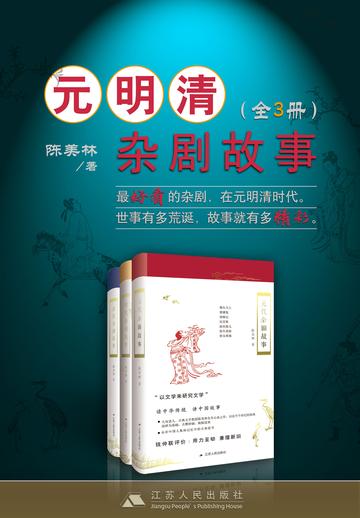
This book is one of the results of Mr. Chen Meilin's many years of drama research. By rewriting obscure ancient dramas, the ancient dramas are adapted into short stories that are easy for modern people to understand and accept. It is quite readable. The book contains dozens of stories adapted from famous ancient dramas, such as "The Peony Pavilion", "A Chinese Girl's Lost Soul", "Zhongshan Wolf", etc., Which are presented in a convenient way to facilitate modern readers to understand ancient dramas and related cultural metaphors, and enhance the understanding and application of our country's traditional civilization. Due to the author's status as a senior expert in ancient literature, the writing style of this book is smooth and elegant, and it is also highly literary in nature, making it worthy of being read as a literary work. This book is suitable for readers who are interested in ancient culture. It is also suitable for external promotion as a reading material to popularize traditional Chinese culture and introduce it to overseas Chinese and junior researchers of Chinese culture.
[Introduction to the content of "Zaju Stories of the Ming Dynasty"]
This book is an adaptation of Ming Dynasty dramas compiled and adapted by Mr. Chen Meilin, a professor at Nanjing Normal University. China is one of the three major theater countries in the world, and the art of opera is a treasure in ancient Chinese culture. As a major part of Chinese studies, ancient poetry has been widely popularized and promoted, but opera has always lacked good popular interpretation works. This book is one of the results of Mr. Chen Meilin's many years of drama research. By rewriting the obscure Ming Dynasty dramas, the ancient plays are adapted into short stories that are easy for modern people to understand and accept. The book contains dozens of stories adapted from famous Ming Dynasty dramas, such as "Joining the Army for My Father", "Peach Blossom Face", "Elopement with Xiangru", etc., Which are presented in a convenient way to facilitate modern readers to understand Ming Dynasty dramas and related cultural metaphors, and enhance the understanding and application of our country's traditional civilization. Due to the author's status as a senior expert in ancient literature, the writing style of this book is smooth and elegant, and it is also highly literary in nature, making it worthy of being read as a literary work.
[Introduction to the content of "Zaju Stories of the Qing Dynasty"]
This book is an adaptation of Qing Dynasty dramas compiled and adapted by Mr. Chen Meilin, a professor at Nanjing Normal University. China is one of the three major theater countries in the world, and the art of opera is a treasure in ancient Chinese culture. As a major part of Chinese studies, ancient poetry has been widely popularized and promoted, but opera has always lacked good popular interpretation works. This book is one of the results of Mr. Chen Meilin's many years of drama research. By rewriting the obscure Qing Dynasty dramas, the ancient plays are adapted into short stories that are easy for modern people to understand and accept. The book contains dozens of stories adapted from famous Qing Dynasty dramas, such as "Zhong Kui and My Sister Qingshou", "No Fate", "Mulan Poetry", etc., Which are presented in a convenient way to facilitate modern readers to understand Qing Dynasty dramas and related cultural metaphors, and enhance their understanding and application of our country's traditional civilization. Due to the author's status as a senior expert in ancient literature, the writing style of this book is smooth and elegant, and it is also highly literary in nature, making it worthy of being read as a literary work.
Reader comments
Moreover, each book contains many famous drama stories, such as "The Peony Pavilion", "Joining the Army for My Father", "Zhong Kui's Sister's Birthday Celebration", etc. I especially like the characters in the book. Their behaviors and emotions are very real, which makes me feel the charm of that era. However, I kind of hate the villains who always ruin the protagonist's happiness. Overall, this set of books is worth reading, not only to understand ancient culture, but also to appreciate beautiful literary works.
Moreover, each book contains many famous drama stories, such as "The Peony Pavilion", "Joining the Army for My Father", "Zhong Kui's Sister's Birthday Celebration", etc. I especially like the characters in the book. Their behaviors and emotions are very real, which makes me feel the charm of that era. However, I kind of hate the villains who always ruin the protagonist's happiness. Overall, this set of books is worth reading, not only to understand ancient culture, but also to appreciate beautiful literary works.