The Twenty-Four Aspects of Chinese Culture begins with Auspicious Dragon and Phoenix, which distills the core spirit of Chinese culture, and concludes with Reform and Strengthen the Nation, which looks ahead to the modernization of China. Covering fields including thought, politics, society, literature, art, and daily life, the series forms a clearly structured history of Chinese culture. It is an excellent introduction and general textbook for anyone seeking a comprehensive, systematic understanding of traditional culture.
Auspicious Dragon and Phoenix: The Features, Structure, and Spirit of Chinese Culture
“Introduces the origins of Chinese civilization, the features and character of Chinese culture, and its inner structure and spiritual traditions, offering an overall account of its main elements from a cultural perspective.
Author: Xu Xingwu, professor and dean of the School of Liberal Arts at Nanjing University.”
The Learning of the Junzi: An Educational Tradition for Cultivating Sages
“Introduces the fundamentals of traditional Chinese educational culture, including traditional teaching methods, educational institutions, and the imperial examination system. It focuses on the learning of the junzi, whose educational aim was to cultivate oneself, put one’s family in order, govern the state, and bring peace to the world.
Author: Yan Guangfen, professor at the Institute of Higher Education, Nankai University.”
Benevolence, Righteousness, Propriety, and Wisdom: The Moral Principles in Our Hearts
“Introduces the formation and content of traditional Chinese social ethics and its moral system, and explains the system’s value in ethics.
Authors: Zhou Defeng, professor and doctoral supervisor at the School of Philosophy, Nankai University.
Li Chengfu, PhD, author of papers including ‘Building on the Old to Open New Paths: A Study of Qian Mu’s View of Culture.’”
The Way of the King and the Hegemon: A Political System Balancing Ritual and Law
“Introduces the broad course of Chinese historical development, and the evolution of political systems and official institutions throughout the dynasties, showcasing the political culture and wisdom of Chinese civilization.
Author: Wang Zijin, professor at the School of Chinese Classics, Renmin University of China; professor at the Collaborative Innovation Center for Unearthed Documents and Ancient Chinese Civilization; and Hongguo Chair Professor at Nanjing Normal University.”
Reform and Strengthen the Nation: Modern Challenges and Reform
“Introduces China’s modernization process from the late Qing onward, explains the patterns and forms of China’s transformations and development, and offers insight into the cultural trajectory China may follow amid globalization.
Authors: Hou Jie, deputy director of the Institute of Urban Culture at Nankai University, professor at its School of History, director of its Department of Modern Chinese History, and full-time researcher at the Center for Chinese Social History.
Zhao Tianlu, doctoral student at the School of History, Nankai University.”
The Nine Schools and Ten Thinkers: Debates in Philosophy
“Introduces ancient Chinese thought, scholarship, and philosophical wisdom. It focuses on the schools of thought, thinkers, and ideas of different historical periods, and discusses the distinctive features and highest ideals of Chinese philosophy, as well as its significance for modern East Asian culture.
Author: Zhang Fengyi, professor, head of the Department of Ancient Chinese Literature at the School of Chinese Language and Literature, Nankai University, and president of the Tianjin Society for Ancient Chinese Literature.”
Inner Sagehood and Outer Kingship: The Confucian Ideal
“Introduces Confucian thought and its influence on Chinese culture, focusing on its spiritual traditions from the thought of Confucius and Mencius in the pre-Qin era through Song and Ming Neo-Confucianism.
Author: Li Xianghai, professor, chair of the Academic Committee of the School of Marxism at Peking University, and executive deputy director of the Center for Chinese Cultural Development Studies.”
Pure Land of the Lotus: The Buddhist Beyond
“Introduces the origins, characteristics, rituals, and wisdom for living of Chinese Buddhism, as well as its influence on Chinese culture.
Author: Chen Yinchi, professor and dean of the Department of Chinese Language and Literature at Fudan University.”
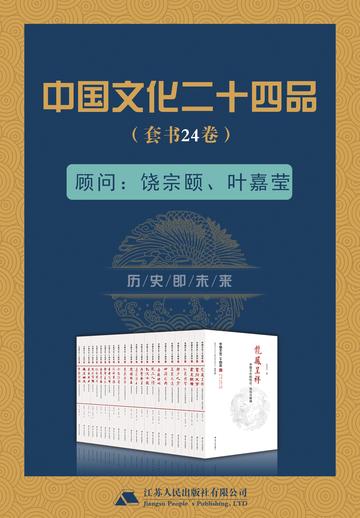

This set of books is rich in content and covers all aspects of Chinese culture. Reading it is like chatting with a knowledgeable friend. I especially like the volume "Benevolence, Righteousness, Propriety and Wisdom", which makes me understand the importance of moral laws in Chinese culture. I am also very interested in "The Way of the Overlord", which allows me to understand the political system and wisdom in Chinese history. However, I kind of hate people who have historically done whatever it takes to gain power. This set of books gave me a deeper understanding of Chinese culture. It also reminded me that I should pay attention to moral cultivation in my life and strive to be a responsible person.