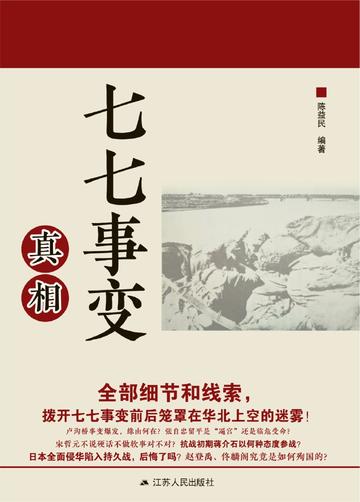
This book takes the historical materials of the July 7th Incident as the core and answers the main controversial topics about the July 7th Incident. In particular, it conducts a well-founded analysis of the main differences between China and Japan in the historical comments on the July 7th Incident. For example, when the Sino-Japanese war broke out, who was responsible? In the early days of the Anti-Japanese War, what was Chiang Kai-shek's attitude towards participating in the war? How to judge the peace talks between Song Zheyuan and Japan after the incident? Wait... This book is different from either a special history or a pure compilation of historical materials. It is a historical book that is mainly based on document excerpts and supplemented by analysis and commentary.
The process of the July 7th Incident seems to be clear, but in fact it is controversial. There are different comments about the same character; there are different descriptions of the same thing. This is an important history of the starting point of the eight-year war of resistance. It should not be too controversial and should have a convincing conclusion. This book is based on a large amount of historical data, collects various different opinions, strives to distinguish their authenticity, and conducts a comprehensive discussion of the July 7th Incident to restore the historical truth of the incident.
Editor's recommendation
All the details and clues clear up the fog that shrouded North China before and after the July 7th Incident!
What was the reason for the Marco Polo Bridge Incident?
Was Zhang Zizhong "forcing the emperor" to stay in the palace, or was he ordered to do so in a desperate situation?
Song Zheyuan doesn't say hard words and doesn't do soft things, right?
In the early days of the Anti-Japanese War, what was Chiang Kai-shek's attitude towards participating in the war?
Japan fully invaded China and fell into a protracted war. Do you regret it?
How did Zhao Dengyu and Tong Linge die for their country?
This book is based on the historical materials of the July 7th Incident as the core, involving telegrams, book and newspaper reports, letters and diaries, memories of the parties involved, National Government documents and archives, as well as Japanese archives, memories of the parties involved, war history books, etc. It makes selected excerpts from these original texts and uses historical materials to concisely reflect the entire process of the July 7th Incident. This book uses historical materials to answer the main controversial topics in the July 7th Incident. In particular, it provides a well-founded analysis of the main differences between China and Japan in the historical comments on the July 7th Incident. For example, when the Sino-Japanese war broke out, who was responsible? In the early days of the Anti-Japanese War, what was Chiang Kai-shek's attitude towards participating in the war? How to judge the peace talks between Song Zheyuan and Japan after the incident? When Zhang Zizhong stayed in Peiping, was he "forcing Song Zheyuan to go to the palace" or was he "accepting the order in the face of danger"? Did the Japanese army "enter" or "invade" China? Why did the Japanese army expand its invasion of China after the July 7th Incident, and what consequences did it bring? This book collects various opinions on the evolution of the event, and adds the editor's comments to provide the editor's evaluation and opinions on the historical facts. This book is different from either a special history or a pure compilation of historical materials. It is a historical book that is mainly based on document excerpts and supplemented by analysis and commentary.
Author introduction
Chen Yimin graduated from the History Department of Nankai University with a master's degree and served as the editor-in-chief of Tianjin People's Publishing House. Over the years, he has been paying attention to the study of the history and culture of the Republic of China, and has published works such as "Book Edge Silk" and compiled a number of historical and informative readings, such as "Old News Series", "Republic of China Everyone's Beautiful Essays Series" and "Rereading Xu Zhimo Series".