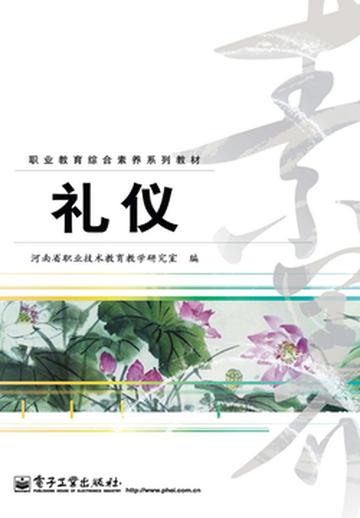
This book is a basic book written for secondary vocational students to learn etiquette. It closely follows the characteristics of secondary vocational students and teaches students the basic knowledge and skills of etiquette, so that they can gain something and apply what they have learned. At the same time, it can also be used as a teaching material for public quality courses, an auxiliary teaching material for various professional etiquette education, and a basic reading for popularizing etiquette knowledge. This book mainly includes nine parts: etiquette overview, image and behavior etiquette, etiquette in and out of school, family and public etiquette, employment etiquette, workplace and interview etiquette, service etiquette, business event etiquette, and Chinese and foreign etiquette. It takes secondary vocational students as the research object and abandons the traditional model of imparting theoretical knowledge. Based on the principle of combining theory and practice, the teaching objectives are clear, the writing is based on a wide range of materials, with pictures and texts, it is beautiful, practical and has strong plasticity, making students easy to imitate and able to imitate, achieving the effect of teachers being easy to teach and students being eager to learn.
Reader comments
As the book says, etiquette is not only a bonus in the workplace and social situations, but also a reflection of our personal qualities. This reminds me of Lin Daiyu in "A Dream of Red Mansions". Her speech and behavior were in line with the etiquette norms of that era. Moreover, the content of this book is very rich, not only theoretical knowledge, but also many practical cases and pictures, so that we can better understand and learn. I think this book is not only suitable for secondary vocational students, but also for everyone who wants to improve their etiquette literacy.

As the book says, etiquette is not only a bonus in the workplace and social situations, but also a reflection of our personal qualities. This reminds me of Lin Daiyu in "A Dream of Red Mansions". Her speech and behavior were in line with the etiquette norms of that era. Moreover, the content of this book is very rich, not only theoretical knowledge, but also many practical cases and pictures, so that we can better understand and learn. I think this book is not only suitable for secondary vocational students, but also for everyone who wants to improve their etiquette literacy.