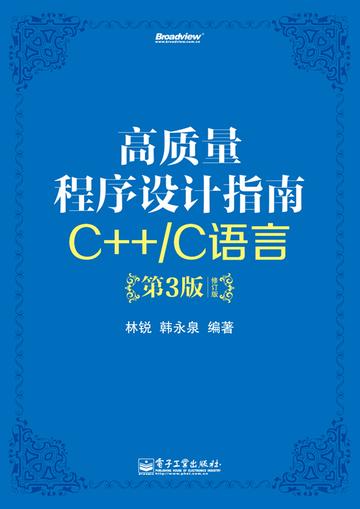
High-quality programming is a weak link in the software industry. Most companies pay a high price for this and can only improve the quality of software products through a large number of tests and error corrections. Therefore, how to enable programmers to master programming technology and programming specifications proficiently and build high-quality code during the development process is one of the main challenges faced by IT companies.
This book discusses high-quality software development methods and C++/C programming specifications to readers in a relaxed and humorous tone. This is also a summary of the author's years of experience in software development. The book has 17 chapters in total. Chapters 1 to 4 focus on software quality and basic programming methods; Chapters 5 to 16 focus on C++/C programming style, object-oriented programming methods and some technical topics; Chapter 17 explains the principles and usage of STL.
Some chapters of the first and second editions of this book were widely circulated on the Internet and were adopted by many software developers in domestic IT companies. Appendix C of this book, "Ten Years in College", is a short biography of the author published online. The passionate attitude towards study and life described in the article has infected a large number of students.
Reader comments
This book is really good! It talks about high-quality software development methods and C++/C programming specifications in a relaxed and humorous way. It is also easy to understand for a girl in love like me. I especially like the parts about programming style and object-oriented programming methods. I feel it is very helpful to improve the quality of the code. Moreover, I think "Ten Years in College" shared by the author in Appendix C is also very interesting and I was very inspired by it! Recommended!
When talking about const modification, the author's point of view is that when we take the address of a const-modified variable, we take out the address of the const-modified variable copied on the stack and modify it without affecting the address of the original const-modified variable in the read-only storage area;
After consulting the information, we found that this is undefined behavior in C++ or C. That is to say, we don't know how the compiler protects const modified variables. We only need to know that it executes the protection function, but we also don't know the pointer modification function.
If there are different understandings, we can discuss [exploration]
It talks about programming standards, which is very good.


This book is really good! It talks about high-quality software development methods and C++/C programming specifications in a relaxed and humorous way. It is also easy to understand for a girl in love like me. I especially like the parts about programming style and object-oriented programming methods. I feel it is very helpful to improve the quality of the code. Moreover, I think "Ten Years in College" shared by the author in Appendix C is also very interesting and I was very inspired by it! Recommended!
When talking about const modification, the author's point of view is that when we take the address of a const-modified variable, we take out the address of the const-modified variable copied on the stack and modify it without affecting the address of the original const-modified variable in the read-only storage area; After consulting the information, we found that this is undefined behavior in C++ or C. That is to say, we don't know how the compiler protects const modified variables. We only need to know that it executes the protection function, but we also don't know the pointer modification function. If there are different understandings, we can discuss [exploration]
It talks about programming standards, which is very good.