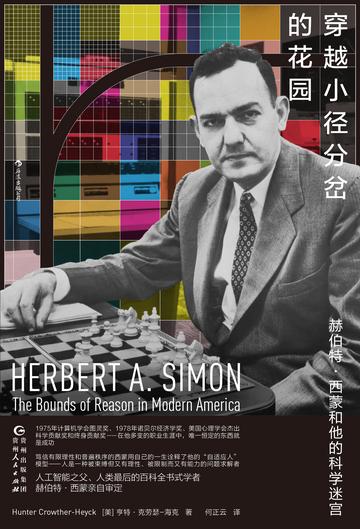
After the second industrial revolution, the Western world underwent earth-shaking changes. The old order is almost disintegrating, and modern society characterized by complexity and dependence is born in the throes of pain. Is there an order hidden in this complicated new world that can be grasped? Are there limits to individual rationality, and does it make sense? How do individuals in organizations make choices?
Herbert Simon spent his life searching for answers to these questions. Based on the same problem awareness, he first tried his hand in the fields of political science and public administration, and then turned to mathematical economics, and won the 1978 Nobel Prize in Economics with the far-reaching concept of "bounded rationality". In the mid-1950s, he began to study the psychology of human problem-solving. This work earned him the Lifetime Achievement Award, the highest award from the American Psychological Association. At the same time, he and his colleague Alan Newell jointly developed a "thinking machine" - the logic theorist. It was this program that announced the birth of artificial intelligence and put Simon on the podium of the Turing Award.
Starting from political science, passing through management, operations research, mathematical economics, cognitive psychology, and finally settling on information technology and artificial intelligence, Herbert Simon's success runs throughout his academic career. In the 20th century, when disciplines are increasingly divided, specialization is getting higher and generalists are almost extinct, it is a mystery in itself to achieve such dazzling achievements in so many fields. Why did Simon keep changing his major? What kind of transformation has his thought undergone? What imprint has the trend of the times left on him, and how has he shaped the academic frontier?
With these questions in mind, science historian Hunter Crowther-Haike tells the life of Herbert Simon as a profound academic leader and a long-sleeved social activist in a calm yet warm writing style. Simon's ambition to bridge the disciplinary divide, his persistence and belief in reason and order, and his persistent exploration of combining abstract concepts with practical applications are enough to bring us eternal inspiration and motivation.
Reader comments
This book resonated with me very much. It tells the life of Herbert Simon, who started from political science and made dazzling achievements in many fields. This reminds me of my job. Although I am just a courier, I also need to constantly learn and adapt to new changes, just like Simon, constantly exploring and challenging. His insistence on reason and order also inspired me a lot, allowing me to find direction in my busy life. This book is not only about science, but also about thinking about life. It is worth reading.



This book resonated with me very much. It tells the life of Herbert Simon, who started from political science and made dazzling achievements in many fields. This reminds me of my job. Although I am just a courier, I also need to constantly learn and adapt to new changes, just like Simon, constantly exploring and challenging. His insistence on reason and order also inspired me a lot, allowing me to find direction in my busy life. This book is not only about science, but also about thinking about life. It is worth reading.