Stats
9.1Score
9Chapters
Tags
Synopsis
Reader comments
In booklists 9
Nobel Prize for Literature, Mao Dun Literature Prize, Lu Xun Literature Prize and Other Literary Works
I want to read a book similar to "One Sentence is Worth Ten Thousand Sentences: Collector's Edition".
122.1MViews701Books3dUpdated
Literary Masterpiece, (ㆁωㆁ)
84.9MViews748Books1dUpdated

Novel About Educated Youth Going to the Countryside
63.3MViews367Books19hUpdated
Why Not Read Classics?
Recommend some good books that are meaningful, influential and well-written.
54.6MViews881Books15hUpdated
Worth Reading Literary Works
Keep it for the record and look at it again when you have time.
48.1MViews651Books2dUpdated
Japanese Light Novels, Campus Romance Novels Are in Urgent Need
If you want to watch something like "My Youthful Campus Life, I Don't Want Shura Field!" Book. Nowadays, I love light novels. Is there anything about the beautiful campus life of high school students? ‧⁺◟( ᵒ̴̶̥́ ·̫ ᵒ̴̶̣̥̀ )
17.9MViews258Books2dUpdated
Chemistry Books, Psychology, Mathematics Books, English Books, Physics
Simpler
12.7MViews732Books7dUpdated
Nobel Prize in Literature Works with a Score of 9.0 or Above
6.9MViews323Books9dUpdated
Literature Books, I Want Literature Books! ! !
Family members, I want to read literature books, books that can improve my writing skills or increase my knowledge. Beg on your knees!
3.1MViews739Books10hUpdated
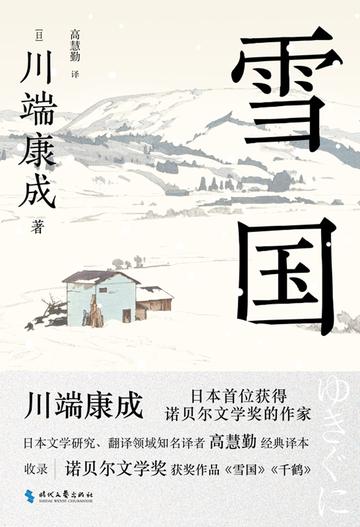
The writing is incredibly beautiful, the author writes well, and his translation skills are evident. Being in a snow country, but encountering a fire, this kind of story also makes people feel happy and frightened. Re-reading the "Thousand Cranes" part, it is poignant and graceful. It is clear that the Thousand Cranes itself is not the theme, but it seems to appropriately connect the whole story. But I often wonder, must Japanese stories transcend ethics?
Ye Zi is also another Ju Zi. He has Ju Zi's purity, and he also assumes the responsibilities that Ju Zi should do. With the separation of Dao Cun and Ju Zi, the purity of the year left like Ye Zi.
Snow Country is really beautiful. There is a view that people's traumatic experiences may be helpful to creation. The one we are most familiar with may be Sima Qian. He suffered castration but still insisted on completing "Historical Records". Do you still remember the preface he wrote after completing "Historical Records"? It seems that the Chinese textbook requires memorization. "King Wen was detained and performed "The Book of Changes"; Zhongniee wrote "Spring and Autumn"; Qu Yuan was exiled and wrote "Li Sao"; Zuo Qiu lost his sight and wrote "Guoyu"; Sun Tzu Binjiao compiled the "Art of War"; Bu Wei moved to Shu and wrote "Lü Lan"; Han Fei was imprisoned in Qin and wrote "Speaking of Difficulties" and "Lonely Fury"; the three hundred poems in "Poetry" are probably the work of sages and sages out of anger." Although there was a sense of being forced at that time, it was painful to read such a long article, but now it feels different when I read it. The "I" in "Knight Commander" and the painter Tomohiko Amada are such people. They both received their genius as a result of traumatic experiences. Painter Tomohiko Amada painted the painting "Knight Leader of Assassination". The painting features the elderly Knight Commander and his daughter Anna. Assassin painter Tomohiko Amada painted the painting "Assassination Knight Commander". In the painting are the elderly knight leader, his daughter Anna, and Don Juan, the long-faced man who assassinated the knight leader. During World War II, Tomohiko Amada and his girlfriend objected, and in the end his girlfriend was brutally murdered, while he survived in this world with the help of his family status. This painful experience was etched in Tomohiko Amada's mind and he couldn't get rid of it. From this, Tomohiko Amada depicted his trauma in this painting, sealing away the evil side of his human nature so that he could leave this world peacefully. What about "I"? I accidentally opened the painting sealed in the attic, and was led to the deep cave near the small ancestral hall, where I took out the ancient bell and liberated the knight leader. The knight leader who appears in front of "me" is actually an idea (concept). He borrows the form of the knight leader in the painting and enters reality, affecting "me" and the world around him. So, "I" started to become creative. This darkness is probably a nameless evil of human nature. It was the imprint left on "I"'s heart after my wife cheated on me and filed for divorce. Later, "I" sealed this painting in the attic together with "The Assassination of the Knight Commander", and I was able to return to peace. Therefore, Ruohe's sentence, assassinating the knight leader, represents a metaphor: Have you assassinated and sealed the evil side of your human nature? Mencius Translation and Annotation Mencius has no doubt that his death was the most spectacular feat, his honor, and his unyielding heart's struggle against the secular world and reality against the great. In a hurried life, he has experienced two love affairs that were tainted with the pursuit of fame and wealth, and repeated tricks, which were unacceptable to the world and despised by morality. The most sincere love that poured out all his sincerity was unforgettable for the person involved and made everyone enjoy the meal. Finally, I would like to say that this man was born, and he was born to die, and his death will be magnificent! (As an aside, throughout the book, our heroes also have various kinds of climbs in pursuit of fame and wealth, but their goal motivation is not to cater to the world and pursue enjoyment, but to be a great hero and imitate great heroes. The hero Napoleon changes the world. The idea of this book is not to turn around in the world, nor to seek glory in the world, but to criticize reality and fight against reality. From this point of view, both realism and anti-realism have something in common, but one stops at exposing, and the other has the motivation to change everything.)
I read the physical version, and it really captures the Japanese restrained style, and the exploration of the spiritual world is very good.
I found that my writing was very shallow, but I was afraid of trouble and just stated my feelings directly. In the snow country, Shimamura and Komako's love in the hot spring village was very moving and they cared about each other. However, Shimamura was obviously more preoccupied and didn't think much about it. He just inadvertently accepted Komako's love. But in the end the leaves died, which really shocked me. Then Chizuru, this short story goes around and around, saying that Kikuji's father had an affair with Mrs. Ota, and Mrs. Ota played more playfully with his father. They used the tea set as a carrier of their chaotic love, and even after death, they used it to reminisce. Mrs. Ota even regarded Kikuji as an extension of her father and had an inappropriate relationship. And all this was seen by two women, Chihuako and Miss Ota, and all they did was conceal it. There was a feeling that women were being devalued. Chikako is willing to be driven by her father, so she likes to destroy this relationship and interfere in Kikuji's life. Although later, after Mrs. Ota's death, Kikuji still wanted to inherit the legacy of some ancestors with Ms. Ota. But the pure Miss Ota said that she followed her mother's teachings and did not touch the tea set, which meant that she would not get involved in the relationship. In the end, she broke off the obscene song by throwing away the tea set used by her mother. The open-ended IOU also provides us with thoughts, but in fact there are only two endings, either Miss Ota dies or she does not die. After her death, the relationship may turn around and there may be a new beginning, but that's it. I think it is more suitable for her to die. In addition, I actually really want to see Kikuji and Chikako get together. Although they are his father's vassals, why can't they become his vassals? [Laughing][admiration][admiration][cool]
After reading Snow Country, I saw the two elements of "beauty" and "cold". After reading the interpretation, I found that Komako has a tenacious vitality, like steaming steamed buns just out of the oven. She is passionate about Dao Cun, dares to pursue love, and is full of hope for life. Ye Zi has a pure beauty like snow. The author first gave hope and let Dao Cun and Ye Zi go to Tokyo, but the final fire ending also symbolizes the fragility of this beauty and a reality. The beauty of beauty, an illusory beauty, is like the moon and sixpence, a contradiction between ideal and reality, while Dao Cun prefers illusory beauty and likes Ye Zi, but Dao Cun is also like an "outsider", feeling Ju Zi's feelings for him, but does not express his stance, is not responsible or rejects, and does not actively pursue Ye Zi. Of course he feels guilty in his heart, but his feelings are like a layer of glass between Ju Zi and Ye Zi. I would like to call it "loneliness". But what the author wants to express is the "futility" that Shimamura thinks. When all the beauty, pure, warm, and tenacious are swallowed up by the snow in the snow country, everything returns to nothingness. Then what is the meaning of all existence? This is in line with the style of Japanese Mono-e literature. Regarding the discussion of beauty, passionate beauty is close to reality with warmth, while illusory beauty that does not belong to the world is fragile and desolate.
The writing is very beautiful and the Japanese style is very distinct. It's really beautiful.
I read the physical book, and I was really shocked at the beginning. I felt really talented. I really like Komako, and I feel like she is a copy of me. The person I like always dislikes me, and I have worked hard for a long time but it is still in vain. Shimamura has never really liked Komako. He has a good life and a favorite career, but Komako is just a geisha who cannot control her own choices. In terms of identity, they are completely different. But her persistence still makes me unforgettable. Even I can't help but sigh. It's in vain.
I don't understand it, but I like it
The description is very delicate. This novel is like an elegant ink painting. It is breathtakingly beautiful. Reading this book is like staring at the ice flowers on the car window in the depth of winter - the beauty is really beautiful, and the cold is really cold. Kawabata Yasunari wrote the word "futility" to the core: Komako worked hard to learn the piano, keep a diary, and love someone who didn't love her. All these efforts were "in vain" in Shimamura's eyes. However, this kind of vitality that still wants to live despite knowing that it is meaningless is precisely the most heart-wrenching part of the book. Yasunari Kawashima uses delicate techniques and profound literary skills to perfectly integrate the inner world of the characters with the external environment, and creates a very three-dimensional and vivid image of the characters, making people read as if they are immersed in the scene, empathize with them, and have endless aftertaste. Although the plot of this book is not that fascinating, the atmosphere it creates is very touching. If you want to sink your heart and feel the "broken beauty of ultimate nothingness" tonight, it is definitely a top-notch work of art and your best choice. It is not suitable for "reading", but more suitable for "tasting". It is like drinking a pot of cold sake, which has great stamina but is very bitter in the mouth.
Why didn't Mrs. Ota let Fumiko order tea? ? Why was Kikuji so shocked when he heard this? ? Or Ye Zi... Is she dead? Also (typo)
It's really beautifully written, and it also has Japan's unique sentimental sadness. It's beautiful and desolate, and it gets worse and worse step by step, and finally dies.
Whether it is Snow Country or Chizuru, the character descriptions in the book are very detailed, and many psychological descriptions are very powerful. The plot feels a bit like a stream-of-consciousness novel, which is more attractive, but not easy to understand thoroughly. And regarding the background or theme of this book, there must be a reason to win the Nobel Prize for Literature. Kawabata Yasunari said that writers should write things that violate morality and confront people's desires. Indeed, we have to accept the existence of all thoughts.
The poetic language tells an illusory love story that seems to be there but not at all. The love of all geishas begins like the master's, with no ending. It is just passed down like a moth laying eggs, and then they die one by one. The sad tragedy is like leaves and horses, which can only waste time in turning one turntable after another. Oh, woman, you are abusive!
Okay, okay, haha
I remember when I was in school, in order to write so-called reading notes, I forced myself to read the entire text word for word. I just couldn't see it clearly at the time. I didn't understand the meaning of this emotional description. Now that I look back and think about it again, I am full of emotion.
February 13, 2024 Zunyi Zheng'an, Guizhou
The writing is beautiful, but maybe it's because of cultural differences! I feel like I'm a little under-understood in some places.
The character of Ju Zi left a deep impression on me, and her phrase "in vain" made people feel helpless and sad. I like the atmosphere created by this work very much. It makes me feel like I am in a snow country and feel the unique tranquility and beauty. As for "Thousand Cranes", it shows the conflict between love and morality. Although complex and controversial, it is also worth reading.
Everything is nothingness, and the infinite pursuit of the mirror, flowers, water and moon is also a kind of aesthetics.
The writing is beautiful and artistic, especially "Snow Country". It is indeed worthy of winning the Nobel Prize. It is like a work of art that makes people admire.
Very good psychological description
The characters are drawn very delicately
Passing through the long tunnel across the border is Snow Country.
The future is like the snow in the snow country. It is cold and the direction cannot be seen. It is getting bigger and bigger until the withered grass is buried with the past.
The Snow Country is like a beautiful and gorgeous firework. After it blooms, only the black night is left. Maybe... There will be another bouquet of fireworks waiting to go off.
The book is very interesting and makes sense. It gave me a lot of inspiration.
It's very beautiful, with a lot of side descriptions, the time jumps sometimes, the emotions are quite complex, and the ending feels very sudden and strange.
The language is very beautiful and gives people an ethereal feeling. It will be a little uncomfortable at first, but when you calm down and think about it carefully, you will feel the inner peace.
Good, good, good, good