I have some unique perspectives on the role that emotions like anger play in our lives. People often think that anger should be suppressed, but I question this idea.
People think that negative emotions are negative. In fact, "positive" and "negative" are respectively: "feelings that occur when our needs are met" and "feelings that occur when our needs are not met." Both are very valuable and they both speak to life! So I think anger can be a gift that helps us connect to unmet needs, because it's those unmet needs that trigger our reactions like anger.
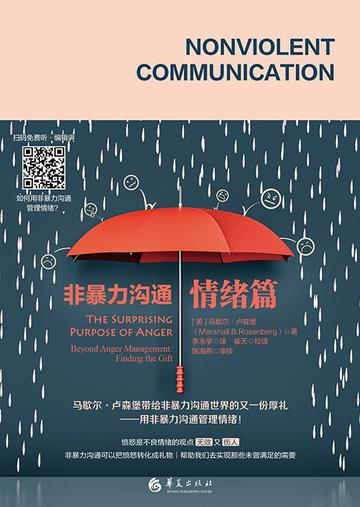
"Nonviolent Communication: Emotions" reveals people's common misconceptions about anger. At the same time, the discussion about anger will more easily support our better understanding of nonviolent communication, because it involves many key nonviolent communication characteristics. In fact, when emotions like anger come to you, you can still start from your heart, conduct non-judgmental observations, clearly understand your feelings and needs, make clear requests, and try to have more colorful connections with life. When we shed the hidden mental violence, love will naturally reveal itself. The idea that anger is a bad emotion is invalid and hurtful. Nonviolent communication can transform anger into gifts and help us realize those unmet needs. This is another great gift that Marshall Luxemburg brought to the world of nonviolent communication - using nonviolent communication to manage emotions!
Reader comments
"Non-violent communication" is a way to correct one's own ideas and help others correct their ideas. It can dig out deeper "needs" from superficial "confrontations". All confrontations are manifestations of unsatisfied needs. Why communicate violently? Because expressing needs will make you feel ashamed, so you use strong methods to try to persuade the other party to obey instead of persuading. In nature, it is difficult for the weak to survive. Expressing needs represents one's own shortcomings and weaknesses, which is unbearable for individuals. So by blaming others, one's own shortcomings are replaced by others' shortcomings. In this way, it is not that I am weak and unfit for survival, but that others lack my needs, and misfortune is also the fault of others. , This is called "projection" in psychoanalysis and "inferiority complex" in individual psychology. It is an individual who projects negative emotions that he cannot accept onto others, so the other person in his eyes is the projected self, the person he blames because he does not want to admit his shortcomings. There are many versions of this book, but they all use the same method: "Understand what your own emotions need and express them, and understand what the other person's emotions need to help him express them."
This book gave me a new understanding of emotions! It teaches us that there are no good or bad emotions and that anger can be a gift. The author Marshall Luxemburg has a unique perspective, a concise and clear writing style, and smooth writing. He uses non-violent communication to help us understand and manage emotions. This is not only a book about communication, but also a book about self-growth. It is worth reading!
What is observed is reality, what is imagined is criticism. Have you learned to distinguish between what is observed and what is criticism? What causes anger? Anger is a natural feeling caused by unnatural thinking.
A book worth reading again and again can indeed temporarily change or alleviate the emotional problems of communicating with people, but in fact change is still a long process. Maybe like Marshall's friend in the book, he needs to write some small cards to remind himself repeatedly ¯(°_o)/¯
Nonviolent communication is really helpful for interpersonal relationships and seeing inner needs. I will practice it slowly and no longer use anger to express needs. I want to see the real needs behind it.
Relatively easy to read, this is one of the few books related to communication that I read with great interest.





"Non-violent communication" is a way to correct one's own ideas and help others correct their ideas. It can dig out deeper "needs" from superficial "confrontations". All confrontations are manifestations of unsatisfied needs. Why communicate violently? Because expressing needs will make you feel ashamed, so you use strong methods to try to persuade the other party to obey instead of persuading. In nature, it is difficult for the weak to survive. Expressing needs represents one's own shortcomings and weaknesses, which is unbearable for individuals. So by blaming others, one's own shortcomings are replaced by others' shortcomings. In this way, it is not that I am weak and unfit for survival, but that others lack my needs, and misfortune is also the fault of others. , This is called "projection" in psychoanalysis and "inferiority complex" in individual psychology. It is an individual who projects negative emotions that he cannot accept onto others, so the other person in his eyes is the projected self, the person he blames because he does not want to admit his shortcomings. There are many versions of this book, but they all use the same method: "Understand what your own emotions need and express them, and understand what the other person's emotions need to help him express them."
This book gave me a new understanding of emotions! It teaches us that there are no good or bad emotions and that anger can be a gift. The author Marshall Luxemburg has a unique perspective, a concise and clear writing style, and smooth writing. He uses non-violent communication to help us understand and manage emotions. This is not only a book about communication, but also a book about self-growth. It is worth reading!
What is observed is reality, what is imagined is criticism. Have you learned to distinguish between what is observed and what is criticism? What causes anger? Anger is a natural feeling caused by unnatural thinking.
A book worth reading again and again can indeed temporarily change or alleviate the emotional problems of communicating with people, but in fact change is still a long process. Maybe like Marshall's friend in the book, he needs to write some small cards to remind himself repeatedly ¯(°_o)/¯
Nonviolent communication is really helpful for interpersonal relationships and seeing inner needs. I will practice it slowly and no longer use anger to express needs. I want to see the real needs behind it.
Relatively easy to read, this is one of the few books related to communication that I read with great interest.