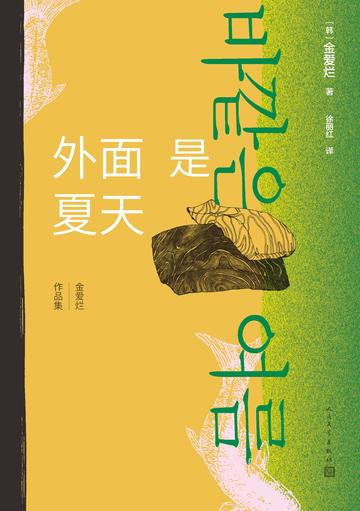
It's Summer Outside (Collection of Works by Kim Ae-Ran)
外面是夏天(金爱烂作品集)
- Status
- Completed
- Length
- 90k Words
- Updated
- 2y ago
- Source
- Fanqie
Stats
1.3kReads
9.4Score
470Shelves
11Chapters
100Listens
39.1kReads · all time
Tags
Synopsis
Reader comments
In booklists 3
Looking for Literary Works That Can Improve My Writing Skills! ! !
29.9MViews522Books1dUpdated
Books to Improve Your Sense of Chinese Language
I want to read books similar to "The Collection of Lu Xun (21 volumes in total)". I'm looking for books with stories that are more interesting and interesting.
8.3MViews570Books2dUpdated
Literature Books, I Want Literature Books! ! !
Family members, I want to read literature books, books that can improve my writing skills or increase my knowledge. Beg on your knees!
3.2MViews764Books1dUpdated
After reading the whole book, I once again lamented that Jin Ae-ran's writing really has his own style. It has set a slightly melancholy tone from the beginning, which can make people immerse themselves in the scenes and stories. I remember that it was written in the preface or introduction that this book is about loss, so whenever I wonder what the story wants to convey to us, these two words will once again guide me in the direction of reading. The protagonist in every story is losing, losing a child, losing a companion, losing a relative, or losing a partner. Whenever I feel that the sadness and hidden pain in the text are about to overwhelm the protagonist, in the end they seem to be slowly accepting life and gaining a stronger version of themselves. This is what makes me feel sad and healing at the same time.
I finished reading "It's Summer Outside" by Kim Ae-ran. When I read this book, I found that although the implicitness of Eastern literature is very beautiful, and the rhetoric is impeccably elegant, it is too implicit, so I still felt confused after reading it... A bit in a fog, and it was actually very difficult for me to understand some of the expressions. There are also some articles that I was really looking forward to when I read the preface, but I feel that my expectations may have been increasing unconsciously, so after reading it, I felt that it had not reached the ideal state, and I felt that it was not as good as what was not mentioned in the preface. For example, when I reread the first article, I found that the concept was particularly clever...! ! It's the kind of ideal interlude (I don't know if it is, I can't tell the difference between interlude and supplementary narration), Memoirs of God! Maybe because of re-reading it, I succeeded in empathizing with the characters described. I really like the first chapter, "The Opposite Side". The characters in the story are indeed in a "wandering" feeling, but when I read it, I felt like the hole had not been filled...
Each short story is filled with a touch of sadness. After leaving school, my life seems not to be so smooth sailing, and stumbling blocks always surround me. In this novel, there are parents who lost their children, a boy who lost his puppy, a couple who lost their love, a language that lost its users, a family that lost its connection, a wife who lost her husband... At the beginning of a loss, grief is always the most intense. Soaked in tears every day, everything from skin to internal organs is pickled. I don't know when my heart started to feel less and less painful. Did time give me the prescription for forgetting? It's not just a passive acceptance, it seems to be an active choice of one's own. People grow up between constant loss and acceptance.
This book is very lifelike, and the characters in the story seem to be living around us. I particularly like the old lady in "Where Do You Want to Go"? She lost everything but is still so strong. I also hate the man in "The Silent Future". His selfishness makes people very angry. Jin Airan's writing is very plain, but it touches people's hearts and makes me feel the pain and beauty in life.
There is a touch of sadness throughout the book, and each chapter ends abruptly when I want to know the ending most. It is this incompleteness that impressed me even more. The most touching thing is life and death. This person has passed away, but the living people are always immersed in pain. A small thing will bring back memories of him and the eternal dampness. Books are short, chapters are short, and human life is also short.
First of all, after reading this book, I feel that my soul has a compassionate attitude towards many things in the world. In fact, if you think carefully about the protagonists of each story in the book, they are all very smart. Some of the protagonists even have pretty good academic work, such as being university lecturers and having the opportunity to go abroad. But their mental grief seemed so overwhelming that I was particularly afraid that they would not be able to bear the pressure and commit suicide while reading it. No matter how glamorous the appearance is, sometimes it can't stop the blow of reality. Only if a person's spirit is strong enough can he have the power to fight back in the face of reality. If this book is compared to a person, then he must be a sensitive and delicate person. You may not be able to read some sentences in this book, but it does not prevent you from reading it fluently. I think this is amazing, and some of the metaphors are used very subtly, which must be attributed to the translator. Although this book is filled with great sadness, its language is light and smart, and its many detailed descriptions allowed me to get the mood of the characters at once. Perhaps we understand the grief in the book as the hope that vaguely emerges from the ruins, just as Liu Tong wrote in "Your Loneliness, Even in Defeat, Glory", "Escape is always a loser. Only facing is the first step to win."
This book uses different stories to tell different losses and regrets. It does not give loss and regret a destination, but it leads us to think about how to face loss and regret.
I have read it intermittently. Every little story is very interesting. The author's metaphors are really superb. Many metaphors are amazing👍After reading each story, I feel calmer than ever before. Occasionally, I feel a little rippled. I like the author's writing style.
The writing is very delicate, and the many detailed descriptions made me feel the author's love for life, and it also made me start to love life. A touch of melancholy, maybe this is a characteristic of Korean writers. It is the kind of touch of sadness that can be remembered for a long time and never go away.
I don't know if this is a line drawing, but the language style is very distinctive. The story will not make me cry immediately, but it will make me think "Oh, how miserable" when I am in a daze on an ordinary afternoon in the future.
The author's writing style is very delicate. Those things that are not often noticed in life are like having a magnifying glass and are brought to the eyes of the author. The overall mood is a bit sad. If you are still young or have not been in a good mood recently, you can put this book away first. I personally feel a lot of emotions about this book. You can read it, but you must not think too much about it. Because it's so well written, it's like it's part of my senses being broadcast live. Very nice
Ordinary life and the pressure of taking public exams, the world of two people, two worlds, being together is accidental, and being apart is inevitable. Although it's hard to leave, it's better to leave as soon as possible and start a new journey than to suffer together for the rest of your life.
It's summer outside, a summer with the bitter aftertaste of loss I often envy others who can say things that I can't, and write sentences that I can't. This sentence kept popping up in my mind when I was watching Jin Airan's works (the first half of "The Silent Future" is too similar to what Wu Qingfeng wrote, and while I was watching it, I kept thinking that he would definitely like it or have definitely seen it)
The language gives people a sense of plainness, and some stories have an illusory and ethereal feeling. The plot is close to life and expresses real life vividly. Some language descriptions are also painful and shocking. Reading will make people really think about our current life.
It's so well written. Every story reveals the dark, reasonable and normal side of human nature. Reading it makes one's heart tremble, and it's terrifying to think about it.
The story between Zheng and Evan made me wet the pillowcase with tears.
This collection of short stories by Jin Ae-ran has a Yuhua-like feel.
White snowflakes are flying in the glass ball, but outside the ball it is summer. A noisy and exuberant season.
Such a delicate expression of emotion, a bit depressing to watch
It feels like it is narrated by a friend. Each story has its splendor and origin, which is worth savoring. Maybe this is the variety of life, this is life, ordinary and simple, suffering and strong, each story feels like a picture appearing in front of you, real and full of philosophy.
The content is not too long, it is really delicate and easy to empathize with. Some small points in life that cannot be expressed well are written down.
Very modern, delicate and life-like
Very delicate writing, very catchy
It's summer outside, but my heart feels like cold winter
My favorites are "Lousin and Evan" and "Where Do You Want to Go".
It is not easy to review and accept loss peacefully. What is left behind is not only the memory, but the small changes are like ripples on a calm lake, pushed in circles, spreading out, and it is no longer the past.
I love Jin's words and the stories he writes. I like her abstract metaphors of concrete things, her meticulous observation of life down to the dust particles floating in the air, her precise grasp of the pace, and the unresolved dilemmas and unresolved lives in all her short stories.
Such delicate writing... Some of it is so depressing.
There are different chapters. The stories in each chapter are very exciting and beautiful.
The description is very detailed and makes people want to keep reading.