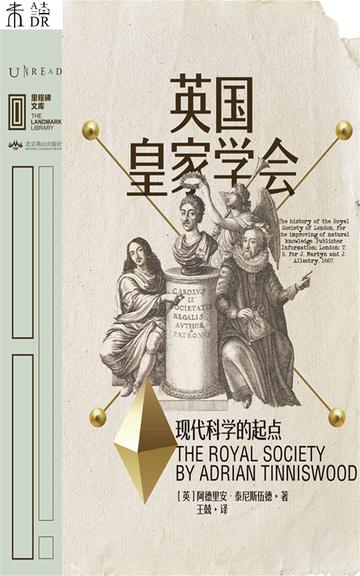
The Royal Society is one of the oldest scientific institutions in the world and has made great contributions to the dissemination of natural science knowledge. Scientific giants such as Newton, Darwin, Leeuwenhoek, Boyle, and Hawking were all its members. Relying on the unremitting efforts of generations of outstanding members, and after more than 300 years of continuous growth and transformation, the Society has gradually developed from an "invisible academy" founded by enthusiasts to one of the most cutting-edge institutions in the world's science.
In this book, Adrian Tenniswood takes us back to the difficulties and prejudices faced by the Royal Society at its birth, its unremitting efforts to gain social recognition, and the bumpy road it took to promote experimental science. As time goes by, while the rapid development of science and technology has brought about disruptive changes, many problems have arisen. How to carry out scientific research also needs to be rethought. Therefore, the motto of the society - "Do not follow what others say" - still has great practical significance, warning us not to blindly believe in what others say.
Reader comments
I especially like the part in the book about learning to grow from difficulties and prejudices, and I admire their efforts in scientific research. And the book also mentioned the problems facing modern science, which made me think about how we should treat science. All in all, this is a very inspiring book and I recommend it to you!





I especially like the part in the book about learning to grow from difficulties and prejudices, and I admire their efforts in scientific research. And the book also mentioned the problems facing modern science, which made me think about how we should treat science. All in all, this is a very inspiring book and I recommend it to you!