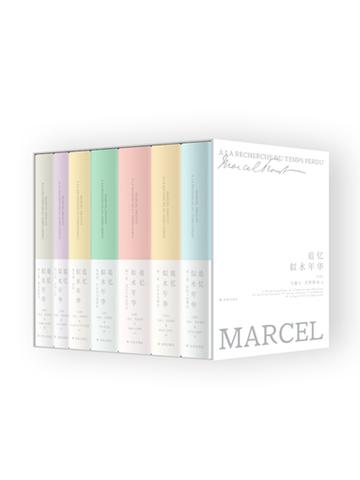
Looking Back on Lost Time: Collector's Edition (7 Volumes in Total)
追忆似水年华:珍藏纪念版(共7册)
- Status
- Completed
- Length
- 2.4M Words
- Updated
- 2y ago
- Source
- Fanqie
Stats
672Reads
9.4Score
209Shelves
34Chapters
68Listens
40.1kReads · all time
Tags
Synopsis
Reader comments
In booklists 3
Nobel Prize for Literature, Mao Dun Literature Prize, Lu Xun Literature Prize and Other Literary Works
I want to read a book similar to "One Sentence is Worth Ten Thousand Sentences: Collector's Edition".
122.5MViews725Books5dUpdated
Are There Any... Foreign Masterpieces... Chinese Masterpieces?
2MViews783Books9dUpdated

Big Collection of VIP Books! I Want to See How Many VIP Books Tomato Has
281.3kViews112Books1dUpdated
Proust's life is undoubtedly short in today's eyes. The fifty-four years ended before the traces of the coastal cliffs were etched on his body. He lived in France where the old and the new were intertwined, and where wars and great changes were the most frequent. Fang was born in the aftermath of the Franco-Prussian War and died in the mist after the First World War. When he was alive, the old French aristocratic society fell from the palm of Galileo's hand to the mid-air of the Leaning Tower. However, he faithfully recorded the lost time. The water droplets flowing from his fingertips were just like the past years. No matter how hard he tried to save them, only the wet marks on his palms remained. The miracle of Proust was that he glimpsed and restored the paradise of apoptosis on paper through the extremely weak and subtle sensations brought to people through neural electrical signals before the wet marks were about to disappear. As he said, the reality we are experiencing does not match our imagination, and we are too late to bring ourselves the only happiness that imagination can bring. However, "a small Madeleine cake soaked in tea" and "the uneven paving slabs outside St. Mark's Basilica", just like the traditional Celtic beliefs, the souls of the lost time are placed in these moments, and when the memories reappear, we truly understand the meaning of life. Forgetfulness is defeated and we have never lost them. The author's writing never leaves life, aging and death. Life can have countless sections. The countless individual lives in the novel are all reflected in the colors of love and social interaction. And love, this passing away like a fleeting cloud - or just a complete temple composed of sad people, confused people, passionate people and jealous people, is exquisitely composed. The author presents the infinite gestures in it, which can appear or pass away in an instant; be lost or rekindled in forgetfulness. In the two-way torture, they are afraid of being separated from each other, but at the same time they are aware of their own pain; they are safe when they are together, but they are jealous and even doubtful when they are separated, but they also feel that when they are together, "even if the appearance is fully present, it is never possible to get a glimpse of the heart." Separation only deepens the fire of love. Even the process of forgetting is still in the winding path of memory. Only by walking back can we reach the confused starting point! Hilbert, the author's first love, the moist and fluid familiarity of the past, was eventually "separated by life", or rather separated by the growing body and the throbbing heart. The vague feelings for Mrs. Guermantes that sprouted along with pure lust and youthful mood also dissipated when the Guermantes complex was unveiled by the naked reality. Albertine was undoubtedly the most passionate and lasting love affair. The beautiful figure of the girl when they first met on the beach of Balbec, and the ensuing curse-like transcendental moral judgment were quickly covered up by the almost inaccessible nobility burned by desire. However, when they reunited again, the double changes in appearance and love were renewed. The image of Albertina, and the curse of the two forbidden sin cities "Sodom and Gomorrah", along with the deepening of doubts and lies in the passionate love, have become mysteries and gaps. The girl who yearns for freedom finally becomes the author's "female" in Paris. "Prisoner", the protagonist finally uses irony to cover up his sincerity, thinking that he can keep everything together, but he can only run away after a night walk. When the letter of never seeing him again is handed out, and he is actually full of hope for the return of his lover, the news of his death comes unexpectedly. Life exists in infinite areas, such as Combray, Messegliese, Paris-Saint-Germain, Doncières, Balbec, Venice... Place names are the interweaving of colors and light and shadow, and are also the basis of countless memories. Even if they are forgotten in parting and covered with dust in the war, what the author gained when he and Gilberte set foot on the trail of Combray again is by no means less than when he looked at the children attending the church school in the fields. The awareness of time is present throughout the text, and it becomes increasingly clear. Aging and death are perfect footnotes. Grandma, Swann, Albertine, Saint-Loup, everything is so perishable. Fortunately, what we can grasp is only a short slice of time, and its existence does not depend on the outside world. I almost forgot that the author, as the subject of all narratives, is always meticulous, watching everything calmly or passionately, and is still the bearer of aging. In the light footsteps of the words, it seems that we have also gone back to the past more than a hundred years ago, from the gray terracotta countryside of Combray to the boulevards of Paris. Like the author, we have lived a long and profound life, experienced sad and sad or heart-tugging memories, witnessed the decaying social scene, the withered beauty, and the watery youth. All fleeting impressions are eventually transformed into concrete existence by the author. "This is a longer book than One Thousand and One Nights", but it is not the same. When the narrative is coming to an end, the author points out passionately that this book will guide readers to discover their own lives. Indeed, it is! Seeing the afternoon between the ringing bells is not the memory of sitting on the school afternoon chair; is the fantasy impression of the Venetian Gothic city not our reverie about countless unknowns? The author has long since withered and fallen into the soil along with the vegetation of that era, but I can still see from the end of the page that young man who was sensitive, fragile, and thoughtful, accurately captured every picturesque moment, and had an indescribable sentimentality for time, leaning over the table, writing for Mr. De Blois was thinking about writing for the visit a few days later, and the lingering ringtone that must have sounded when his childhood guest left echoed in his mind. He was completely unaware that he had cast an immortal gaze that spanned centuries on the white paper stained with writing marks.
The classic among classics must be read diligently and repeatedly! As for most of the books, it requires great courage and super perseverance. You have to be able to endure loneliness and sit on the bench. As for its stream of consciousness, it cannot be understood by a clear brain and careful reasoning. It must have leaping thinking and rich associations. Speaking of its literary nature, it is not only a simple and majestic master of its own, but also its vivid metaphors, such as "pure French dancing between lips", etc., Are absolutely unprecedented!
It took me 6 years to finish reading it. After reading it briefly, I understood it. From the irritability when I first read it → to the shock after repeated reading → to the spiritual nourishment I finally gained. I dare not say that I fully understand it, so I can only use Maugham's "I would rather read Proust and get bored than read the works of other writers to relieve my boredom" or Proust's book "Things that you can fall in love with quickly are often short-lived; only those you can fall in love with slowly can you love deeply and long-term." He uses the longest length to capture the shortest moment. Good reading is not about acceptance, but about awakening. The value of a book depends on how much of yourself you read in it. 1. Philosophy, rebuilding real life in the ruins of time 1. Unconscious memory: the key to the essence The moment of "Little Madeleine", just as Proust pointed out that active recall can only restore the skeleton of facts, and unconscious memory can resurrect the "truth of feeling". Only by combining the two can "reminiscing" be complete. Trigger conditions - any pleasant or unpleasant sensory experience - "the things that most evoke our memories are the things we have long forgotten." Past events are hidden in the senses given by objects, not in the scope of intelligence. For example, the uneven stone slabs underfoot when walking (the floor of the Baptistery in St. Mark's Basilica in Venice), the rough touch of napkins (the towels on Balbec Beach), these "discomforts" make it easier to break the dullness of habits. 2. Synchronicity and the nature of life Proust believed that when unconscious memory is triggered, what we experience is an "eternal moment" - a moment in which the past and present are present at the same time, and people are temporarily freed from the linear passage of time, and therefore no longer afraid of death. Because death only destroys "temporal" life, while "essential life" transcends time. 3. The falseness of the representational world Proust believed that things such as material, power, money, social comparison, love pain... And even "pain" itself may become symptoms - if you are painful because the other person does not love you or others look down on you, it is just "social pain"; the real pain must touch "existential loneliness", that is, the break between you and your true emotions. The world of appearances will become fragile and evanescent under the influence of time and emotions. Behind the reality are human desires and vanity, pointing to universal human nature. 4. Limitations of rational cognition The "reality" obtained by relying on reason, intelligence, and active memory is false. Habitual cognition will paralyze the senses. Only by touching the deep experience of life can we obtain the true reality. If the accumulation of knowledge is divorced from real life, it is just an escape. Proust was not anti-rational, but pointed out that reason can only deal with "classified knowledge" and cannot touch "unclassified, living experience." If the accumulation of knowledge is just a pile up, it is indeed a kind of escape; but if it is used to clarify experience and help expression, it is a prelude to art. 2. Art: The only weapon that can fight against time and nothingness 1. Art does not imitate life, but reveals the essence of life. Writers do not take pictures, but extract the "deep truth" obscured by habits from the surface. 2. Creation itself is a kind of "reliving": When Proust wrote on his sick bed, he was not reminiscing, but using artistic forms to "crystallize" the scattered moments of life into eternity. 3. What readers complete in reading is their own "recollection": good books do not instill truth, but are like a magnifying glass, allowing readers to see the originally vague truth in their own hearts. 3. The dialectical paradox of pain and love: 1. Proust did not advocate "actively seeking pain", but said: when pain is inevitable (such as jealousy, separation, loss), do not escape, but use it as "an opportunity to dive deep into your heart." Pain is a "mining tool," not an end. 2. The negative film theory of love: Just as two people cannot feel happiness when they get along, memories will only appear after separation. He believes that "happiness" in love is actually the experience of "absence of pain" - you feel happy when you are not jealous, not because you love deeply, but because you are temporarily safe. 3. Why do people fall in love with people who are different from themselves: They are often confused by appearances or unsuspecting and gradually fall into them. The deeper reason is: what we fall in love with is not the other person, but the state of life in the other person that "we can never be". So love is essentially "obsession with the missing part of yourself," and therefore necessarily painful - because you can never truly have that state. 4. Pain is a tool towards truth, even sublimation into art - one of Proust's most profound insights. It's not that "pain deserves to be celebrated", it's that art can extract "general truths" from pain. Writing about jealousy is not to accuse Albertina, but to reveal "the emotional structure of jealousy." Once this extraction is accomplished, personal suffering becomes a specimen of universal humanity. 5. The relationship between aristocratic salons and the civilian world Proust spent a lot of space writing about the salon of the Guermantes family, Jupien's hotel, and the living room of the Verdulain family. These are not only the stuff of "social comparison" but also the juxtaposition of different "social class worlds." Through the process of the protagonist from "upper class worship" to "disillusionment", the illusory nature of social status is revealed - but this level of disillusionment itself is completed through extremely fine social observation. 6. The hidden structure of homosexual themes Baron Charles, Jupien, and even the relationship between Albertine and André are not his verbose side stories. Proust used "homosexuality" to demonstrate a more general proposition: the object of desire can be changed, but the structure of desire (jealousy, possession, loss, memory) is eternal. Charles's pain of abandonment and the protagonist's jealousy of Albertine are completely isomorphic in structure.
I haven't finished a chapter yet [shy], but I always read half of it, and I'm afraid I won't read it next time, so I'm going to comment first. The author is such a cute mama's boy. He is very sensitive and full of emotions. I saw earlier that his mother died and left him a large inheritance. I can't imagine how sad he must be. He also had insomnia. When he had insomnia or even when he fell asleep, his mind would jump so much that he would sleep from one bed to another, which was very interesting. I only thought it was interesting at first, until I saw his father, I suddenly remembered that in that era, people pursued ideals and sensibility, which were suppressed things, but the author's emotions were like a flood. Some people are still experiencing the real and sour emotions to this day (such as me [making faces]), and the author also described it as literary and vivid (I want to praise it but I can't [grievance]) Of course, there are many things in the article that reflect the times. The sharp contrast (Ivan and the author's elders), wow, he is really a person from a feudal society and a capitalist society. It is really interesting [blowing kiss]
Regarding this book, I added it to my bookshelf on March 27, 2023. It was not until today, February 19, 2026, that I finished reading this masterpiece, although I had about 61 reading days. Who made that widely circulated comment - life is too short, Proust is too long. At first, I dismissed this sentence, but as I picked up the book intermittently over the past three years, my life has also changed. Three years is a long time, enough for certain things to happen and change, but these three years are also very short, because I can only finish reading this book. Speaking of my relationship with "In Search of Lost Time", I remember that I first learned about this book from Garcia Marquez's "Love in the Time of Cholera". I remember that Proust was highly praised in the book, so I was curious about the charm of this book. Reading such a book is very dull and boring, because its thoughts are like the mud in the swamp. Once you step into it, you will sink in. But at the same time, reading such a book is interesting and makes you want to cry. Why do you want to cry? Because if you are determined to finish reading such a book, it will be very painful. It's hard to understand what's interesting about it, because its requirements are very high, especially high. It's like those philosophy books. You can only understand it when you resonate with the author's soul, as if you are listening to Proust telling you these stories face to face, or you yourself are Marcel (the name of the protagonist in the book, generally considered to be the incarnation of Proust, because Marcel Proust). Such a book can be said to be a complete way to experience other people's lives. A kind of classical French aristocratic life is difficult to find and understand if you just look at it. But at the same time, we can only rely on listening or reading. These two methods. As we often say, it is very simple to retell a story. It is very easy to read the book and retell the story of the book. But in this case, you will lose the opportunity to read the book. It is difficult to open a book like this after you read it once, especially when we are young. If you want to know the gist of this book, I can indeed tell you, but if you look at other people's comments and want to know the gist, then you have lost the opportunity to talk to Proust's soul. And this book is as simple as its name, "Reminiscence of Lost Time", why must it be "Reminiscent of Lost Time"? Because that is what we can pursue but cannot obtain. Like Marcel, he pursued Gilberte and Albertine. But we will find that he has always touched their souls and can never cry and hold their souls in his arms, including his beloved grandmother. When our loved ones leave, we will not cry until we suddenly see the yesterday of our loved ones in peace. The cold tears we want to stop will make us faint. Speaking of which, there were many such genres in that era, such as Thomas Mann's "Death in Venice" and the Russian symbolism novel "The Burning Angel". However, after I read it, only "In Search of Lost Time" made me couldn't help but wipe my wet eyes with paper after reading it. But if you want to read this book, you still need to be able to endure the cold shoulder, because you don't know when you will be able to build a bridge with Proust's soul. Like me, I remember reading a description of flowers by him in the second volume or somewhere. I remember that he seemed to compare the blooming flowers to a bride. When I read this, my soul trembled. The last time I felt this tremor was "Steppenwolf" which pulled me into reading such a book. The tremors in my soul made me feel that reading this book was no longer a torturous enjoyment, but even so, it still took me three years and more than 90 hours to read this tearful book. Life is too short and Proust is too long. No matter how many books I read in the future, my soul will always remember being scratched with a knife by this book "In Search of Lost Time". If you ask me for advice on reading such a book, I can only say that other methods of taking reading notes and underlining golden sentences are just nonsense. Maybe this method is suitable for you. But for me, my soul will always embrace this "ordinary novel" with tears.
This book really made my heart ripple, as if I couldn't put down my rice bowl and wanted to keep filling my stomach. The memories in the book made me understand that human life can be such a graceful life. If it were us, we might not have that many memories to recall.
Taking into account the characteristics of novels and prose, it is both narrative and lyrical, and is very beautiful.
This book is like a symphony, with various themes intertwined, making me feel the charm of time. The author's delicate description of memories made me recall my own childhood. The characters in the book experience love and hate, joy and pain in the long river of time, which made me deeply realize the colorfulness and complexity of life. I think we all need to cherish the present moment, because every moment will become a memory.
There are golden sentences in each paragraph, describing the modern story in detail.
A very good book, love comes from porcelain👍
A classic is a classic!
One of humanity's bibles.