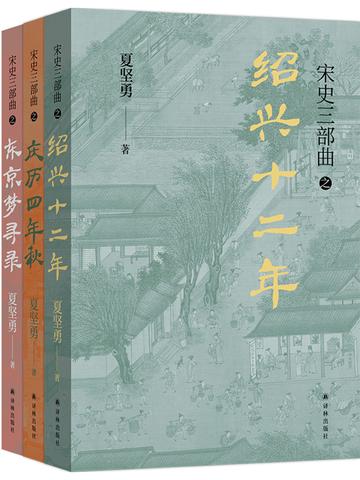
The "Song History Trilogy" includes "The Twelve Years of Shaoxing", "Autumn of the Fourth Year of Qingli" and "Tokyo Dream Search". It takes three representative historical periods as the narrative nodes: the twelfth year of Shaoxing under Emperor Gaozong of the Southern Song Dynasty, the fourth year of Qingli under Emperor Renzong of the Northern Song Dynasty, and the first year of Xiangfu under Emperor Zhenzong of the Northern Song Dynasty. Starting from the meaningful historical events of Yue Fei's murder, Qingli's New Deal, and Song Zhenzong's eastward enfeoffment, it enters a cross-section of history, elucidates the subtle details, and peels off the cocoon. The narrative time of the work spans the two Song Dynasties, covering customs, prices, imperial examinations, arts and literature, officialdom, reform, tea administration, horse administration, ultimatums, edicts, geography, climate, celestial phenomena, industry, foreign trade, clan, relatives, officials, It covers every detail, from the turbulent political struggles and checks and balances between monarchs and ministers, to the various world conditions of people selling pulp in shacks and carts, vividly reflecting the political situation and social life of the two Song Dynasties. It can be called the literal version of "Along the River During the Qingming Festival".
Xia Jianyong has been deeply involved in the history of the Song Dynasty for more than ten years. He "searched for new aesthetic objects on the big coordinates of nature, history and life, and also looked for a new territory to promote individual souls and reflect on the national spirit." Song Gaozong, Song Renzong, Song Zhenzong, emperors, monarchs and ministers were all human beings. Understanding human nature naturally means understanding the emperor. He profoundly revealed the inner world and behavioral logic of the parties involved, deeply explored the subtleties and commonalities of human nature behind the events, and understood the eternal nature of human nature.
"Shaoxing Twelve Years"
The first part of Xia Jianyong's "Song History Trilogy". In 1142 AD, the twelfth year of Shaoxing, Emperor Gaozong of the Southern Song Dynasty. The twelfth year of Shaoxing was a watershed and milestone year in the history of the Southern Song Dynasty. This year, it seemed that the people were happy and living in peace, but behind the scenes were the peace talks between the Song and Jin Dynasties, Yue Fei was killed on "unfounded" charges, Qin Hui became increasingly powerful, and other historical turning points occurred frequently. This not only marked the end of the fifteen-year war after the Jingkang Incident, but also marked the transition period of the Southern Song Dynasty's basic national policy of maintaining external prosperity while internally seeking prosperity. This also marked the beginning of the so-called "Zhongxing Era".
The work passes through the historical cross-section of Shaoxing's twelve years, from "Little New Year's Eve" in Shaoxing's eleventh year to "New Year's Eve" in Shaoxing's twelve years, using the twelve months of the year as the longitude and a series of major events that happened in that year as the latitude, re-examining the shame of Jingkang, the peace talks between Song and Jin Dynasties, the murder of Yue Fei, the return of Zi Palace and the "Zhongxing Dynasty", creating It vividly displays the political structure of the Southern Song Dynasty, the internal structure of the political power, and the power game between various political forces. It also provides a detailed description of the society at that time, from palace etiquette to market customs. It deeply observes the mentality and mood, behavioral logic and social conditions of the people at that time, and uses "Tao in daily life" to write about the ancient human ethics.
"Autumn of the Fourth Year of Qingli"
The second part of Xia Jianyong's "Song History Trilogy". A small dinner party to honor the gods caused an uproar in the court. The background was the Qingli New Deal in the mid-Northern Song Dynasty. The work shows the broad aspects of life from the palace to the market, the complexities of politics, society, military diplomacy, and government affairs; the struggle for power in reform, conspiracies and man-made disasters, and the thrilling undercurrents. The twists and turns of the new policies of the imperial court are placed in the depiction of daily life. It not only contains detailed insights into human affairs, the publicity of the spirit of the broad-minded Qingyuan scholars, but also has a macroscopic grasp of the general trend of the world. It is thought-provoking to read.
"Tokyo Dream Search"
Xia Jianyong's "Three Parts of History of the Song Dynasty"
Reader comments
A serious book, very rational, but there are some opinions that I don't agree with.
"The History of the Song Dynasty" uses a unique perspective and delicate writing style to show the social features and historical changes of the two Song Dynasties. The author Xia Jianyong's writing style is rigorous yet vivid, and the characters have distinct personalities and different experiences, making readers feel like they are in that era. At the same time, through a profound insight into human nature, the author reveals the complexity and helplessness behind history, making the work more thoughtful and in-depth. All in all, this is a historical masterpiece worth reading.
The narrative is detailed and the historical knowledge is rich and colorful. It is a fascinating and profitable read.
The writing is smooth, the concept is unique, the history is reproduced, and the scenery is magnificent.
Rich and colorful content 👌
Thank you ah ah ah ah
Good looking, super good looking
Respect history, restore the truth, describe it in detail, and write sharply. In particular, Zhao Gou's psychology is well described and worth reading.
This book is very beautiful!
Super love to look good
The writing style is quite comfortable and the entry point is more appropriate.
It sounds good and highly recommended.
Rich content! The voice is clear! Worth listening to!



A serious book, very rational, but there are some opinions that I don't agree with.
"The History of the Song Dynasty" uses a unique perspective and delicate writing style to show the social features and historical changes of the two Song Dynasties. The author Xia Jianyong's writing style is rigorous yet vivid, and the characters have distinct personalities and different experiences, making readers feel like they are in that era. At the same time, through a profound insight into human nature, the author reveals the complexity and helplessness behind history, making the work more thoughtful and in-depth. All in all, this is a historical masterpiece worth reading.
The narrative is detailed and the historical knowledge is rich and colorful. It is a fascinating and profitable read.
The writing is smooth, the concept is unique, the history is reproduced, and the scenery is magnificent.
Rich and colorful content 👌
Thank you ah ah ah ah
Good looking, super good looking
Respect history, restore the truth, describe it in detail, and write sharply. In particular, Zhao Gou's psychology is well described and worth reading.
This book is very beautiful!
Super love to look good
The writing style is quite comfortable and the entry point is more appropriate.
It sounds good and highly recommended.
Rich content! The voice is clear! Worth listening to!