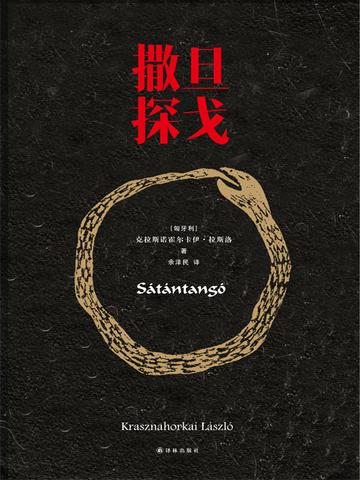
The story of "Satan Tango" takes place in a dilapidated small village. A dozen villagers with nowhere to make a living staged a drama of alcoholism, adultery, voyeurism, betrayal, dreams and broken dreams in the rainy and muddy late autumn season. Indifference and numbness cruelly tortured all life, until the appearance of two liars ignited everyone's hope, leading them to take the dance of death over and over again, towards the bright future they imagined...
The wonderful structure and unique language style of this book make it one of the most mysterious works in the history of literature and a miracle in the history of translation.
Reader comments
Congratulations on winning the 2025 Nobel Prize for Literature [Like]
The writing style of this book is unique, and the language is like ancient Chinese without punctuation, making it very challenging to read. But it's this unique style that makes the story even more fascinating. The characters in the book are very delicately described. For example, the description of "The nearest small church is located alone four kilometers away in the southwest" made me seem to be able to see the scene of that dilapidated small village. It's a tough read, but definitely worth it!
You can't try to stop and catch your breath, you should get out of here as soon as possible
The tango dance steps of six advances and six retreats make the story cycle, creating an inescapable sense of fate. Half of the story goes from despair to hope, and the other half goes from hope to despair. The recurrence of human destiny and the eternity of despair. The perspectives of different characters intertwine and complement each other, adding complexity and depth to the story.
In a desperate Hungarian farm in the 1980s, hope was ignited by a former "dead man". Through the help of little Ashti, after being defrauded of all his savings by his brother, he explored the truth of existence in despair and grievance, causing the villagers to commit sins of self-redemption and coercing everyone forward with hope for the future. Return to the starting point with the echoing bells.
Compared with Faulkner's stream of consciousness, which uses characters' chaotic inner monologues and free associations to show the character's consciousness process and break the traditional order of time and space, Laszlo uses long sentences and paragraphs to create a slow and depressing atmosphere, using symbols and metaphors to reveal the character's psychology and behavior. Personally, I feel that it is easier to understand after reading long sentences after removing those modifiers.
He looked sadly at the gloomy sky and the scorched remains of the locust-infested bitter summer. Suddenly he saw the seasonal changes of spring, summer, autumn and winter on the branches of the same locust tree. He seemed to suddenly understand that the whole event was just playing a clown in the unmoving eternal sphere. He played the role of seducing the devil's conscience in the chaos, managing an advantageous position, pretending madness as a necessity of life... He saw himself being nailed to the wooden cross of his cradle and coffin, struggled painfully, and finally, with a clean verdict , he was handed over naked to the hands of the body washers without being knighted or awarded, and handed over to the skinners who were busy and laughing. There, people had to face human circumstances without mercy, and there was no path that could lead to resurrection from the dead, because one The individual will then understand even this fact, that his entire life is destined to be manipulated by liars, who have marked the cards in advance, and in the end not only confiscate his last weapons, but also deprive him of any hope of one day finding his way back.
First of all, congratulations to the author for winning the 2025 Nobel Prize for Literature. 🎉
Secondly, after four days of reading, although the content in the book is indeed a bit difficult to read, if you read it carefully, you will find that the characters and stories experienced in the book are very real. It is said that art comes from life, but is higher than life. The author realistically depicts the dilapidation of the countryside. I think the most powerful thing is to depict a special environmental atmosphere through heavy rain and muddy roads. It really makes people think of many scenes when reading. This is really amazing.
Finally, literary works express a kind of philosophical thought, but they are fundamentally different from philosophical works. Literary writers truly depict different characters, letting them represent different meanings, and express their understanding of the entire society through the entire work.
(If anything is wrong, I hope readers will correct me, thank you)
If there is anything more bizarre than the way of death here, maybe it is the next work like this. In fact, I do not mean to belittle other works, but I really rarely read such works. The last book about death I read was "The Seventh Day" by Yu Hua. However, I think this book is more difficult to write than "The Seventh Day".
In the ruins of post-socialism, the function of the mill has been transformed into a girl receiving guests. Years of rain in the countryside have blocked people's sight of the outside world. Wet clothes and water-filled boots have added a burden to people's desire to escape. The countryside has thus become an inescapable cage.
In the seemingly liberated tavern, under the paralysis of alcohol, people indulge in absurd revelries and forget about moral ethics. The ubiquitous surveillance system of the spider web in the tavern is suffocating. Once prey touches the thread, it will fall into a trap. This is not a pure land of bliss, but a spiritual sanctuary in false fantasy.
The city is the utopia in people's hearts. As long as they go to the city, they will have warm street lights, delicious food, and a dazzling array of exquisite products. But this is an unreachable utopia after all. Even the sergeant said that everything here is rotting! The smell of sewers, the smell of decay, and the world-ending depression on people's faces are like trees in this city being crushed to the ground by the wind.
The tango of despair and the escape of fantasy are nothing more than one step forward and one step after another, and one step after another, stepping into another desperate space again, cyclically and degenerate.
The only character who died was little Ashti, the innocent lamb.
Rejected by her family, true happiness can only be experienced when she has a fever in the attic. The death of her father brought her death enlightenment. For her, this choice was supported by angels and seemed much better than reality.
But her brother Shanni's cash cow plan delayed the maturity of this choice. The poor girl indulged in her brother's lies. Maybe she was also deceiving herself. Her brother said that only she and he controlled the world. She had never been so affirmed. In order to show her strength, she drowned the only black cat Mikul who loved her. She was not without conscience or without guilt, but when the abused becomes the perpetrator, the world is sick.
Finally, under the double blow of her brother's ruthless exposure and the doctor's rejection, her choice of death matured. The doctor was the only person who gave her warmth. She hugged Mikul's body and chose an uninhabited manor. This was a pure and unpolluted place, far away from the countryside and the city. She and Mikul welcomed the arrival of her angel together.
For her, this is a desperate and hopeful choice, a poor girl, a poor cat, two innocent victims in this cruel historical background.
I really like this writing style. It's just the content inside, sometimes it feels a bit 18+
"On a late October morning, shortly before the first drop of the long, cruel autumn rain fell on the dry and cracked salt marshes to the west of the village (from then on until the first frost, the sea of fetid silt made the winding paths unwalkable and the city inaccessible), Futaki was awakened by the sound of a bell."
Great writing! It seems that I have seen the unbearable side of myself and the stubborn side of living.
Pure reality, dystopia
Faced with the decline and decay of society, and the sudden decline of life. Most of us may settle down in a corner, be unwilling to make progress, or even linger on our last breath.
Some people who want to change the status quo by their own strength find that they are powerless and then use others as their saviors. Even though they know it is a trap, they still go with the flow. Some people put their hope in others and gods, others rely on pen and paper to record all this, and some even marry themselves.
In indulgence and pleasure, we use physical pleasure to escape the decay of life. Life is just jumping from one trap to another.
The book is a good book, but a bit difficult to read. I admire the translation even more. He is a character [like][like][like]
How to bring a fat, bloated and lazy doctor to life requires a little pen and ink.
Although I don't identify with the pessimists, my understanding of reality is clear.
I like to write long sentences in one go, regardless of length, so as not to lose inspiration.
It's a good book, but it's difficult to read, but I did read it bit by bit, and I had a unique feeling every time I calmed down.
It's very interesting, but you need a little patience to finish it.
Nothingness is gone
The language is unique and the content is in-depth
The perspectives of 12 characters explain the desolation of the village.
The language style of long sentences vividly expresses the desperate tone of the work
If you don't have jade syndrome, this book will be very interesting for you [laughing and crying]




Congratulations on winning the 2025 Nobel Prize for Literature [Like]
The writing style of this book is unique, and the language is like ancient Chinese without punctuation, making it very challenging to read. But it's this unique style that makes the story even more fascinating. The characters in the book are very delicately described. For example, the description of "The nearest small church is located alone four kilometers away in the southwest" made me seem to be able to see the scene of that dilapidated small village. It's a tough read, but definitely worth it!
You can't try to stop and catch your breath, you should get out of here as soon as possible
The tango dance steps of six advances and six retreats make the story cycle, creating an inescapable sense of fate. Half of the story goes from despair to hope, and the other half goes from hope to despair. The recurrence of human destiny and the eternity of despair. The perspectives of different characters intertwine and complement each other, adding complexity and depth to the story. In a desperate Hungarian farm in the 1980s, hope was ignited by a former "dead man". Through the help of little Ashti, after being defrauded of all his savings by his brother, he explored the truth of existence in despair and grievance, causing the villagers to commit sins of self-redemption and coercing everyone forward with hope for the future. Return to the starting point with the echoing bells. Compared with Faulkner's stream of consciousness, which uses characters' chaotic inner monologues and free associations to show the character's consciousness process and break the traditional order of time and space, Laszlo uses long sentences and paragraphs to create a slow and depressing atmosphere, using symbols and metaphors to reveal the character's psychology and behavior. Personally, I feel that it is easier to understand after reading long sentences after removing those modifiers. He looked sadly at the gloomy sky and the scorched remains of the locust-infested bitter summer. Suddenly he saw the seasonal changes of spring, summer, autumn and winter on the branches of the same locust tree. He seemed to suddenly understand that the whole event was just playing a clown in the unmoving eternal sphere. He played the role of seducing the devil's conscience in the chaos, managing an advantageous position, pretending madness as a necessity of life... He saw himself being nailed to the wooden cross of his cradle and coffin, struggled painfully, and finally, with a clean verdict , he was handed over naked to the hands of the body washers without being knighted or awarded, and handed over to the skinners who were busy and laughing. There, people had to face human circumstances without mercy, and there was no path that could lead to resurrection from the dead, because one The individual will then understand even this fact, that his entire life is destined to be manipulated by liars, who have marked the cards in advance, and in the end not only confiscate his last weapons, but also deprive him of any hope of one day finding his way back.
First of all, congratulations to the author for winning the 2025 Nobel Prize for Literature. 🎉 Secondly, after four days of reading, although the content in the book is indeed a bit difficult to read, if you read it carefully, you will find that the characters and stories experienced in the book are very real. It is said that art comes from life, but is higher than life. The author realistically depicts the dilapidation of the countryside. I think the most powerful thing is to depict a special environmental atmosphere through heavy rain and muddy roads. It really makes people think of many scenes when reading. This is really amazing. Finally, literary works express a kind of philosophical thought, but they are fundamentally different from philosophical works. Literary writers truly depict different characters, letting them represent different meanings, and express their understanding of the entire society through the entire work. (If anything is wrong, I hope readers will correct me, thank you)
If there is anything more bizarre than the way of death here, maybe it is the next work like this. In fact, I do not mean to belittle other works, but I really rarely read such works. The last book about death I read was "The Seventh Day" by Yu Hua. However, I think this book is more difficult to write than "The Seventh Day".
In the ruins of post-socialism, the function of the mill has been transformed into a girl receiving guests. Years of rain in the countryside have blocked people's sight of the outside world. Wet clothes and water-filled boots have added a burden to people's desire to escape. The countryside has thus become an inescapable cage. In the seemingly liberated tavern, under the paralysis of alcohol, people indulge in absurd revelries and forget about moral ethics. The ubiquitous surveillance system of the spider web in the tavern is suffocating. Once prey touches the thread, it will fall into a trap. This is not a pure land of bliss, but a spiritual sanctuary in false fantasy. The city is the utopia in people's hearts. As long as they go to the city, they will have warm street lights, delicious food, and a dazzling array of exquisite products. But this is an unreachable utopia after all. Even the sergeant said that everything here is rotting! The smell of sewers, the smell of decay, and the world-ending depression on people's faces are like trees in this city being crushed to the ground by the wind. The tango of despair and the escape of fantasy are nothing more than one step forward and one step after another, and one step after another, stepping into another desperate space again, cyclically and degenerate. The only character who died was little Ashti, the innocent lamb. Rejected by her family, true happiness can only be experienced when she has a fever in the attic. The death of her father brought her death enlightenment. For her, this choice was supported by angels and seemed much better than reality. But her brother Shanni's cash cow plan delayed the maturity of this choice. The poor girl indulged in her brother's lies. Maybe she was also deceiving herself. Her brother said that only she and he controlled the world. She had never been so affirmed. In order to show her strength, she drowned the only black cat Mikul who loved her. She was not without conscience or without guilt, but when the abused becomes the perpetrator, the world is sick. Finally, under the double blow of her brother's ruthless exposure and the doctor's rejection, her choice of death matured. The doctor was the only person who gave her warmth. She hugged Mikul's body and chose an uninhabited manor. This was a pure and unpolluted place, far away from the countryside and the city. She and Mikul welcomed the arrival of her angel together. For her, this is a desperate and hopeful choice, a poor girl, a poor cat, two innocent victims in this cruel historical background.
I really like this writing style. It's just the content inside, sometimes it feels a bit 18+
"On a late October morning, shortly before the first drop of the long, cruel autumn rain fell on the dry and cracked salt marshes to the west of the village (from then on until the first frost, the sea of fetid silt made the winding paths unwalkable and the city inaccessible), Futaki was awakened by the sound of a bell."
Great writing! It seems that I have seen the unbearable side of myself and the stubborn side of living.
Pure reality, dystopia
Faced with the decline and decay of society, and the sudden decline of life. Most of us may settle down in a corner, be unwilling to make progress, or even linger on our last breath. Some people who want to change the status quo by their own strength find that they are powerless and then use others as their saviors. Even though they know it is a trap, they still go with the flow. Some people put their hope in others and gods, others rely on pen and paper to record all this, and some even marry themselves. In indulgence and pleasure, we use physical pleasure to escape the decay of life. Life is just jumping from one trap to another.
The book is a good book, but a bit difficult to read. I admire the translation even more. He is a character [like][like][like]
How to bring a fat, bloated and lazy doctor to life requires a little pen and ink.
Although I don't identify with the pessimists, my understanding of reality is clear.
I like to write long sentences in one go, regardless of length, so as not to lose inspiration.
It's a good book, but it's difficult to read, but I did read it bit by bit, and I had a unique feeling every time I calmed down.
It's very interesting, but you need a little patience to finish it.
Nothingness is gone
The language is unique and the content is in-depth
The perspectives of 12 characters explain the desolation of the village.
The language style of long sentences vividly expresses the desperate tone of the work
If you don't have jade syndrome, this book will be very interesting for you [laughing and crying]