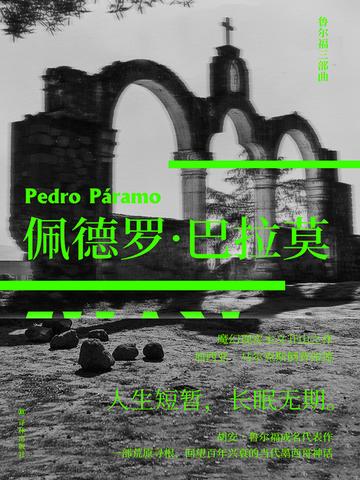
In order to fulfill my mother's last wish, I came to the small town of Comala to look for my father Pedro Páramo, whom I had never met. The kind-hearted donkey driver directed me to stay at the house of Mrs. Eduway Hayes - she seemed to have been waiting for my arrival early in the morning. The village is deserted and withered, but you can often hear the sound of footsteps wiping the ground and the buzzing sound like a swarm of bees. The life there seems to be whispering and rippling in the wind...
Through conversations with them, the past Comala gradually emerged: Pedro Páramo, whose family was in decline when he was young, became a ruler by plunder and robbery, and committed all kinds of evil. However, the only son he recognized fell from a horse and died, and the beloved wife he married after half a life went crazy and died. He cursed the entire village, and he himself could not escape the disaster...
Reader comments
When I first read it, I fell into the mist. Then the characters were indistinguishable from humans to ghosts, and finally I realized that it had a different flavor.
"... There was a huge moon in the world at that time. I looked at you and my eyes were broken. The moonlight seeped into your face. I kept looking at this face and never tired of it. This was your face. It was very soft, softer than the moonlight; your lips seemed to be decorated with ruffles, very moist, and the starlight made them colorful; your body was so transparent and glowing in the water of the night. Susana, Susana San Juan."
This book is very mysterious! Pedro Páramo is a really complex character, he is both a ruthless ruler and a loner. His experience made me feel the impermanence of fate. I especially hate him because what he does brings a lot of pain to others. However, the characters in this book are all very vivid and made me feel like I was in that deserted town.
I miss you, Susanna, and I miss the green mountains. During the windy season, we always fly kites together. I heard the noise of people in the villages below the mountain. At this moment, we were on the mountain, on the ridge. At this time, the wind blew the kite forward, and the hemp rope was almost out of hand. "Help me, Susanna." Then her soft hands took mine. "Loosen the rope a little more."
A novel with a stream of consciousness is very difficult to read at first, and you need to concentrate on integrating into it and understanding it carefully before you can read it smoothly. I feel like Marquez was inspired by this book when he wrote "One Hundred Years of Solitude".
This is the charm of literary works. All I can say is
After reading it, I didn't understand it. There were too many names. Then I searched for the story line, and I immediately felt the author's mastery. He wrote a story about the oppression of the rural landlord class in such a foggy and ups and downs. The translator's postscript will also help readers understand the story line. I commend the translator. Finally, it is not the translator's preface but the postscript. It is a very good book.
Reading together with "The Village" and "Satanic Tango" makes you feel like you are in a dark and absurd countryside.
Great novel, better than Marquez.
The concept is novel and the writing methods are diverse, which is different from traditional novels. No wonder Marquez strongly recommends it.
It is like a dream, the suspenseful search is like the soothing feeling of poetry, and the strange and free reading feeling.
When I first read it, I fell into the mist. Then the characters were indistinguishable from humans to ghosts, and finally I realized that it had a different flavor. "... There was a huge moon in the world at that time. I looked at you and my eyes were broken. The moonlight seeped into your face. I kept looking at this face and never tired of it. This was your face. It was very soft, softer than the moonlight; your lips seemed to be decorated with ruffles, very moist, and the starlight made them colorful; your body was so transparent and glowing in the water of the night. Susana, Susana San Juan."
This book is very mysterious! Pedro Páramo is a really complex character, he is both a ruthless ruler and a loner. His experience made me feel the impermanence of fate. I especially hate him because what he does brings a lot of pain to others. However, the characters in this book are all very vivid and made me feel like I was in that deserted town.
I miss you, Susanna, and I miss the green mountains. During the windy season, we always fly kites together. I heard the noise of people in the villages below the mountain. At this moment, we were on the mountain, on the ridge. At this time, the wind blew the kite forward, and the hemp rope was almost out of hand. "Help me, Susanna." Then her soft hands took mine. "Loosen the rope a little more."
A novel with a stream of consciousness is very difficult to read at first, and you need to concentrate on integrating into it and understanding it carefully before you can read it smoothly. I feel like Marquez was inspired by this book when he wrote "One Hundred Years of Solitude".
This is the charm of literary works. All I can say is
After reading it, I didn't understand it. There were too many names. Then I searched for the story line, and I immediately felt the author's mastery. He wrote a story about the oppression of the rural landlord class in such a foggy and ups and downs. The translator's postscript will also help readers understand the story line. I commend the translator. Finally, it is not the translator's preface but the postscript. It is a very good book.
Reading together with "The Village" and "Satanic Tango" makes you feel like you are in a dark and absurd countryside.
Great novel, better than Marquez.
The concept is novel and the writing methods are diverse, which is different from traditional novels. No wonder Marquez strongly recommends it.
It is like a dream, the suspenseful search is like the soothing feeling of poetry, and the strange and free reading feeling.